Modern companies face rising pressure to operate with more precision, stronger performance controls, and systems that can scale without slowing teams down. Many leaders hear the term “managed services” yet find mixed definitions that focus too narrowly on cost savings or outsourced labor, unaware that the concept has evolved well beyond that reputation. Managed services now describe a structured model where a provider oversees an entire function and owns daily execution, committing to performance improvement over time.
As you explore this guide, you can expect a clear explanation of how managed services work, a comparison to other outsourcing models, and the reasons why companies utilize it as a tool for stability and growth. The sections that follow outline the core definition, describe the operational processes behind a managed service partnership, and explain how providers apply automation, governance, and quality systems to produce consistent results.
Why Managed Services is Essential for Businesses
Growing companies face a recurring tension. As leaders seek stronger operational performance, tighter controls, and more predictable output, it comes at the expense of internal teams struggling to scale at the same pace as demand. Hiring cycles take time, and expertise gaps widen once systems expand, so operational oversight becomes heavier as companies add tools, platforms, and processes.
Managed services emerged as a response to this challenge, as the approach goes far beyond outsourcing tasks. Managed services involve outsourced management, where an external partner carries responsibility for outcomes and continuous improvement. Companies adopt this model for stability and for the confidence that operations run on defined standards rather than ad-hoc work.
Managed services continue to gain traction because they support companies that need to grow without straining their internal bandwidth. Leaders view them as a way to create resilience, enabling teams to focus on priorities that generate revenue or drive innovation. Many decision-makers exploring outsourcing in the Philippines also start evaluating managed services to compare how each model supports scale and long-term reliability.
What is “Managed Services”?
Managed services refer to a structured partnership where a provider oversees a specific function and owns the process to deliver ongoing performance based on defined commitments. Providers do not simply complete tasks, as they manage the work from end to end, taking responsibility for the accuracy and quality of the output, along with its continuous optimization.
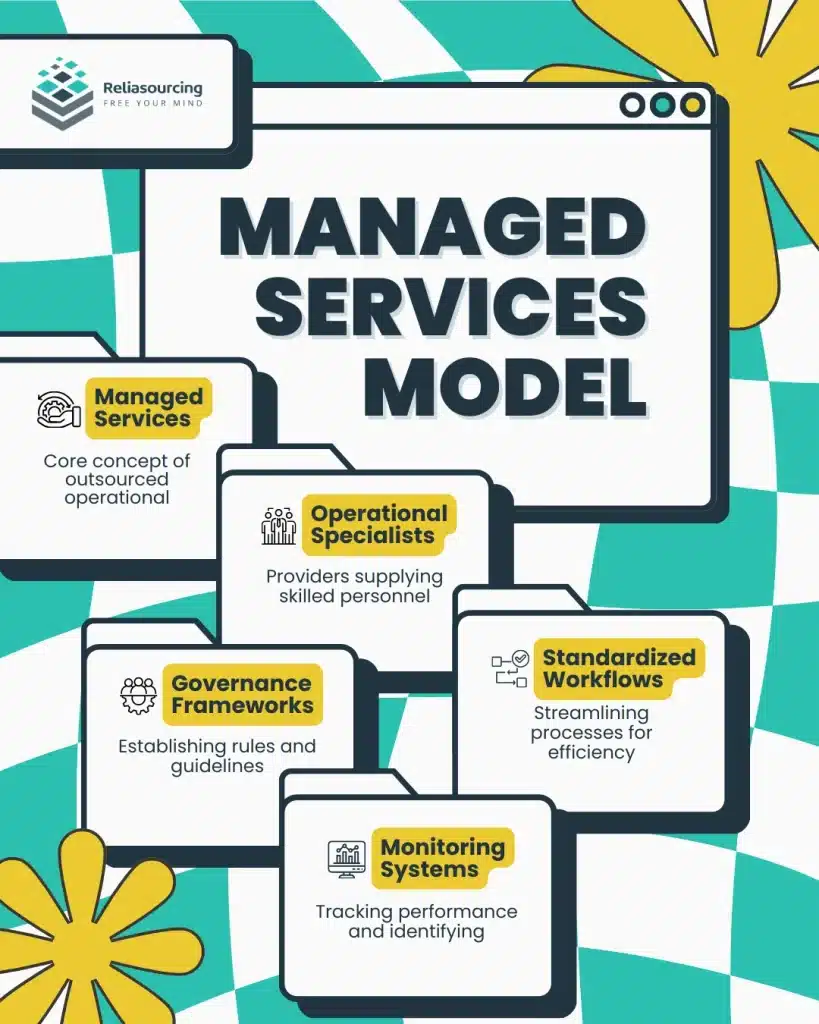
A high-functioning managed service model includes several key elements, since Managed Services Providers (MSPs):
- Supply the operational specialists
- Create governance frameworks
- Standardize workflows
- Implement monitoring systems
- Adapt processes as business needs shift.
With MSPs, companies gain a consistent operational system that does not depend entirely on internal staffing. Managed services also differ significantly from hiring freelancers or engaging traditional BPO teams:
- Freelancers deliver individual assignments without the oversight of an overarching accountability.
- BPO teams complete tasks, yet do not usually own outcomes.
- MSPs bridge that gap with full operational ownership, structured reporting, and improvement cycles built into the partnership.
Comparing managed services and outsourcing, one often discovers that the distinction lies in responsibility and continuity, stretching to strategic alignment rather than simple cost or capacity.
The service model likewise appear across multiple business environments. IT operations, customer support, finance coordination, creative production, research functions, compliance monitoring, and data operations can all fall under this model. The provider becomes an extension of the business, producing consistent work under agreed standards.
Difference between Managed Services and Employer of Record (EOR)
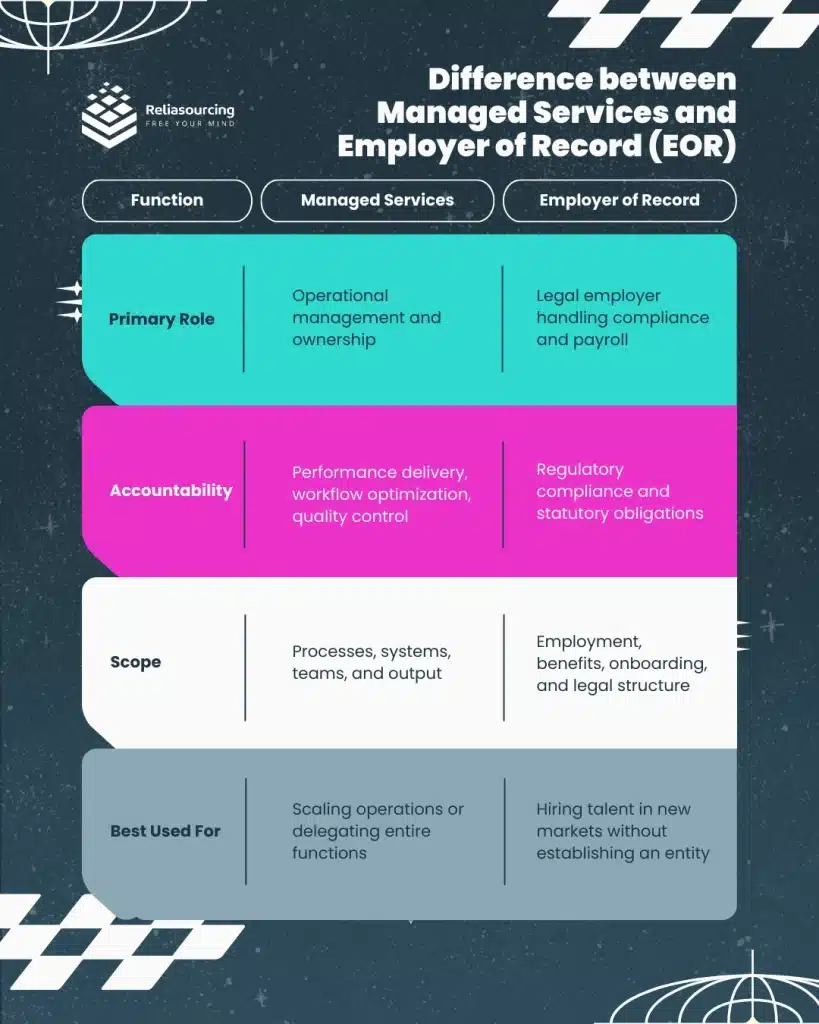
Companies evaluating an employer of record solution often integrate MSPs once operations expand beyond staffing needs.
How Managed Services Actually Work (Processes, Tools, Ownership)
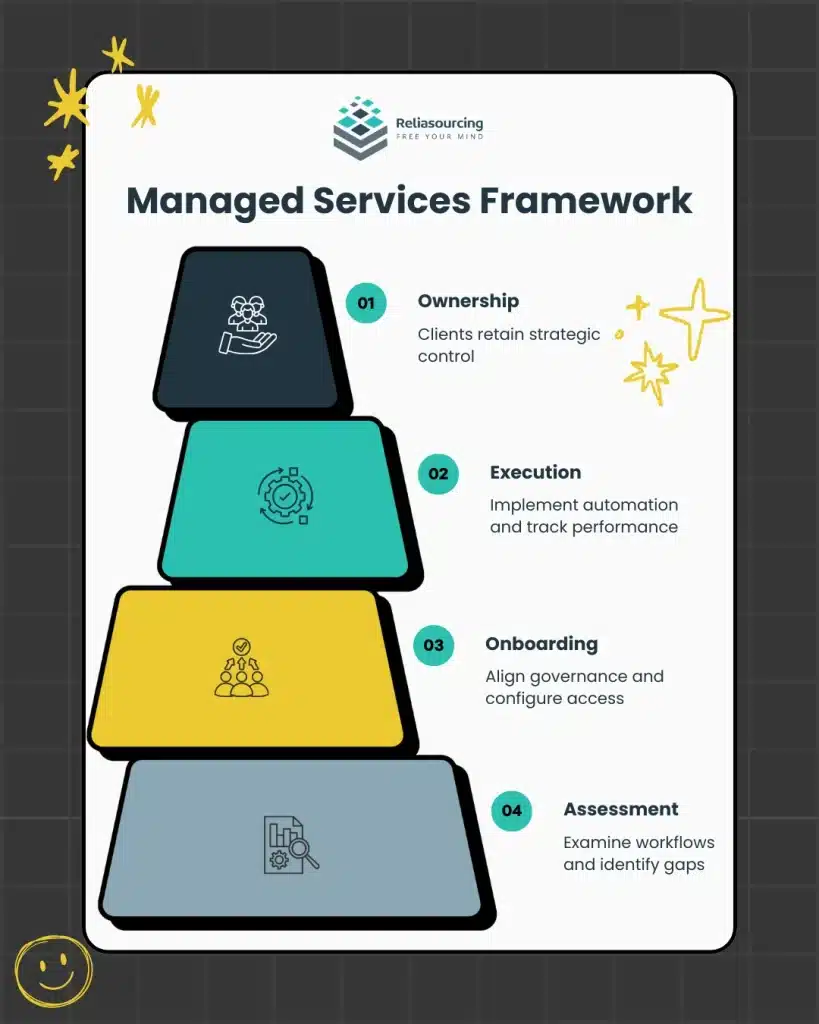
A managed service relationship follows a structured progression. Providers begin with an assessment phase, where they examine current workflows, performance baselines, system requirements, and operational bottlenecks. Providers identify gaps, resource needs, and areas where automation or process refinement can enhance efficiency.
Onboarding follows. MSPs align on governance structures, escalation paths, and communication rhythms. Providers also configure access to tooling, knowledge resources, and system integrations. A service level agreement then sets expectations for output, timelines, and reporting cycles, as well as continuous improvement commitments.
Execution relies on well-defined processes supported by automation. Providers implement AI-assisted monitoring, workflow trackers, ticketing systems, QA layers, and forecasting models. Providers track performance against KPIs and adjust resourcing models as volumes rise or fall, while also being responsible for documenting process changes and maintaining historical insights that help refine future decisions.
Ownership remains the defining element of managed services, with clients retaining control over strategy and final direction. Simply put, providers are responsible for daily execution in terms of quality management and productivity oversight.
How Reliasourcing Delivers Modern Managed Services
Reliasourcing approaches managed services with operational structure and stability as the foundation. Teams follow repeatable processes that support consistent output, which is strengthened by a quality assurance system that identifies accuracy gaps and improvement opportunities. And in this, clients do not lose visibility, as they gain structured reporting, documented workflows, and predictable patterns of work.
Reliasourcing primarily works with, but is not limited to, companies in the SaaS, eCommerce, gaming, and fintech industries. MSPs coordinate tasks through integrated systems, allowing clients to monitor performance without managing individual contributors. Automation tools support ticket routing, workload distribution, and performance checks, allowing providers to adapt the workflow as the client identifies a need for a shift.
Philippine-based talent also provides quite the advantage. Companies gain specialists trained for process-driven environments along with cost efficiency that supports long-term scale. Clients exploring the benefits of managed services will also often discover that operational ownership creates far more stability than ad-hoc outsourcing.
Reliasourcing teams integrate into existing systems while maintaining accountability for delivery, so clients get a partner capable of supporting growth without adding internal hiring pressure.
Frequently Asked Questions
What is the difference between managed services and outsourcing?
The difference between managed services and outsourcing centers on accountability and scope of responsibility. Outsourcing typically focuses on task execution, whereas managed services concentrate on managing the function itself.
Managed Services Providers (MSPs) create structure, monitor performance, and maintain processes. MSPs also refine operations over time and supply reporting that reflects operational health, so companies choose it when they want predictable results and leadership oversight rather than transactional support.
Is managed services cheaper than hiring internally?
Managed services are often cheaper than hiring internally. The question of cost, though, usually depends on scale, required expertise, and operational complexity. They are often more economical because companies avoid building internal teams, training staff, or maintaining multiple tools and platforms.
Providers supply the specialists, workflow design, and monitoring systems already in place, while also handling volume fluctuations that would otherwise force companies to hire or downsize teams. Many companies find that the financial savings come from reduced overhead and the elimination of operational inefficiencies.
What types of companies benefit most from managed services?
The type of company to benefit most from managed services would be those that need consistent delivery, strong operational structure, or support for functions that no longer fit internal bandwidth. Firms in growth stages often use the model to stabilize operations while focusing internal teams on high-impact initiatives.
Businesses with recurring task loads also gain value because providers maintain workflow continuity even during staffing shifts. Scaling tech companies, subscription-based businesses, and global support operations utilize MSPs to maintain reliability without the need for constant internal hiring.
What should be included in a managed services contract or SLA?
In a managed services contract or SLA, the following should be included:
- Performance metrics
- Reporting frequency
- Workflow ownership
- Escalation paths
- Documentation requirements
The agreement should outline which responsibilities remain with the client and which responsibilities shift to the provider. Providers and clients also align on accuracy standards, productivity expectations, and quality review processes.
Ultimately, the document should determine the improvement cycle, clarifying how adjustments are made as needs change. Contracts that clearly define boundaries and expectations are bound to build stronger partnerships.
Are managed services only for IT teams?
Managed services are not only for IT teams, although they are commonly associated with them. The model applies to operations, support, content production, finance coordination, and compliance functions.
Providers bring structured processes and monitoring systems that improve consistency across different business environments, and also use automation tools that work beyond IT tasks. The model fits any team that requires predictable performance and documented workflows for ongoing and constant oversight.
How do I know if my company is ready for managed services?
You know your company is ready for managed services when there come signs of readiness, including recurring operational backlogs, inconsistent work output, and rising internal workload. Companies often consider managed services once they feel pressure to add staff, yet want a flexible, structured alternative.
Leaders also explore the model when performance varies across internal teams or when tools and workflows require more oversight than current staff can provide. Businesses that want stability and predictable output usually find they are ready for managed services long before they realize it.
Conclusion
Managed services have become central to modern operations because companies want consistency, depth of expertise, processes that scale without constant internal hiring. And providers support those needs by creating structure, tracking performance, and maintaining systems that run reliably over time. Companies examine alternatives, such as EOR or traditional outsourcing, before committing; however, managed services stand out because they combine ownership with measurable performance outcomes.
Growing teams gain the freedom to focus on strategy rather than monitoring daily execution since providers assume responsibility for the work, allowing leaders to plan growth with confidence. And so, companies that want long-term operational stability continue to rely on managed service partners for clarity and efficiency in scaling their business.
If you’re interested in exploring managed services for your organization, we’d be happy to assist you. Contact us today.