Back office operations rarely receive attention until something breaks, like payroll errors surfacing during audits or reports arriving late or conflicting with one another. Founders and operators sense this friction but struggle to pinpoint the cause, and growth-stage companies often assume that these issues reflect temporary strain, but all point to structural failure.
Internal back office systems often degrade quietly, and the processes built during early traction remain unchanged as transaction volume, compliance exposure, and reporting needs expand. Manual workarounds multiply. Ownership blurs. Teams burn out. Leadership loses clarity. And then, revenue-facing teams feel the downstream effects without knowing the source.
Back office outsourcing has gained traction for reasons that go beyond trimming expenses. Many companies are facing recurring delays, mounting errors, and limited operational visibility, all of which point to deeper structural issues in their back offices. This article breaks down what typically goes wrong in internal operations, why those failures compound as companies grow, and how back office outsourcing functions as a corrective mechanism, challenging the common assumption that it’s just a simple staffing decision.
What Is Back Office Outsourcing?
Back office outsourcing refers to transferring responsibility for internal operational functions to an external provider that manages execution, reporting, and process discipline. Functions of this type of outsourcing typically include administrative support, finance operations, human resources (HR) administration, data management, compliance tracking, and internal support workflows.
For clarity’s sake, there is a clear distinction between outsourcing tasks and outsourcing processes. Task-based outsourcing covers isolated activities like invoice entry or document formatting, while process-based outsourcing covers the full workflow, including inputs, approvals, quality checks, exception handling, and reporting cadence. Growth-stage companies benefit more from process ownership because internal breakdowns usually stem from fragmentation, not just workload alone.
Moreover, many companies label back office functions as low value because the work stays invisible when it runs properly. Accurate records, timely reconciliations, clean data, and compliant processes rarely draw attention, yet failures in these areas surface quickly and disrupt revenue, customer experience, and decision-making. Early-stage teams often treat administrative, finance, and HR operations as support tasks rather than as operational systems, leading to underinvestment and reactive fixes. Going back to why companies outsource work in the first place points to the reality of these misconceptions, showing that back office outsourcing succeeds when leaders recognize process ownership and execution quality not as secondary concerns, but as foundational to scale.
Back office outsourcing also differs from staff augmentation since providers assume responsibility for outcomes. Managed service providers in the Philippines offer this, especially for companies seeking stability without expanding internal management layers.
Why So Many Companies Struggle with Back Office Operations
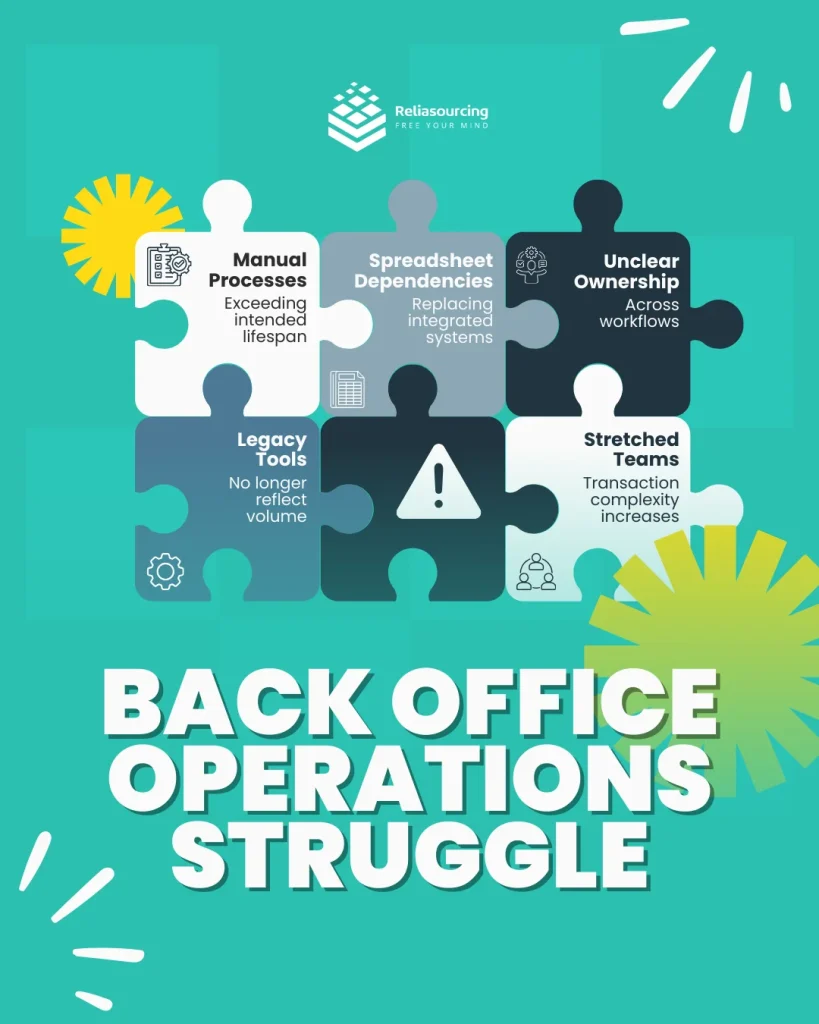
Internal back office breakdowns rarely result from a single failure, given that these patterns recur across industries. Common structural causes include:
- Manual processes extending far beyond their intended lifespan;
- Spreadsheet dependencies replacing integrated systems;
- Unclear ownership across workflows;
- Legacy tools that no longer reflect operational volume; and
- Teams stretched thin as transaction complexity increases.
Early success masks these gaps, but informal processes work until they don’t. Small delays turn into recurring bottlenecks, error correction consumes time that should be spent on analysis, and burnout inevitably rises quietly.
Leadership often notices symptoms before causes: reports arrive late, numbers conflict, approvals slow down initiatives—at this stage, companies begin exploring outsourcing, especially in the Philippines, after internal teams reach capacity without stability.
The Real Cost of Poor Back Office Operations
In reality, payroll represents only a fraction of operational costs. Hidden expenses emerge through delays, rework, compliance exposure, and lost opportunities. Missed filings lead to penalties, inaccurate reporting misguides planning, and manual reconciliation delays cash flow visibility. All of this will spread like wildfire unless prevented.
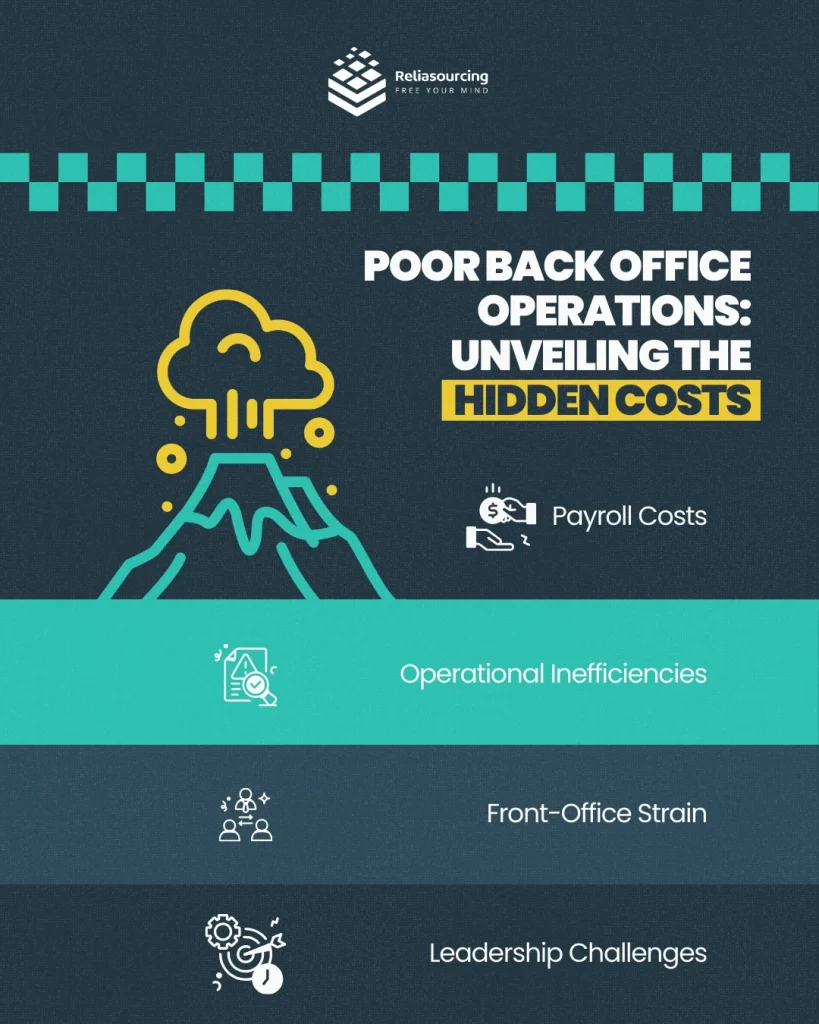
Undoubtedly, front-office teams feel the strain first, where sales teams lose momentum waiting for contract processing, customer support handles billing disputes that originate internally, or product teams receive distorted usage data. As a result, revenue suffers indirectly due to operational drag.
On the other end, leadership faces a different cost with visibility eroding, dashboards conflicting, and forecasts requiring caveats. Consequently, confidence in internal reporting weakens and control slips away without an obvious trigger.
How Back Office Outsourcing Fixes Operational Inefficiencies
Effective outsourcing addresses structure as opposed to just the symptoms. Providers begin by documenting workflows, clarifying ownership, and defining performance standards. And then, execution improves once processes move from informal practices to standardized systems.
What operational improvement looks like in practice
- Documented workflows replace ad hoc execution;
- Quality controls reduce recurring errors;
- Reporting cadence improves leadership visibility;
- Performance metrics track throughput and accuracy; and
- Teams regain capacity without internal reorganization.
In the long run, specialized delivery teams bring a repeatable execution pattern developed across similar environments. And technology enablement follows a structured approach, allowing reporting and monitoring to reflect actual operational performance. Industry and service discussions for 2026 frequently highlight this stabilization effect.
Signals indicating outsourcing readiness
Organizations often consider outsourcing after recognizing recurring operational warning signs:
- Internal reports consistently miss deadlines
- Corrections frequently follow approvals
- Workflows depend on specific individuals
- Leaders lack real-time workload visibility
- Burnout rises without productivity gains
Centralizing accountability and enforcing execution discipline are ways outsourcing resolves these issues.
Frequently Asked Questions
What is back office outsourcing?
Back office outsourcing is the transfer of internal operational workflows to an external provider for execution, reporting, and quality assurance. The primary goal is to restore consistency and operational clarity.
Is back office outsourcing only about cost reduction?
Back office outsourcing is not only about cost reduction, as it addresses structural inefficiencies that restrict scale and increase operational risk. Cost predictability emerges naturally after processes stabilize.
How do companies maintain control when outsourcing back office work?
Companies maintain control when outsourcing back office work through documented workflows, defined metrics, and recurring performance reviews. External teams handle execution while leadership retains oversight.
Is back office outsourcing suitable for growing companies?
Back office outsourcing is suitable for growing companies once internal systems strain under volume. Early intervention prevents deeper operational fragmentation.
How Reliasourcing Approaches Back Office Outsourcing
Reliasourcing treats back office outsourcing as an operational reset for companies, since we understand that outsourcing isn’t just about filling roles. Engagements begin with a process assessment, then documentation, ownership alignment, and measurable performance standards, and, naturally, execution will follow the structure, preventing any uninvited improvisation.
Furthermore, delivery models adapt to organizational maturity: some clients may require Managed Services, while others integrate global hiring solutions through Employer of Record support. To add to this, our Philippines-based teams provide operational continuity and depth, with a scalability aligned with global delivery needs.
Structurally, Reliasourcing maintains a consultative approach throughout engagements, focusing on restoring control rather than replacing leadership. Organizations evaluating outsourcing in the Philippines often begin with an exploratory discussion to assess readiness and scope. Let our team help you with that. Contact us today!
Summary
Back office outsourcing works best as a corrective mechanism for addressing structural operational breakdowns. Internal systems degrade through fragmentation, burnout, and declining visibility long before failure becomes obvious. And so, outsourcing restores process discipline, accountability, and clarity of execution by being a practical operational reset, which is short to say it’s designed to:
- Correct inefficient, fragmented, or poorly structured back office operations;
- Support companies struggling to scale without adding internal complexity; and
- Replace reactive workflows with standardized, accountable processes.
When all is said and done, growth-stage companies gain operational stability without expanding management overhead, and leadership regains confidence in reporting accuracy and internal controls. As business process outsourcing models evolve, back office outsourcing remains valuable because it goes right at the root causes, over masking the symptoms.