Player experience has become a defining factor for success in modern gaming. Monetization models tied to retention, live-service mechanics, and community engagement mean that support interactions now influence revenue as much as gameplay design. And studios operating mobile free-to-play, social gaming, and live multiplayer titles face constant pressure to deliver fast, accurate, and empathetic support across time zones and platforms.
Gaming customer support outsourcing has emerged as a response to these demands. So, instead of functioning as a last-resort cost decision, outsourced support now plays a central role in live-ops stability, player trust, and long-term engagement. In line with this, studios exploring this model often seek reassurance that quality and brand voice, especially game integrity, remain intact while operational strain eases.
The article below examines how gaming customer support outsourcing improves the player experience, where outsourcing fits within real gaming workflows, and how studios can evaluate partners, particularly those operating from the Philippines, a quality-driven customer experience (CX) hub.
Gaming Customer Support Outsourcing in 2026
Live-service games now operate on a continuous feedback loop, so when purchases fail or accounts lock, players expect immediate responses. Mobile free-to-play and social gaming titles also amplify this pressure through sheer volume to boot. Thereupon, a single event launch or content update is bound to trigger tens of thousands of concurrent support interactions.
In 2026, players expect first responses within minutes for live chat and under one hour for ticketed issues. Meeting those expectations internally requires large teams, overnight shifts, and constant retraining as games update. Gaming customer support outsourcing addresses several structural challenges shaping the industry this year, just like:
- Global player bases demanding round-the-clock availability across regions;
- Seasonal spikes being tied to events, holidays, or promotions causing unpredictable volume surges;
- Toxic behavior, fraud attempts, and account abuse requiring specialized moderation skills; and
- Live-ops incidents, especially in online multiplayer titles, escalating quickly and affecting public sentiment within minutes.
Moreover, studios are increasingly treating support as an extension of live-ops rather than just a back-office function. Outsourced teams trained on specific games, tools, and escalation protocols likewise offer stability during growth phases while preserving internal focus on development and publishing.
For teams seeking a broader operational context, business process outsourcing continues to evolve beyond generic service delivery, especially within gaming and entertainment ecosystems.
Core Advantages of Outsourcing Gaming Support
Gaming customer support outsourcing delivers measurable gains when structured as an operational extension of live-ops. Mobile free-to-play and social gaming studios benefit most when efficiency, responsiveness, and player trust align under a single support model that is designed to be proactive, not reactive.
Operational Efficiency and Cost Optimization
Support demand in gaming fluctuates based on content releases, regional activity cycles, and promotional campaigns. Because of this, fixed internal teams struggle to match these patterns without overstaffing or service degradation. To resolve this issue, outsourced gaming support converts variable demand into predictable operating capacity through shared infrastructure and flexible staffing.
Additionally, studios adopting outsourced models commonly report cost improvements driven through optimized scheduling, lower attrition, and reduced management overhead, reflecting broader patterns seen when companies choose to outsource work across scale-driven industries. Financial efficiency also stems from operational maturity, as there is no shortcut to quality.
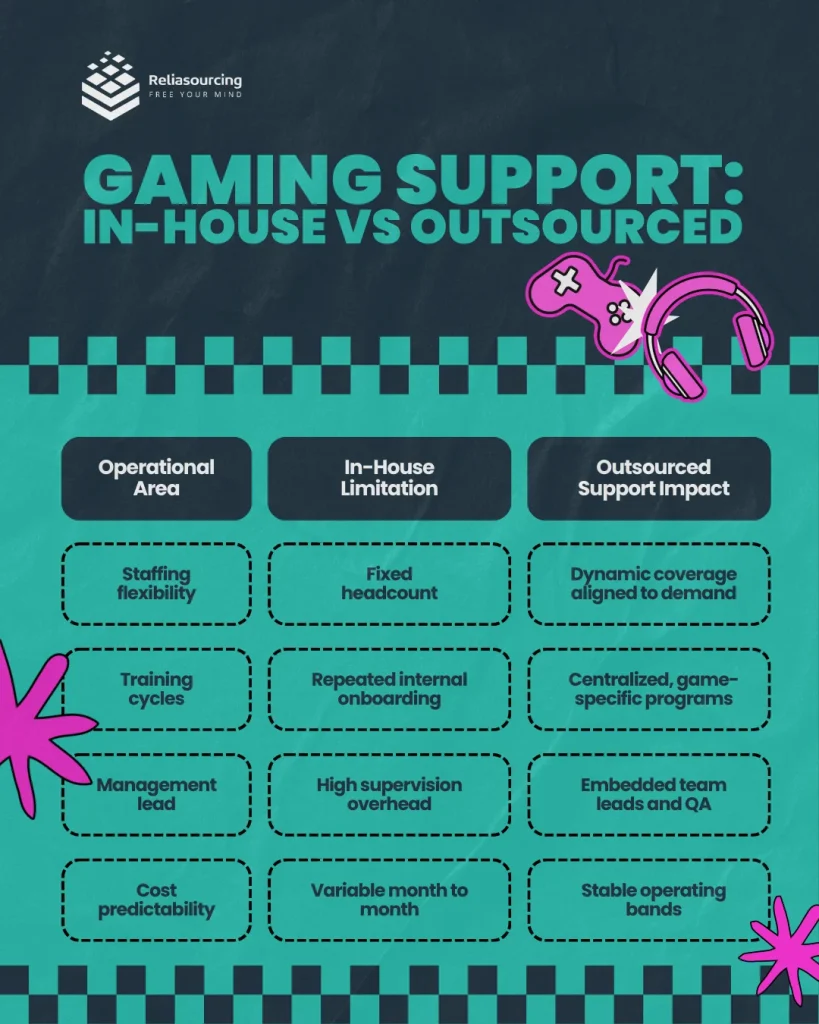
Efficiency gains create room for internal teams to focus on product development and monetization strategy, ultimately shaping roadmap execution.
Faster Issue Resolution That Supports Player Retention
Player tolerance for delays has narrowed significantly since failed purchases, locked accounts, or event-related bugs have generated immediate friction, especially in mobile ecosystems where churn occurs quickly.
Moreover, outsourced teams trained on specific games and support workflows reduce time to resolution through repetition and specialization. Essentially, dedicated queues for payments, account recovery, and technical issues prevent backlog spillover and repeated contacts. Faster answers reduce frustration, while accurate handling reinforces trust.
High-impact workflows affected by faster resolution
- In-app purchase failures during events
- Account recovery after suspected compromise
- Progression rollbacks tied to live-ops issues
- Social feature disputes in multiplayer environments
Support speed becomes a retention mechanism, since, in cases like these, a defensive response works best.
Global Staffing Models for Peak Loads and Seasonal Events
Live-service games experience predictable volatility, specifically for event launches, holidays, influencer campaigns, and regional promotions. Often, ticket volume multiplies within hours due to high activity during these periods. As a result, internal teams absorb these spikes through overtime or temporary hires, both of which strain consistency.
Accordingly, global delivery models will benefit further from mature talent ecosystems, particularly in the Philippines, where quality-driven CX delivery and live-ops familiarity continue to position the country as a reliable support hub for gaming studios, and where teams operate continuous shifts, with staffing plans aligned to known event calendars and historical volume patterns.
| Typical Peak Scenarios Supported Through Global Staffing | ||
|---|---|---|
| Scenario | Volume Impact | Outsourced Response |
| Limited-time events | 2x to 4x ticket surge | Pre-ramped agent pools |
| Holiday promotions | Sustained multi-day load | Rotational global shifts |
| New region launch | Language-specific spikes | Multilingual coverage |
| Platform outages | Sudden incident floods | Dedicated escalation queues |
Predictable coverage during critical moments protects player sentiment and public perception.
Trained Gaming Specialists Delivering Consistent CX
Consistency remains a major differentiator in gaming support since players expect agents to recognize mechanics, currencies, and community norms without lengthy explanations. For this reason, generic support is sure to erode credibility, especially among experienced players.
Hence, outsourced gaming teams recruit for game familiarity and reinforce it through structured onboarding, patch briefings, and live-ops simulations. Specialists like these operate across player support, moderation, and fraud response, as well as incident coordination using standardized playbooks.
Core traits of high-performing gaming support specialists
- Familiarity with monetization and progression systems
- Comfort handling emotionally charged player interactions
- Policy enforcement experience within social environments
- Tool fluency across CRM, moderation, and analytics platforms
When all is said and done, consistent CX across channels and regions strengthens player trust and reduces escalation rates, supporting long-term engagement across player segments.
Key Roles to Outsource for High-Performance Gaming Support Teams
High-performing gaming support operations rely on role clarity since generalist coverage isn’t enough to fulfill player expectations. Additionally, mobile free-to-play and social gaming titles generate distinct support needs across technical, behavioral, and commercial touchpoints. In response to the demands of the gaming industry, outsourcing allows studios to staff specialized roles without building fragmented internal teams.
Core Gaming Support Roles That Drive Player Experience
Each role below supports a specific segment of the player journey, so alignment between role design and workflow prevents slow resolution and inconsistent messaging.
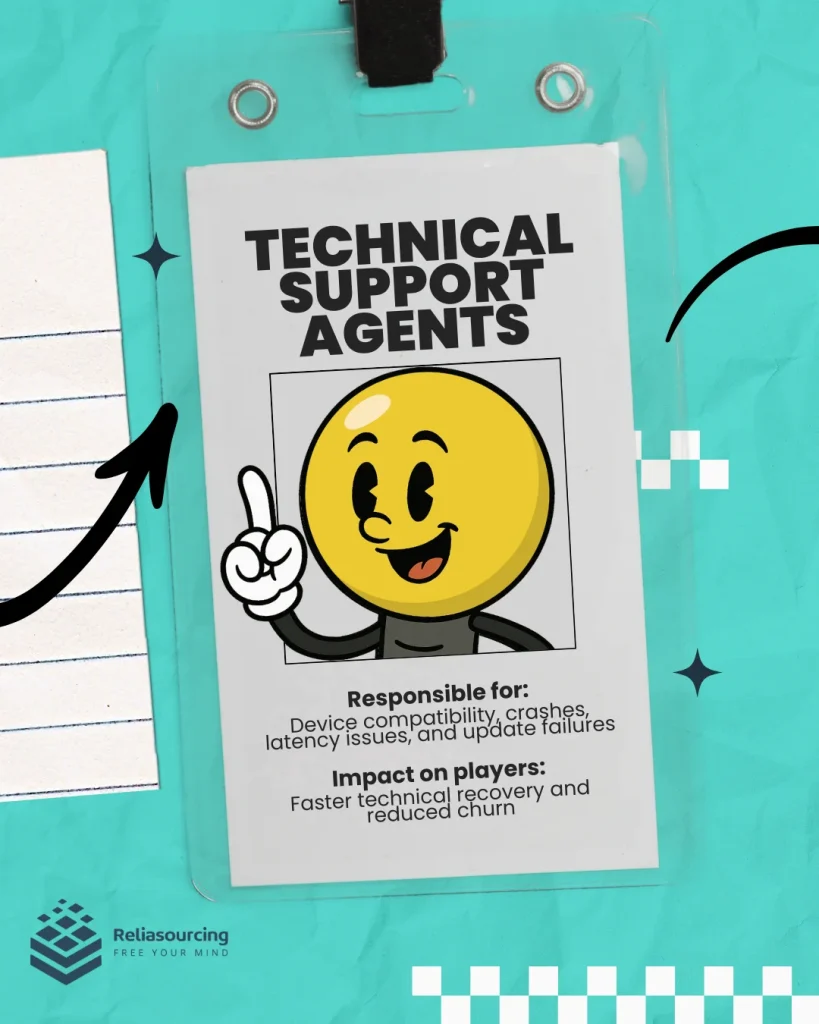
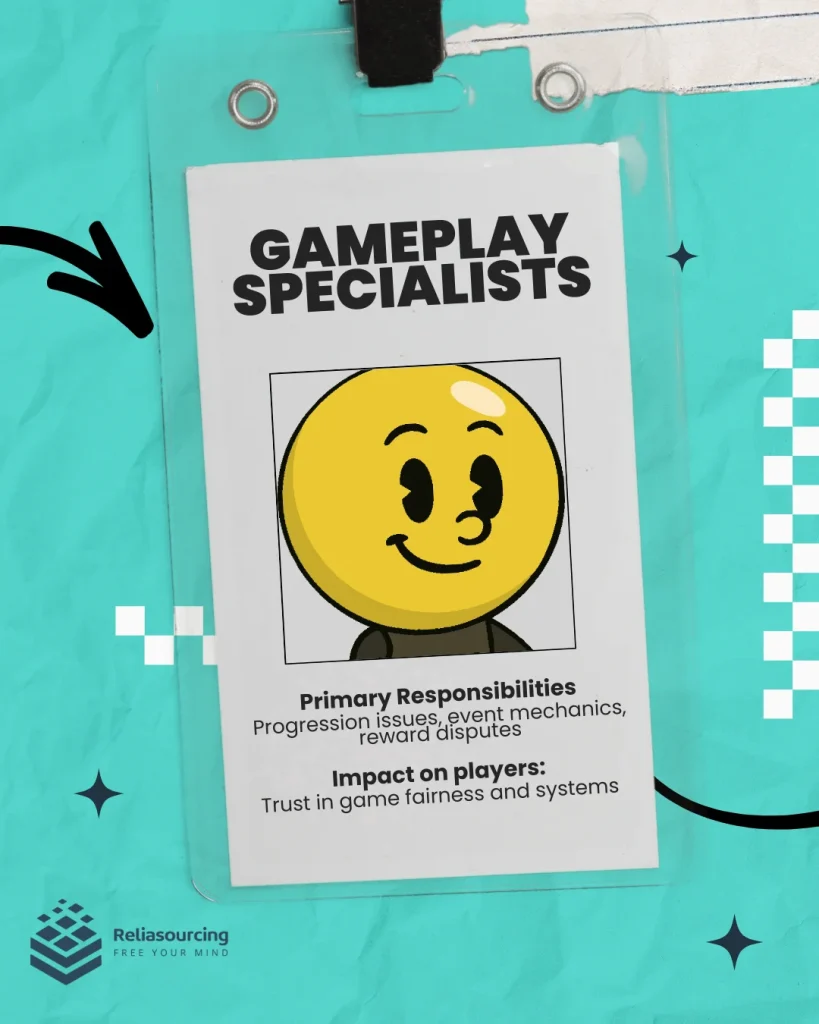
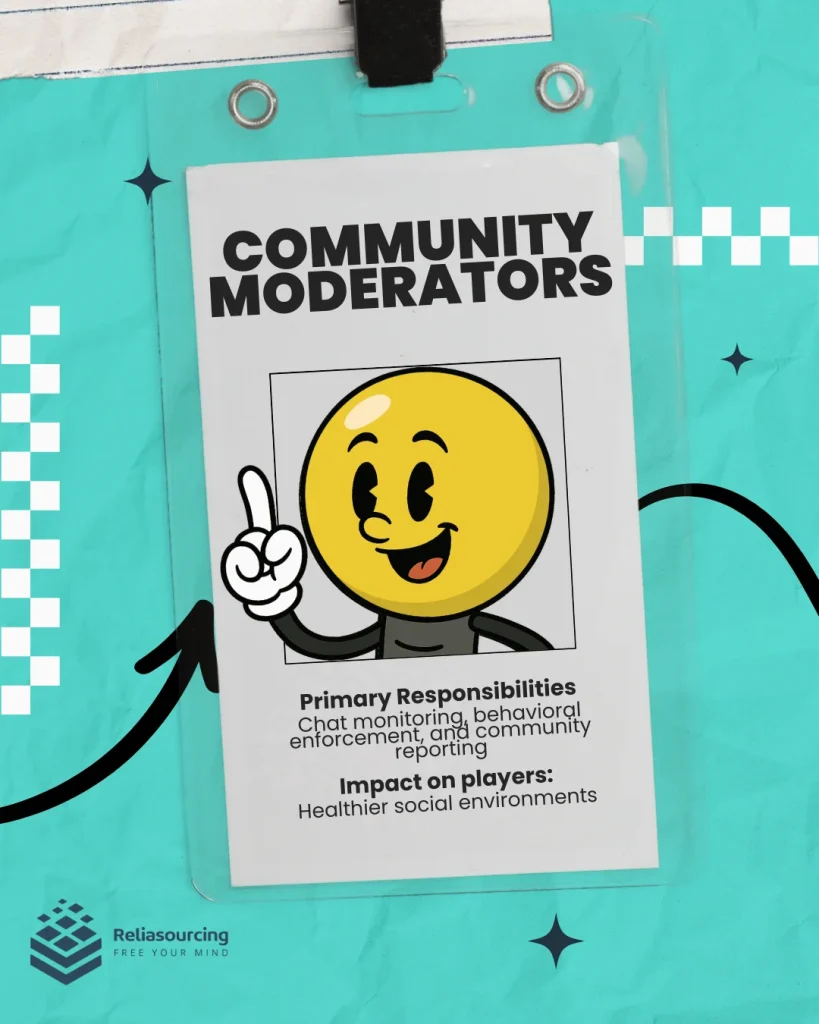
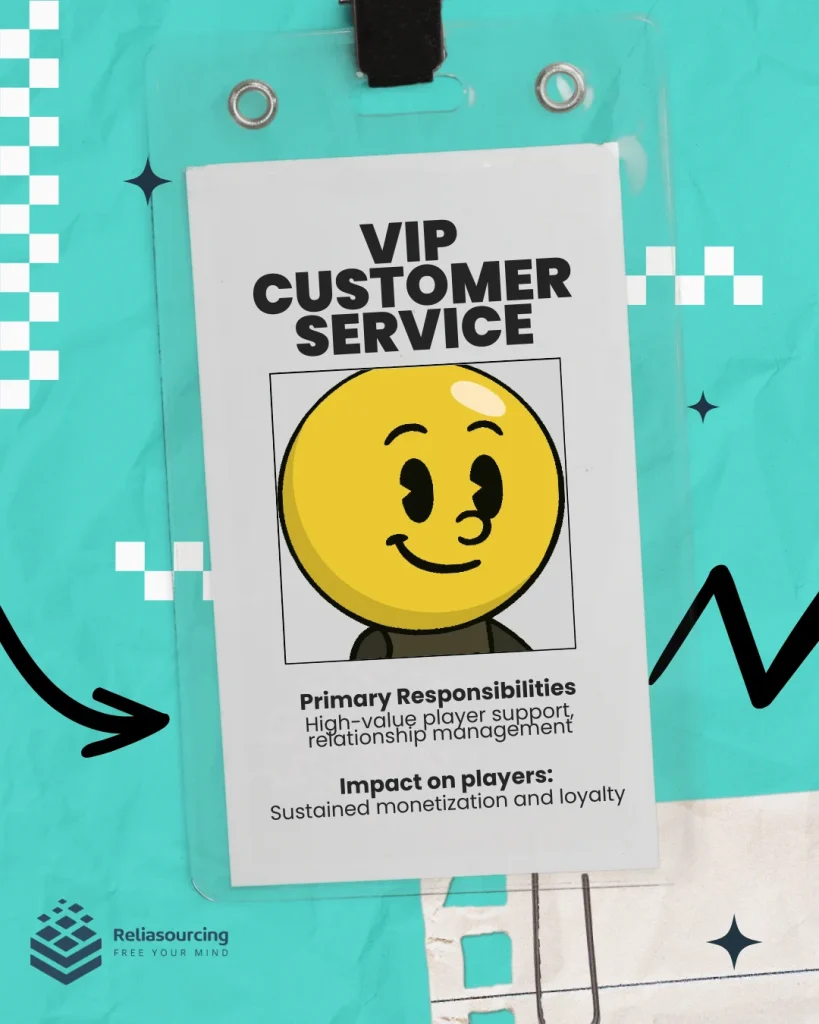
Studios benefit when each role operates within defined boundaries, supported with escalation paths where responsibilities don’t overlap.
Game Literacy, Product Immersion, and Empathy as Performance Drivers
Notably, gaming support differs from traditional customer service due to emotional investment. Since players often contact support after losing progress, currency, or access to time-limited content, agents without game context struggle to respond effectively.
On account of this, outsourced gaming teams prioritize game literacy during recruitment and onboarding. Product immersion includes hands-on gameplay, exposure to monetization systems, and familiarity with community norms. And empathy training likewise reinforces tone control during emotionally charged interactions.
Key capabilities developed during gaming-specific onboarding
- Familiarity with in-game currencies, progression loops, and event logic
- Ability to interpret player intent beyond surface-level complaints
- Confidence explaining decisions tied to game rules or policies
- Calm, respectful communication during high-friction scenarios
Simply, support quality improves when agents speak the same language as players.
Specialized Functions Supporting Live-Ops Stability
Apart from frontline support, modern gaming operations require specialized functions that protect fairness, safety, and uptime. And so, outsourcing enables studios to maintain these functions without diverting internal resources.
| Specialized Gaming Support Functions Commonly Outsourced | ||
|---|---|---|
| Function | Scope | Operational Benefit |
| Fraud Monitoring | Payment abuse, account sharing, suspicious behavior | Revenue protection and player trust |
| Chat Moderation | Real-time enforcement, toxicity reduction | Improved community retention |
| Incident Escalation | Live-ops failures, outages, event disruptions | Faster response and coordinated communication |
These teams operate under strict playbooks and escalation protocols, ensuring issues reach internal stakeholders with context rather than noise.
Role-Based Structure Enables Consistent CX
Consistency remains critical across regions and channels. With this, outsourced gaming support teams benefit from role-based accountability, in which agents master specific workflows, over having a reactive approach to every issue type.
Moreover, clear role segmentation reduces error rates and shortens training cycles, supporting predictable performance during peak demand. And studios, ultimately, gain a support operation that scales alongside player growth, all without having to sacrifice quality or control.
Frequently Asked Questions (FAQs)
What types of customer service functions can gaming studios outsource?
The types of customer service functions gaming studios can outsource include live chat, email support, ticket management, moderation, account recovery, fraud monitoring, VIP support, and live-ops incident handling. With these services, customer support for games, mobile gaming, and entertainment equips studios and companies alike to scale these functions without diluting game knowledge or brand voice.
Is outsourced gaming support capable of handling complex gameplay or technical issues?
Outsourced gaming support teams are capable of handling complex gameplay or technical issues, as they are trained through structured onboarding, game immersion, and shadowing, equipping them to address advanced gameplay questions and technical troubleshooting. Besides that, gaming customer support outsourcing also works best when partners receive access to builds, documentation, and escalation pathways.
How can outsourcing improve player satisfaction?
Outsourcing can improve player satisfaction through faster response times and consistent coverage, with specialized roles aligned with player needs. Additionally, gaming customer support outsourcing likewise reduces backlog during peak events, preventing frustration from unresolved issues.
What should gaming companies look for when choosing a customer support vendor?
When choosing a customer support vendor, gaming companies should look for game literacy, live-ops readiness, moderation experience, reporting transparency, and cultural alignment. Philippine-based vendors specializing in gaming often combine high-quality delivery with operational scalability.
How Reliasourcing Helps Gaming Companies Deliver Superior Player Support
Reliasourcing specializes in the gaming & entertainment industry, supporting gaming studios through a delivery model built for live-service pressure, player volatility, and sustained growth. Our recruitment prioritizes candidates with gaming familiarity, strong communication skills, and sound judgment in high-volume environments. In addition, training centers on product immersion—not just scripts—giving agents hands-on exposure to game mechanics, monetization systems, and live event structures. To top it all off, cultural immersion reinforces tone, community norms, and policy consistency, allowing agents to engage players with credibility and empathy.
Furthermore, support operations follow a structured model that separates responsibilities without silos occurring, and each function aligns to a specific player-facing workflow, preserving clarity during peak demand and live-ops incidents.
| Function | Core Focus |
| Customer Support | Live chat, tickets, email |
| Live-Ops Support | Event monitoring, incident coordination |
| Moderation | Behavioral enforcement, player reports |
| Technical Support | Crashes, platform, and device issues |
| Reporting and QA | Performance tracking, quality validation |
Teams operate inside studio-approved tools and documented workflows, maintaining transparency and control. In the same line, escalation follows tiered processes based on issue severity and impact, ensuring speed and accuracy. Common escalation flows include:
- Payment disputes routed to fraud specialists;
- Account compromise handled by recovery teams;
- Live event failures escalated through live-ops coordination; and
- Platform outages aligned directly with studio technical contacts.
Reliasourcing delivers gaming customer support outsourcing across mobile free-to-play, social gaming, and live-service titles, covering player support, moderation, account recovery, fraud monitoring, VIP services, and live-ops incident handling. Likewise, our execution consistency in the gaming industry has been proven to support revenue-critical initiatives, as evidenced by our case study on gaming sales. Operating as a flexible, long-term CX partner, Reliasourcing continues to scale support models alongside studio growth while maintaining a stable and trusted player experience.
The Future of Gaming Customer Support Outsourcing
Gaming customer support outsourcing continues to move from a reactive service model to a core driver of player experience and studio efficiency. With faster response times, consistent moderation, and reliable live-ops coverage, friction is reduced during moments that shape player perception. Along with this, studios benefit from streamlined operations that absorb volatility without pulling focus away from development, publishing, or growth planning. As a partnership grows, player trust equally strengthens when support interactions feel timely, informed, and fair.
Specialized gaming support teams also increasingly define competitive advantage. With agents trained on specific titles, mechanics, and community norms, issues get resolved with greater accuracy than generalist teams. Expertise across areas like account recovery, fraud monitoring, and live-ops incident handling limits repeat contacts and reduces escalation volume. And consistent execution across channels reinforces brand credibility, especially in mobile free-to-play and social gaming environments where switching costs remain low.
All in all, outsourcing trends also closely align with long-term studio growth and global scalability. Live-service games expand across regions, platforms, and monetization models, all of which increase support complexity. And global delivery models allow studios to scale coverage alongside player growth while maintaining predictable operating structures. As portfolios expand from single titles to multi-game ecosystems, outsourced support provides continuity, removing tendencies for constant internal restructuring.
Studios seeking sustained player satisfaction increasingly look for expert partners who know what they’re doing. Reliasourcing supports this by combining gaming specialization with scalable execution, empowering support operations to grow in step with player communities.
Teams exploring next steps often begin by assessing fit, scope, and long-term alignment through our contact form, keeping the conversation going while planning for future scale.