
Growth brings a familiar set of questions for founders, Chief Operating Officers (COOs), and Human Resource (HR) leaders: 1) Hiring accelerates, 2) new markets open, 3) internal teams stretch across borders, and 4) somewhere in that process, where leaders seek additional support to keep up the momentum going, outsourcing terminology starts to blur. Managed Service Provider. Employer of Record. Staffing. Outsourcing. Each term sounds related, yet each represents a distinct business structure with its own set of responsibilities altogether.
Clarity matters at this stage. While a Managed Service Provider (MSP) and an Employer of Record (EOR) solve very different problems, neither replaces the other, and neither exists to outperform the other. Each model is designed to support a specific operational need, depending on the level of control a company wants over work delivery versus employment compliance.
This article explains both models in clear terms for what they are. The focus remains on responsibility, scope, and real-world use cases, as modern companies often utilize both services at different stages of growth, more so, given that choosing the proper structure depends on operational intent, not preference or trend.
What Is a Managed Service Provider?
A Managed Service Provider operates as a service delivery partner. Under this model, the provider owns outcomes rather than individual workers, so accountability centers on performance, output, and agreed service levels rather than on headcount.
An MSP relationship starts with defined objectives: a company outlines what needs to be delivered, the quality standards required, and how success will be measured. The provider then builds and manages the team, workflows, tools, and governance needed to meet those goals. Day-to-day supervision, performance management, and optimization are the provider’s responsibility.
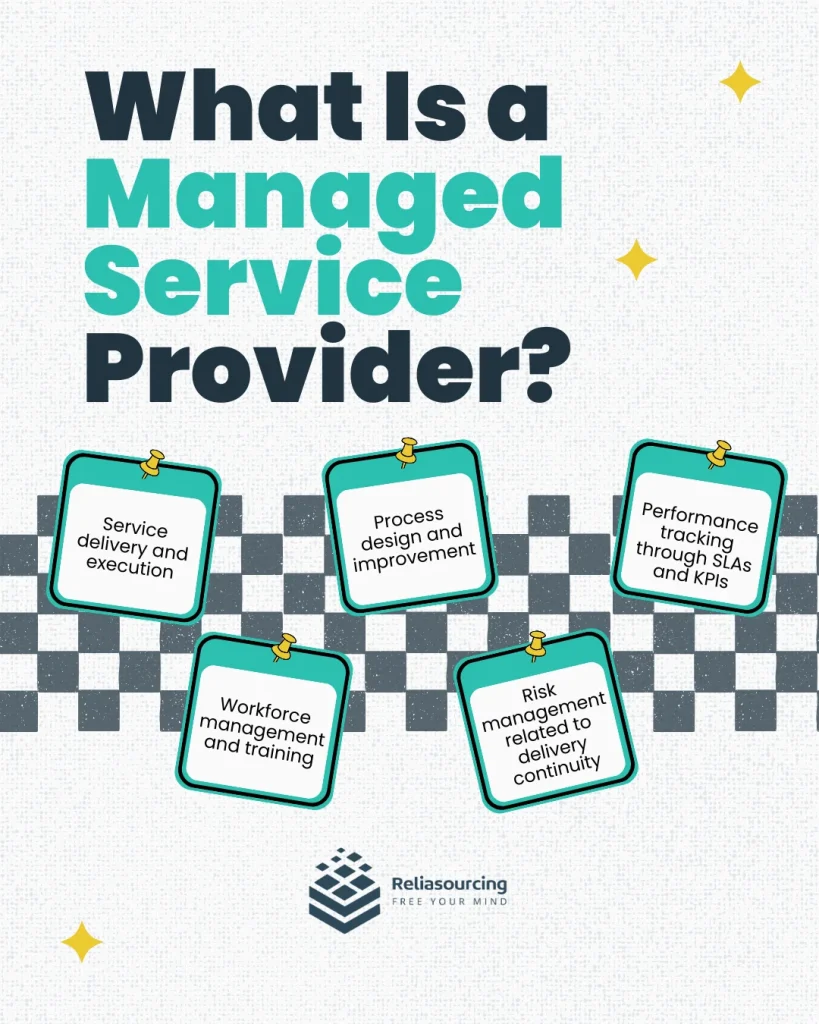
From an operational standpoint, MSP responsibility typically includes:
- Service delivery and execution
- Process design and improvement
- Performance tracking through SLAs and KPIs
- Workforce management and training
- Risk management related to delivery continuity
Internal leadership focuses on strategic direction rather than task oversight, and teams operate as an extension of the business, yet accountability remains external. Companies exploring this structure often examine the benefits of managed services once internal capacity reaches its limit.
MSPs appear across many functions. IT support remains a standard service, though customer experience, finance operations, content moderation, and back-office workflows are also managed through delivery services today. A closer examination of managed services versus outsourcing can help clarify why MSPs are well-suited for organizations seeking consistency and predictability at scale. The distinction matters because an MSP structure goes beyond resource placement. Simply, ownership shifts to the provider.
What Is an Employer of Record?
An Employer of Record, commonly referred to as EOR, serves a very different role. An EOR acts as the legal employer for workers hired on behalf of a client company. Employment compliance, payroll, benefits, and statutory obligations are the responsibility of the provider, but operational control remains with the client.
Under an EOR model, the client directs the employee’s daily work; hence, performance feedback, role design, and task ownership stay internal. The EOR simply ensures that employment aligns with local labor laws, tax regulations, and statutory benefits.
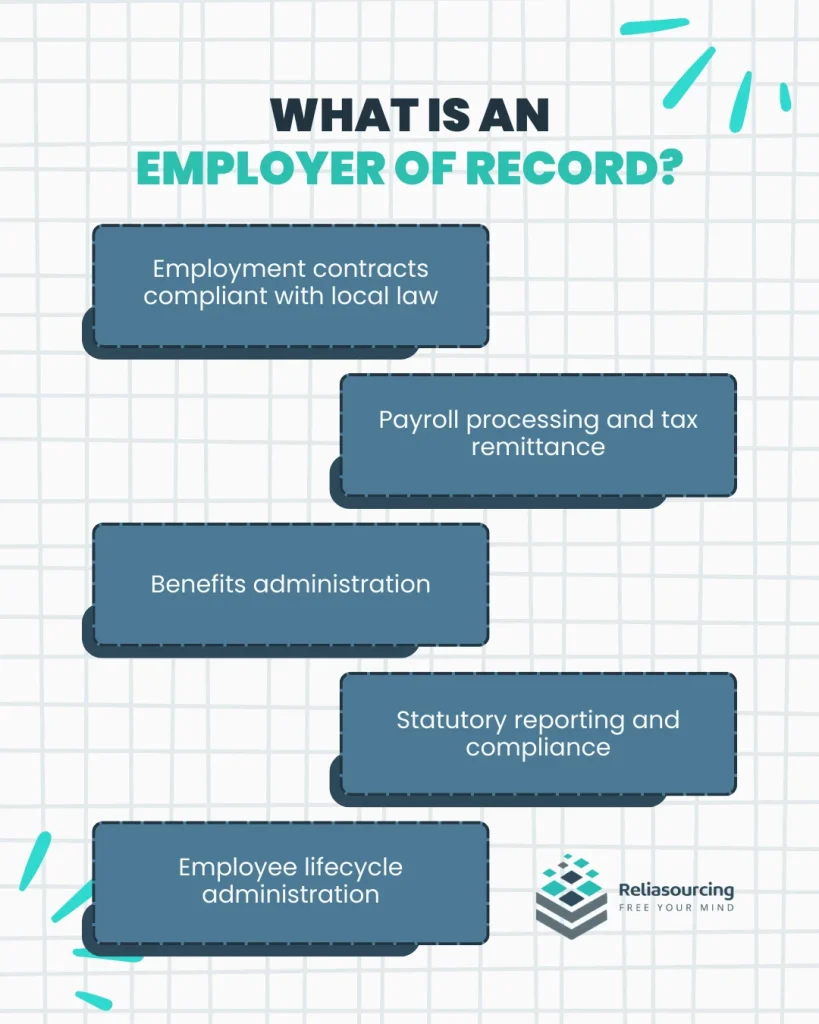
Core EOR responsibilities usually include:
- Employment contracts compliant with local law
- Payroll processing and tax remittance
- Benefits administration
- Statutory reporting and compliance
- Employee lifecycle administration
Operational ownership never transfers, given that an EOR does not manage outcomes or workflows. The service exists solely to support a compliant hiring infrastructure.
Comparisons often arise between EORs and other flexible staffing models. Leaders evaluating early-stage support roles often review the differences between EOR and virtual assistants (VAs) to clarify where employment responsibility lies and how governance differs, as both approaches work similarly but in different ways. The EOR structure is in place to enable teams to expand across borders without adding legal or administrative strain, which is typically present when working with VAs.
The Core Difference Between MSP and EOR
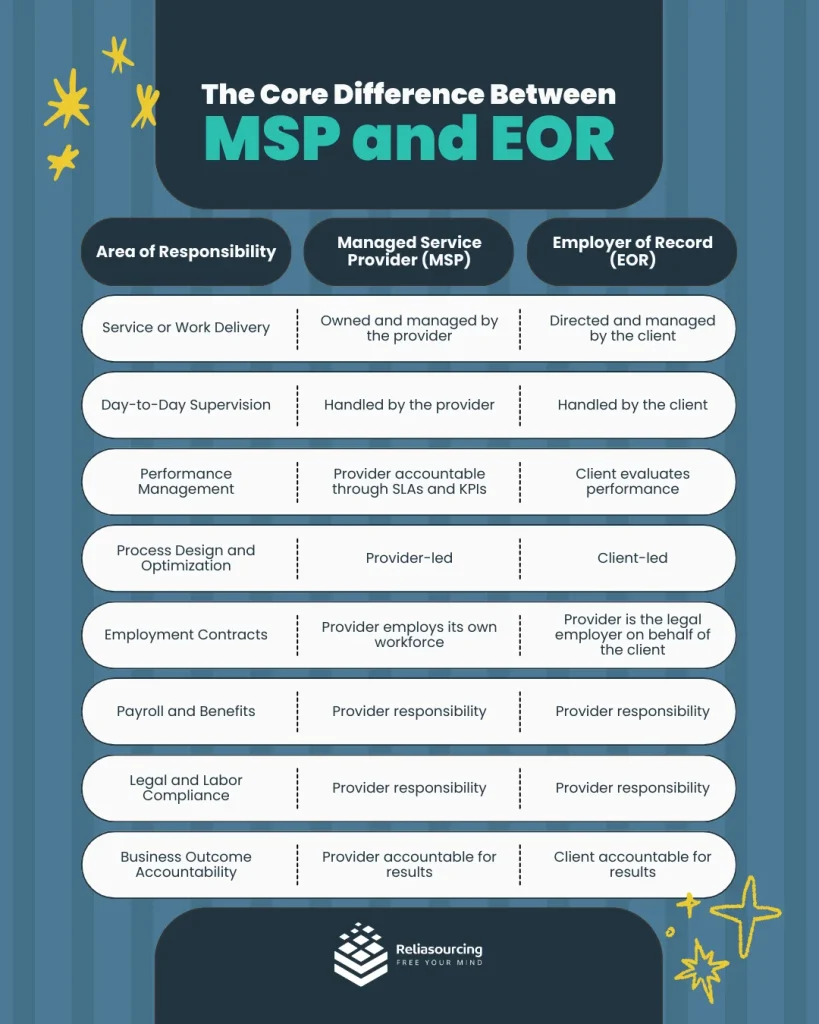
The distinction between a Managed Service Provider and an Employer of Record primarily hinges on ownership: An MSP owns delivery; an EOR owns employment compliance.
With an MSP, a company defines what success looks like and steps back from execution. The provider builds systems, manages people, and delivers outcomes, and governance flows through service-level agreements rather than employment contracts.
With an EOR, a company defines roles and manages work directly. The provider ensures that all legal and administrative requirements related to employment are handled correctly in the background.
A simplified way to frame responsibility looks like this:
No competition exists between the two, given that each model supports a different stage of operational maturity. Early expansion often requires compliant hiring first, and operational scaling later benefits from managed delivery once processes stabilize.
Modern organizations use both structures across different teams or phases. For example, a product company may hire engineers through an EOR while running customer support through an MSP. Ultimately, strategic decisions will guide the structure your business needs.
Frequently Asked Questions
What is the main difference between a managed service provider and an employer of record?
The main difference between a managed service provider and an employer of record lies in responsibility. A managed service provider owns service delivery and outcomes, while an employer of record handles legal employment and compliance. One manages work, the other manages employment.
Is an employer of record the same as outsourcing?
An employer of record is not the same as outsourcing. Outsourcing transfers work to a third party, while an EOR keeps work ownership with the client while transferring legal employment responsibilities. Control over daily tasks remains internal if you integrate an EOR to your structure.
Can a company use both an MSP and an EOR?
A company can use both an MSP and an EOR at the same time. Many organizations hire core team members through an EOR while assigning defined functions to an MSP. Each model supports different operational needs within the same business.
Are managed service providers only used for IT services?
Managed service providers are no longer limited to IT services. Customer support, finance operations, compliance monitoring, and content workflows commonly operate under managed delivery models today. At present, the scope depends on process maturity rather than the type of function.
How Reliasourcing Delivers Both Services
Reliasourcing supports both models because real business growth rarely follows a single, structured approach. Some teams need a compliant hiring infrastructure, others need managed outcomes. Many need both across different phases.
As an Employer of Record (EOR) provider, Reliasourcing enables companies to hire legally in the Philippines without establishing a local entity. Employment contracts, payroll, benefits, and compliance are aligned with local regulations, while clients retain operational control. An overview of Reliasourcing’s Employer of Record solution outlines how this structure supports international teams.
As a Managed Service Provider, Reliasourcing takes ownership of delivery. Teams operate under defined SLAs, structured governance, and performance benchmarks, and the process optimization, workforce management, and continuity planning sit with the provider as well. Leaders exploring managed delivery often begin by exploring Reliasourcing’s managed services before structuring engagement.
The Philippines plays a central role across both services. Strong talent availability, mature compliance frameworks, and operational depth make the region well-suited for both employment infrastructure and managed delivery. In addition to an already-impressive workforce pool, Reliasourcing’s ISO-certified processes reinforce quality management, information security, and business continuity.
Consultative guidance shapes every engagement. Some clients begin with compliant hiring and transition into managed delivery once their workflows stabilize. Others even transition in reverse as internal capabilities mature. Each path, in the end, reflects operational intent instead of preset packages.
Final thoughts… MSP or EOR?
A Managed Service Provider (MSP) and an Employer of Record (EOR) serve different purposes: MSPs focus on results, while EORs focus on compliance; neither replaces the other. Here are some business scenarios that may help frame what works best for you:
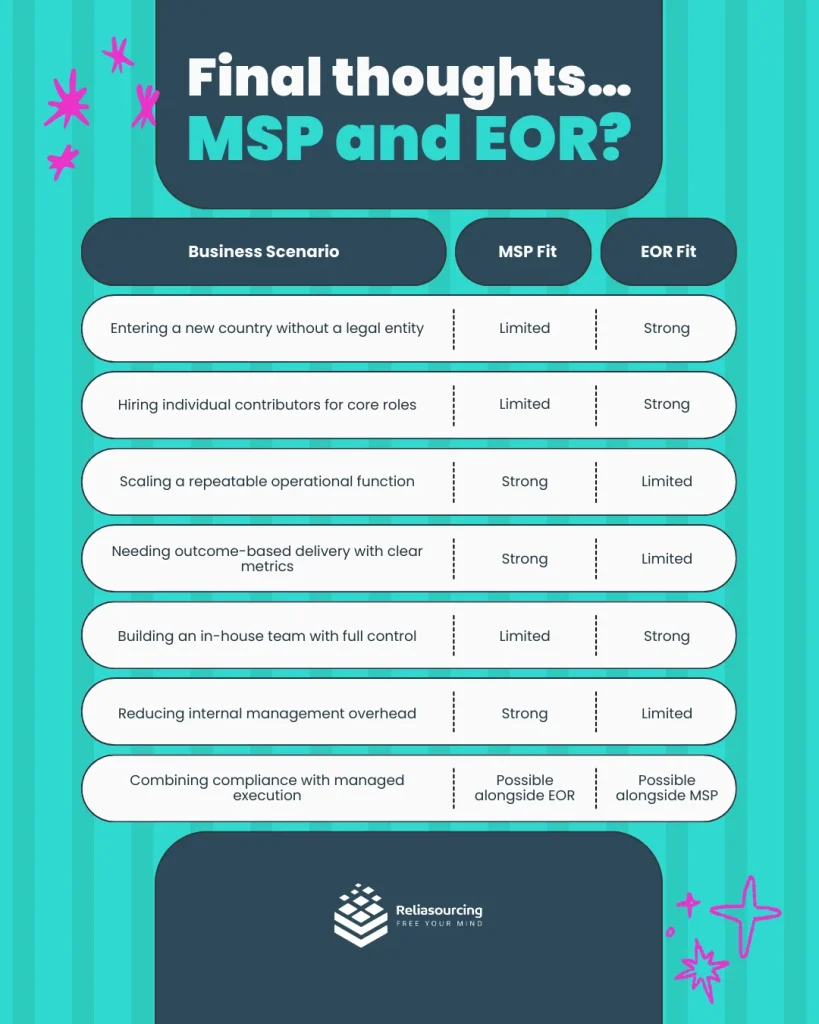
Growth requires structural clarity, and operational ownership demands a managed service model. Compliant hiring across borders calls for an employer of record. Many companies adopt both as needs evolve.
Reliasourcing supports both paths with transparency, regional expertise in the Philippines, and governance built for long-term partnerships. Clear decisions reduce friction, so the right model depends on where responsibility should sit today and how scale will unfold tomorrow. For teams still weighing their options, a consultative discussion brings clarity more quickly than comparison charts.
Decision-makers exploring next steps often benefit from a direct conversation. Strategic discussions clarify which model aligns with current growth goals. Leaders ready to evaluate options can reach Reliasourcing through our contact us page for tailored guidance.