
Scaling a business usually exposes weaknesses long before it creates new opportunities. Early growth will definitely feel energizing, with revenue climbing, teams expanding, and new markets coming into view, but pressure follows close behind. Processes start breaking under volume, and managers end up spending more time coordinating work than improving it. Strategic thinking slips as operational decisions pile up. Issues like these are often what managed service providers resolve for a business.
And many leadership teams assume this friction signals a need for more hiring or new tools. However, growth-stage companies often discover that neither option addresses the real problem, as structure matters more than speed once scale becomes a factor.
A managed service provider (MSP) offers a different path. Instead of adding fragmented resources, an MSP introduces an operating layer built for accountability and controlled expansion.
This article breaks down what scaling truly looks like at present, how managed service providers support growth beyond task execution, and when companies typically reach the point where an MSP makes strategic sense. The later sections outline practical considerations leaders use to evaluate managed services, followed by a closer look at how Reliasourcing supports growth through structured delivery and governance.
What It Really Means to Scale a Business in Today’s Market
Scaling no longer refers only to revenue growth. Sustainable expansion depends on how well systems, people, and decision-making adapt under increased demand.
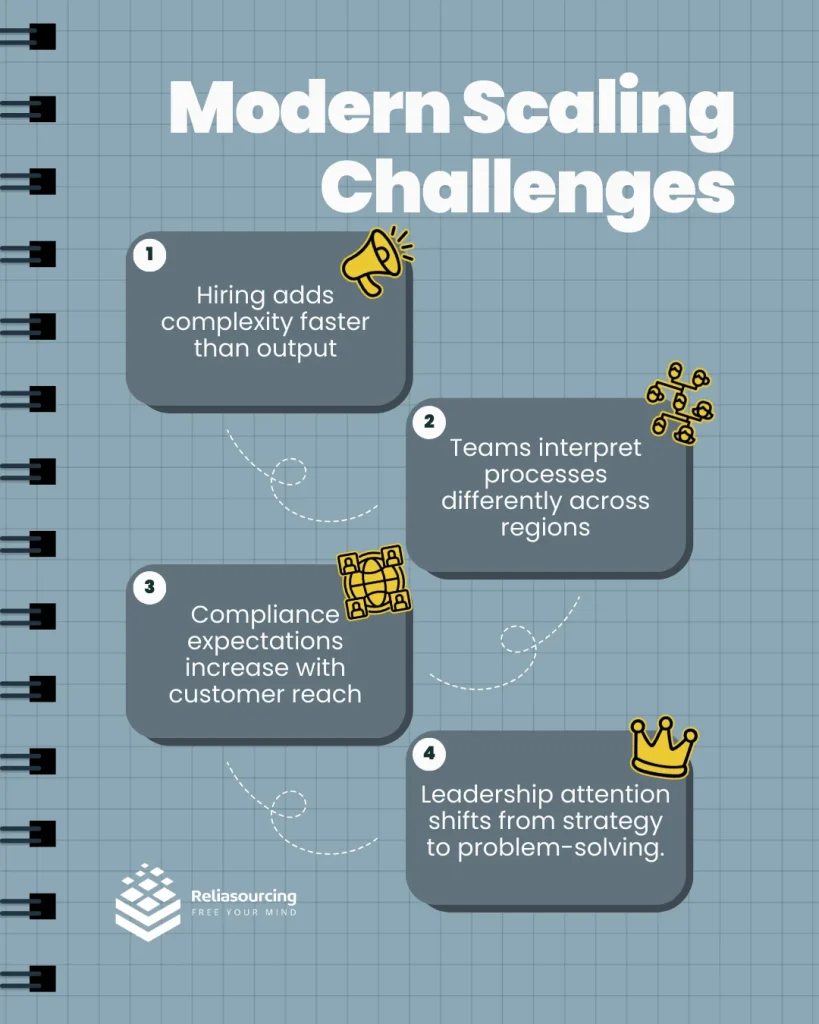
Modern scaling challenges often appear in predictable ways:
- Hiring adds complexity faster than output;
- Teams interpret processes differently across regions;
- Compliance expectations increase with customer reach; and
- Leadership attention shifts from strategy to problem-solving.
Growth exposes operational strain rather than causing it, so internal teams that performed well at smaller volumes begin to feel stretched once workloads multiply. Informal processes no longer hold, and managers become bottlenecks.
Many companies explore outsourcing during this phase, often after realizing that delegation alone does not solve coordination issues. Questions arise as to why companies outsource work, with leaders reassessing how responsibilities should be structured rather than simply redistributed. Scaling successfully requires repeatability, given that consistency across delivery, quality, and accountability becomes the foundation for expansion.
What Is a Managed Service Provider (MSP)? A Growth-Focused View
A managed service provider operates as an owner of outcomes, not a supplier of tasks. Unlike traditional outsourcing models, MSPs take responsibility for delivery within a defined scope, supported by governance, performance tracking, and escalation frameworks.
Currently, managed services have expanded well beyond IT. Growth-focused MSPs support operational functions that demand consistency at scale, including customer operations, finance processes, compliance workflows, and specialized business functions.
The distinction becomes clearer when comparing the models:
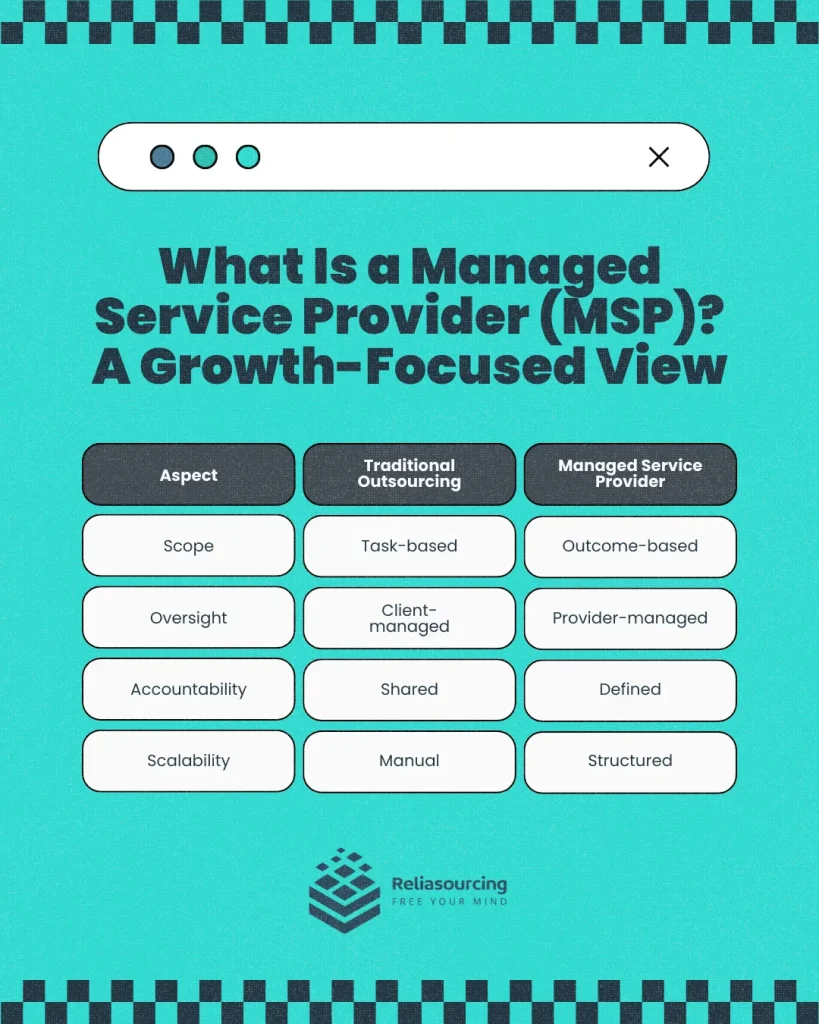
The differences between managed services and outsourcing become especially relevant once growth introduces cross-team dependencies and execution risk.
How Managed Service Providers Help Businesses Scale Faster
Speed without stability introduces risk. Managed services support growth by reinforcing three areas that scaling companies struggle to maintain internally.
Operational stability
Delivery shifts from individual-dependent execution to documented, repeatable workflows, so service quality holds steady as volume increases.
Predictable cost structure
Managed services operate under defined commercial models tied to capacity or outcomes, ensuring that leaders gain clarity without the need for constant renegotiation or surprise hiring cycles.
Leadership focus
Execution oversight falls under the MSP’s scope, allowing internal leaders to recover time for strategy, partnerships, and expansion initiatives.
Many organizations start with business process outsourcing, then transition into managed services once operational ownership becomes essential for scale. Distributed and remote teams also benefit, as governance remains consistent regardless of geography.
When Scaling Companies Should Consider an MSP
Timing matters. Engaging an MSP too early can introduce unnecessary structure, but waiting too long often leads to operational debt.
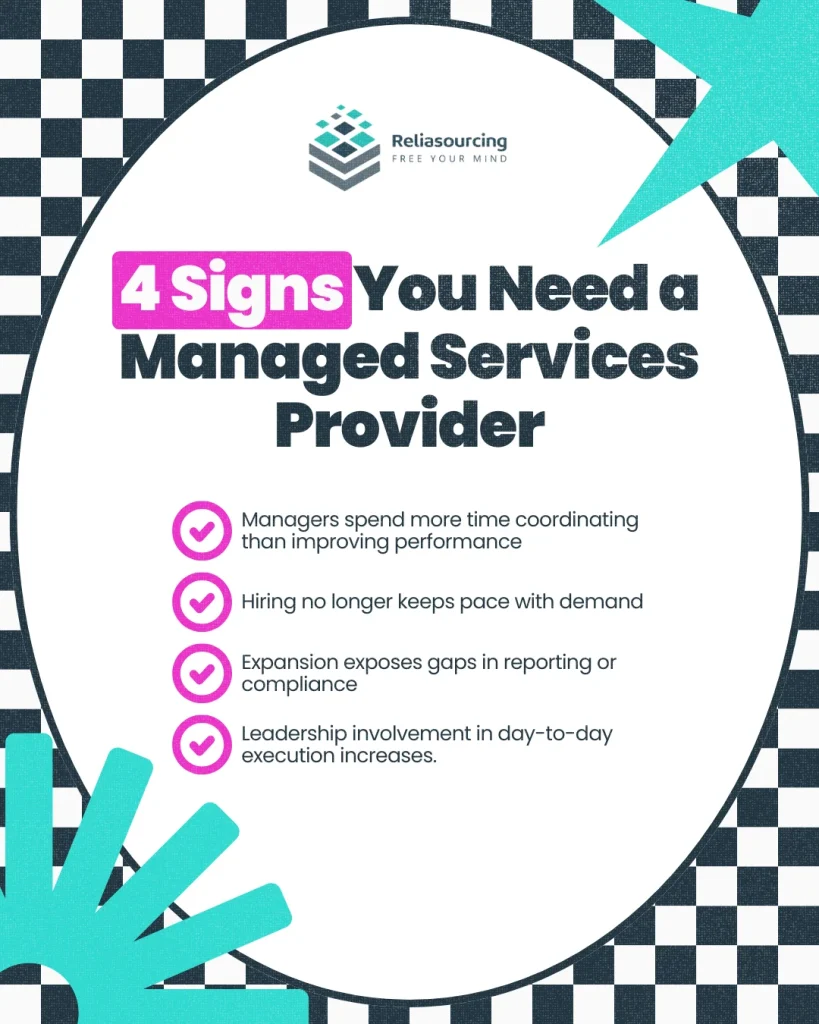
Here are some common signals that indicate readiness:
- Managers spend more time coordinating than improving performance;
- Hiring no longer keeps pace with demand;
- Expansion exposes gaps in reporting or compliance; and/or
- Leadership involvement in day-to-day execution increases.
The decision often centers on control. While internal hiring provides visibility, it adds management overhead; managed services deliver capacity with built-in accountability. At this stage, many leaders evaluate the benefits of managed services as a way to protect quality and growth momentum.
Frequently Asked Questions
How does a managed service provider help scale a business?
A managed service provider helps scale a business by owning operational outcomes within defined functions. Delivery follows structured workflows, reporting cadence, and performance measures, allowing leadership to maintain oversight without managing daily execution.
Is an MSP suitable for startups and fast-growing companies?
An MSP is suitable for startups and fast-growing companies that are experiencing sustained growth, rather than early experimentation. Fast-growing teams often adopt an MSP once coordination limits expansion or distracts leadership from strategic priorities.
What services can MSPs manage beyond IT?
The services MSPs can manage beyond IT include customer operations, finance processes, compliance workflows, back-office services, and industry-specific functions. Scope typically depends on a business’s maturity and operational needs.
How do MSPs support global or offshore expansion?
MSPs support global or offshore expansion through standardized delivery, centralized governance, and scalable workforce management. Many organizations exploring outsourcing, especially in the Philippines, view managed services as a way to maintain consistency while accessing global talent.
How Reliasourcing Supports Business Growth Through Managed Services
Reliasourcing delivers managed services designed for companies moving past fragmented growth. Engagements focus on operational ownership, governance, and scalability aligned with business objectives, with each engagement defining the following:
- Clear scope and outcome accountability
- Performance metrics with regular reporting
- Quality management frameworks
- Workforce scalability aligned with demand
Delivery is supported by established teams in the Philippines, ensuring consistent execution while maintaining flexibility. Along with a highly competent workforce, Reliasourcing’s processes are ISO-certified in quality management, information security, and business continuity, all of which contribute to ensuring that oversight, compliance alignment, and service governance remain centralized.
Reliasourcing approaches managed services as an extension of leadership capacity rather than a transactional vendor relationship, so companies can rest easy that they have a long-term partner in growth.
Conclusion
Scaling a business challenges more than ambition, and operational discipline determines whether growth compounds or collapses under its own weight. Managed service providers (MSPs) offer a structured alternative to fragmented hiring and task-based outsourcing.
Leaders evaluating their next growth phase benefit from examining where execution strain occurs and how much leadership time is spent on operational coordination. Managed services introduce accountability and consistency at a stage where focus and structure matter most.
If you’re ready to explore your business’s readiness for managed services, let’s have a conversation grounded in growth and vision. Contact us today!