As companies grow, people operations tend to expand faster than expected. Early-stage teams often manage hiring, payroll, and employee concerns informally, with these tasks typically handled by founders or finance leaders alongside other responsibilities. Growth brings added layers of coordination, legal exposure, and administrative effort. This, on top of compliance requirements that vary across locations, leads to increasing employee expectations and internal processes starting to strain.
Many organizations reach a point where Human Resources (HR) work pulls focus away from product development, customer experience, or even revenue growth. But building a full in-house HR department can feel premature or inefficient, especially for startups, scale-ups, and SMEs operating with lean teams or distributed workforces. Hence, HR outsourcing offers a structured way to access professional HR support without committing to a large internal function.
This guide explains what HR outsourcing means in practice, how it works, which HR functions are commonly outsourced, and when organizations should consider it.
What is HRO?
HR outsourcing, also known as HRO, refers to a business arrangement in which an external provider manages specific human resources functions on behalf of an organization. Instead of hiring internal HR staff for every responsibility, leadership teams delegate specific HR activities to specialists who possess the necessary tools, processes, and regulatory knowledge to manage them effectively.
How HR outsourcing works in practice
Most HR outsourcing models operate through clearly scoped service agreements. Businesses retain authority over hiring decisions, compensation philosophy, performance expectations, and company culture. The provider handles execution, documentation, and operational follow-through.
Common engagement models include:
- Transactional support focused on payroll or benefits;
- Ongoing HR operations covering multiple functions; and
- Hybrid models supporting internal HR teams during growth phases.
HR outsourcing differs from building an in-house HR team in terms of structure and flexibility, as internal teams require long-term hiring commitments and significant system investments. Simply, outsourcing adapts as workforce size, geography, or regulatory exposure changes, something that could prove difficult for in-house teams.
Some organizations evaluate HR outsourcing alongside business process outsourcing, although HRO focuses specifically on people operations rather than broad operational functions.
Common misconceptions about HR outsourcing
Several assumptions often surface during early evaluation stages:
- Loss of control over employees
- Reduced visibility into HR data
- One-size-fits-all service delivery
Well-structured HR outsourcing partnerships address these concerns through defined reporting, shared systems access, and collaborative governance.
Key Benefits of Outsourcing HR Functions
HR outsourcing delivers value at both operational and strategic levels, allowing leadership teams to direct focus on core business priorities. Benefits vary depending on company size, maturity, and geographic footprint.
Operational efficiency and focus
Administrative HR tasks consume time across payroll cycles, onboarding, benefits enrollment, and record keeping. Outsourcing reduces internal workload, enabling leadership and managers to focus on revenue growth and team performance.
Compliance support and risk reduction
Labor regulations change across jurisdictions. Companies employing distributed teams face added pressure in managing contracts, statutory benefits, and employee classifications, so HR outsourcing partners track regulatory updates and provide guidance that helps reduce compliance exposure.
Cost structure flexibility
In-house HR teams incur fixed costs, including salaries, benefits, and HR systems; meanwhile, outsourcing converts many of these into variable costs that are aligned with headcount and service scope.
Scalability during growth
HR needs to shift as organizations hire quickly, enter new markets, or restructure teams, so outsourced HR services scale without repeated hiring or retraining cycles.
What HR Functions Are Commonly Outsourced?
HR outsourcing does not require handing over all HR responsibilities, given that companies often outsource selectively based on risk, complexity, and internal capacity. And so, HRO offers the type of flexibility that tailors itself according to the company’s size, structure, and maturity.
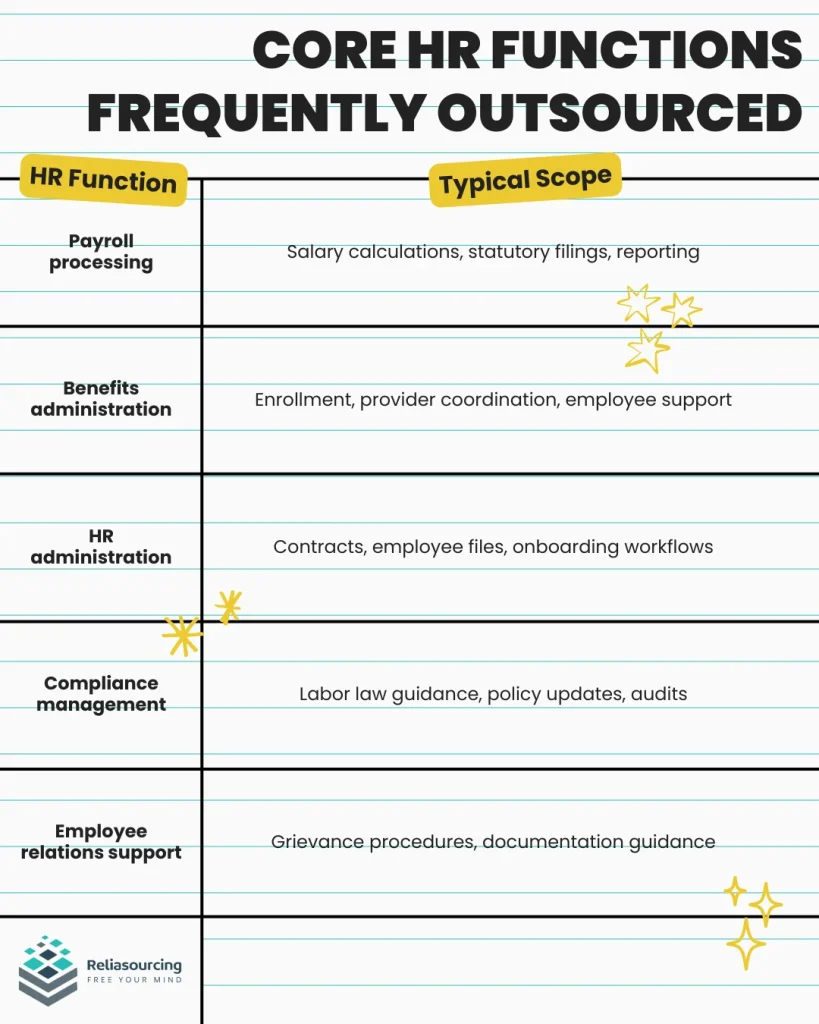
Payroll and benefits often serve as entry points due to accuracy and regulatory requirements. And as organizations compare delivery models, such as outsourcing versus offshoring, HR outsourcing typically complements operational teams rather than replacing leadership functions.
When Does It Make Sense to Outsource HR?
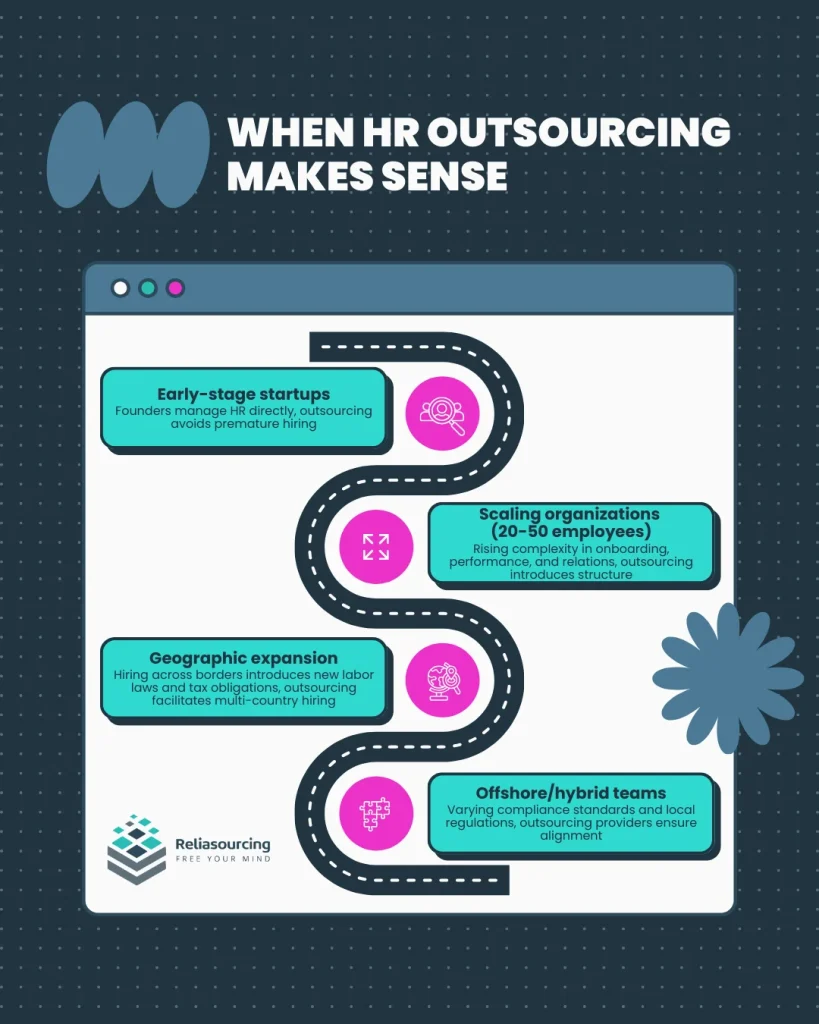
HR outsourcing becomes relevant at different points in a company’s lifecycle.
Early-stage startups
Founders often manage HR responsibilities directly during the early hiring process. As headcount increases, administrative load and compliance exposure grow. Outsourcing for startups is generally seen as a solution for avoiding premature internal hiring.
Scaling organizations
Teams with 20 to 50 employees experience rising complexity in onboarding, performance documentation, and employee relations. This is exactly where outsourced HR support introduces structure without slowing momentum.
Geographic expansion
Hiring across borders introduces new labor laws, tax obligations, and benefits frameworks. HR outsourcing facilitates multi-country hiring without requiring the immediate establishment of a legal entity. Organizations that leverage offshore outsourcing often rely on HR partners to maintain consistency across locations, reaping benefits such as access to local expertise without operational fragmentation.
Additionally, companies employing offshore or hybrid teams may face varying compliance standards. Philippine employment regulations, for example, include statutory benefits, holiday classifications, and advisories from the Department of Labor and Employment (DOLE). Hence, Philippine outsourcing providers help businesses stay aligned with local requirements, avoiding and/or resolving any legal trouble along the way.
Frequently Asked Questions (FAQs)
What is HR outsourcing?
HR outsourcing is the practice of assigning specific human resources responsibilities to an external provider that specializes in HR operations, allowing businesses to manage payroll, compliance, benefits, and HR administration without building a full internal HR department. HR outsourcing works best when companies want professional support while keeping control over people strategy, culture, and leadership decisions.
Is HR outsourcing suitable for small businesses?
HR outsourcing is suitable for small businesses that lack the resources to hire dedicated HR staff. HR outsourcing provides small businesses with access to compliance guidance, payroll support, and streamlined HR processes, all without the long-term overhead. Moreover, HR outsourcing enables small teams to stay focused on growth while maintaining effective employee management.
What HR tasks should companies outsource first?
HR tasks companies outsource first often include payroll processing, benefits administration, and compliance documentation. HR outsourcing for these tasks reduces error risk and administrative pressure early on, and then HRO can later expand into employee relations and HR operations as the organization grows.
How much does HR outsourcing typically cost?
HR outsourcing costs typically depend on service scope, employee count, and geographic coverage. HRO pricing typically follows a per-employee, per-service, or modular model, allowing businesses to align spending with actual HR needs over fixed internal salaries.
Is HR outsourcing compliant with local labor laws?
HR outsourcing is compliant with local labor laws when providers operate within jurisdictional requirements. HRO providers monitor labor regulations and support businesses with compliant contracts, benefits, and documentation to ensure compliance. It also helps companies manage cross-border employment with greater regulatory confidence.
HR Support and Services Through Reliasourcing
Reliasourcing provides HR outsourcing support for growing and distributed teams, focusing on day-to-day HR operations, compliance guidance, and workforce management, allowing leadership to maintain strategic control.
Strategic HR outsourcing support
Reliasourcing’s HR outsourcing approach is built to support modern workforces operating across locations and time zones. Delivery from the Philippines offers an advantage through deep HR operations experience, strong English proficiency, and familiarity with international business requirements. Teams benefit from consistent processes supported by professionals who work within mature outsourcing environments.
Core strengths include:
- ISO-certified compliance guidance aligned with local and international labor regulations;
- Risk mitigation and data security management through standardized documentation and reporting; and
- Ensured business continuity and process standardization that supports consistency as headcount grows.
HR outsourcing with global workforce support
Companies managing cross-border teams often require employment solutions beyond traditional HR support. Employer of Record services act as a complementary extension of HR outsourcing, supporting compliant hiring in countries where no legal entity exists. Reliasourcing provides this option through Employer of Record, enabling businesses to manage complex employment needs while internal teams retain control over performance and culture.
Organizations exploring readiness often begin with low-commitment discussions, and we’re always happy to help you navigate our service models. Contact us today!
Do You Need to Outsource HR Functions?
HR outsourcing suits organizations seeking clarity, consistency, and operational focus. Indicators often include administrative overload, compliance uncertainty, or plans for geographic expansion. Consider the following questions:
- Are HR tasks consuming leadership time meant for growth initiatives?
- Does compliance knowledge keep pace with workforce expansion?
- Do current HR processes scale effectively across locations?
Exploration starts with assessing whether current HR structures support long-term goals or create friction. External HR support offers flexibility for teams evaluating future direction, making it a clear solution for businesses growing worldwide.