
Founders and operators often reach an inflection point where internal teams start feeling stretched: Financial growth slows down, reporting loses consistency, hiring paperwork piles up, and leadership attention drifts away from revenue and product decisions. Now, back office outsourcing often enters that conversation, and is often framed as a cost decision, but forward-looking companies approach this differently. Back office outsourcing has become an operating strategy that supports scale, resilience, and long-term growth, than a short-term expense fix.
This guide explains what back office outsourcing is, why companies rely on it, which functions are commonly outsourced, and how leaders can evaluate the right model and partner, all to help decision-makers understand the value of back office outsourcing as a strategic choice when aligned with growth plans.
What Is Back Office Outsourcing?
Back office outsourcing refers to delegating non-customer-facing business functions to an external partner. Therefore, core activities remain with the company, while operational execution is handed over to a specialized team operating under defined processes and performance standards.
Now, back office functions differ from front office roles in one key way, given that front office teams interact directly with customers and drive revenue. Back office teams support the organization internally, keeping operations accurate, compliant, and scalable. Examples include finance operations, HR administration, data management, compliance tracking, and administrative support.
While early outsourcing models focused on labor cost differences, modern back office outsourcing looks different. Leadership teams now use outsourcing to redesign how work gets done, improve execution quality, and gain access to specialized expertise, and frameworks like business process outsourcing highlight how structured delivery models replace ad hoc internal workflows with repeatable systems.
The Strategic Benefits of Back Office Outsourcing (Beyond Cost Savings)
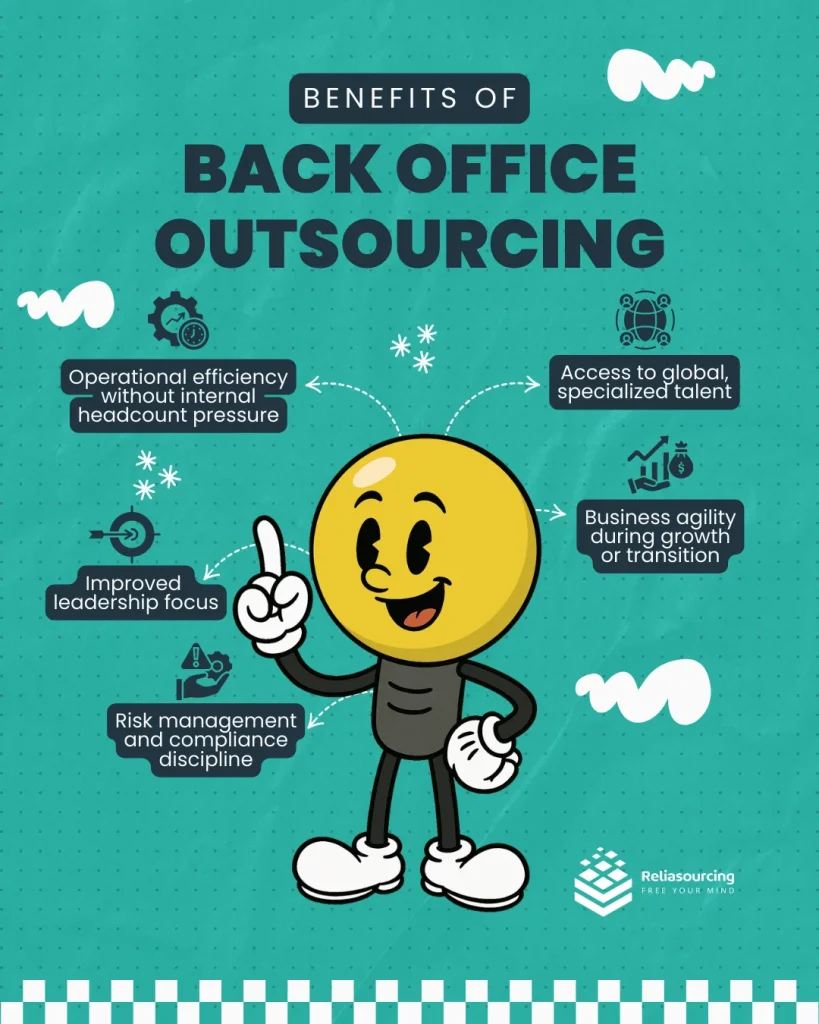
The allure of a 70% cut in costs remains, as cost control will always matter, but strategic value drives modern outsourcing decisions, and several benefits stand out for growth-stage companies.
Operational efficiency without internal headcount pressure
Internal teams often grow unevenly, so outsourced back office teams are designed to scale faster without creating long-term payroll risk. Capacity expands, and contracts become based on business cycles rather than fixed roles.
Access to global, specialized talent
Specialized back office work requires experience, not just availability, hence outsourcing opens access to finance analysts, compliance specialists, HR administrators, and data professionals who work within structured delivery environments. Access to skilled talent is one of the many reasons why companies outsource work in the first place.
Improved leadership focus
Founders and executives regain time for product, sales, and partnerships. With this, back office outsourcing reduces context switching and prevents leadership from acting as an escalation layer for operational gaps.
Business agility during growth or transition
Fundraising rounds, market entry, and acquisitions place strain on internal operations, so outsourced teams absorb volume spikes and process changes without destabilizing core teams.
Risk management and compliance discipline
Standardized workflows, documentation, and oversight reduce exposure to errors and regulatory lapses, so outsourcing providers ensure they operate with mature quality controls that smaller internal teams struggle to maintain consistently.
In-House vs Back Office Outsourcing vs Hybrid Models
No single model fits every company, so decision-makers will always benefit from comparing models across control, speed, and risk.
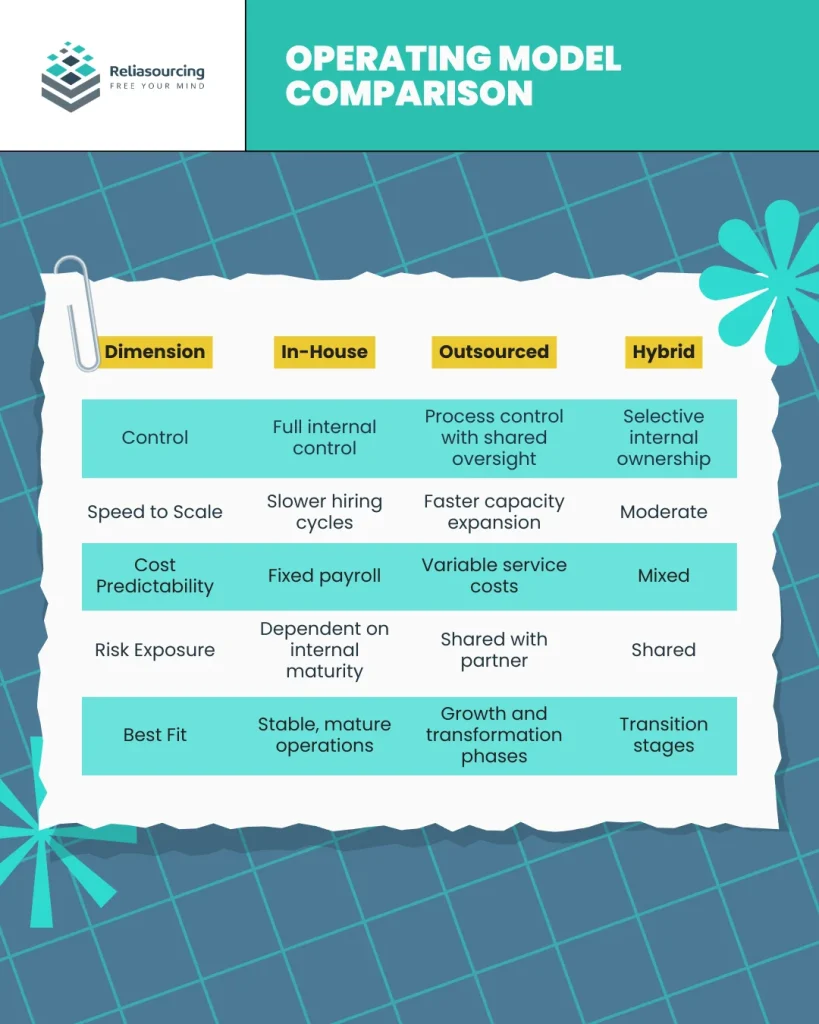
On one hand, in-house teams make sense when processes remain simple, and scale stays predictable. On the other hand, outsourcing works best when volume, complexity, or compliance demands outgrow internal capacity. And when both are mixed, hybrid models appear when leadership wants to retain strategic ownership while outsourcing execution layers.
A practical decision lens includes three questions:
- Which processes require institutional control?
- Which activities benefit from standardization and scale?
- Where does leadership time create the most value?
Answers often point to a blended model that evolves over time.
The Future of Back Office Outsourcing
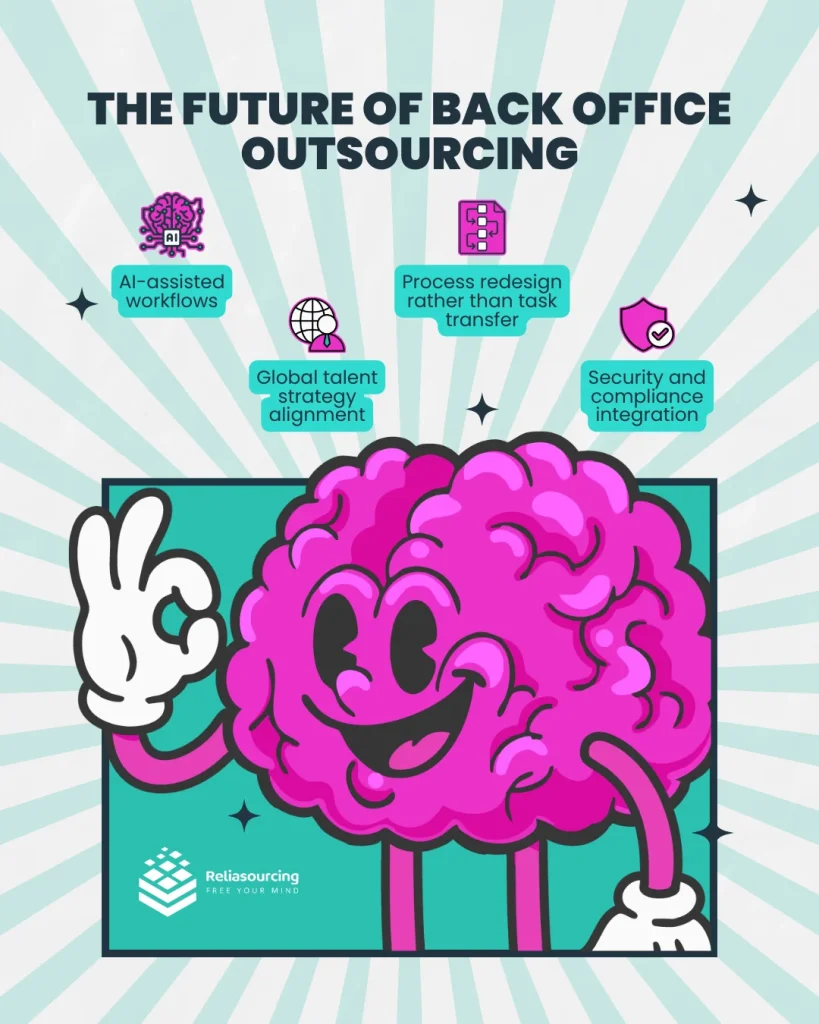
Back office outsourcing continues to shift from task execution to operating model design. And now, several trends are shaping this evolution.
AI-assisted workflows
Automation supports data validation, reconciliation, reporting, and exception handling. Outsourced teams increasingly operate alongside automation tools that reduce manual effort and improve accuracy.
Process redesign rather than task transfer
Leading companies rethink workflows before outsourcing. Work gets simplified, documented, and measured rather than copied from internal habits. Outsourcing back office operations effectively begins once a redesign becomes the foundation for sustainability.
Global talent strategy alignment
Outsourcing now supports long-term workforce planning, as distributed teams provide continuity across time zones and reduce dependence on a single labor market. Outsourcing in the Philippines is part of this broader talent strategy, driven by the country’s operational maturity and depth of talent.
Security and compliance integration
Data protection and regulatory alignment sit at the center of outsourcing decisions, so mature providers invest in infrastructure and access controls, as well as audit readiness as standard operating requirements.
Frequently Asked Questions (FAQs)
What is back office outsourcing and how does it work?
Back office outsourcing works by assigning internal support functions to an external partner that operates under defined processes, service levels, and reporting structures, wherein companies retain oversight while execution shifts to a specialized delivery team.
Is back office outsourcing suitable for startups, SMEs, and enterprises?
Back office outsourcing is suitable for startups, SMEs, and enterprises since it works across company stages, although motivations for outsourcing may differ. Startups gain flexibility, SMEs improve execution quality, and enterprises standardize operations across regions.
How much does back office outsourcing typically cost?
Back office outsourcing cost typically depends on scope, complexity, and service model. Pricing usually follows monthly service fees rather than individual salaries, which improves predictability and reduces hiring risk.
What are the risks of back office outsourcing?
The common risks of back office outsourcing include misaligned expectations, weak documentation, and insufficient governance. Hence, structured onboarding, clear KPIs, and regular reviews significantly reduce these risks.
How do companies ensure data security and compliance when outsourcing back office tasks?
Companies ensure data security and compliance when outsourcing back office tasks by partnering with providers certified in data security, just like Reliasourcing. Security depends on provider controls, access management, and documented procedures, so a partner is ideal if they operate within secure infrastructures and compliance frameworks, especially if it aligns with client requirements.
How Reliasourcing Helps Companies with Back Office Outsourcing
Reliasourcing supports companies by offering tailored back office outsourcing that functions as a strategic operational move. Delivery models focus on long-term alignment, documented processes, and accountable execution.
With our expertise in the SaaS, gaming, eCommerce, and finance industries, support spans finance operations, HR administration, compliance workflows, data operations, and administrative functions. Moreover, teams work within structured governance models that give clients visibility and control without daily micromanagement.
Philippine-based delivery teams play a supporting role in this model, offering operational maturity and talent depth while maintaining strong security and compliance standards. Companies with international hiring needs may also explore our Employer of Record service as a complementary solution.
Engagements typically begin with process assessment and readiness evaluation. Afterwards, leaders gain clarity on which functions to outsource, which to retain internally, and how hybrid models can support growth. Conversations often start through our contact form, allowing teams to map scope, risk tolerance, and growth goals before execution begins.
Summary
Back office outsourcing has shifted from a cost discussion to a leadership decision about how companies operate at scale. Founders and executives who treat outsourcing as a long-term model are now steadily gaining efficiency, focus, and resilience without having to sacrifice control.
The strongest outcomes come from clarity; therefore, clear processes, defined ownership, and aligned partners matter more than labor savings alone. Companies ready to explore this path benefit from structured evaluation and thoughtful execution rather than rushed transitions.
If you’re interested in building scalable operations without operational drag, start by assessing your readiness to outsource back office operations. Contact us today!