
Over the past decade, outsourcing has evolved into a strategic capability that helps companies scale operations and access specialized talent. As a result, organizations can expand globally without the need to build large internal infrastructures. And in 2025, that evolution accelerated. Businesses across industries—from SaaS and FinTech to Gaming and eCommerce—have integrated outsourcing into their core operating models. Instead of viewing external teams as temporary support, organizations increasingly treat outsourcing providers as long-term partners.
After last year’s State of Outsourcing in 2025: Current Trends and the 2025 Outsourcing Recap, this report now combines Reliasourcing’s operational experience supporting global clients. With industry research published throughout 2025 to 2026, outsourcing developments are laid out for the rest of the year. These insights provide a clear picture of how outsourcing has evolved over the past year. They also highlight what leaders should prioritize going forward.
Executive Summary
The outsourcing industry expanded significantly in 2025 as companies sought scalable operating models to support global growth.
According to the 2025 Grand View Research BPO market analysis, the global business process outsourcing market surpassed $328.37 billion. It is then expected to grow at a Compound Annual Growth Rate (CAGR) of 9.9% from 2026 to 2033 as digital transformation accelerates. Additional research from Statista’s 2026 outsourcing industry outlook estimates that the global outsourcing market could exceed $806.55 billion by 2030. And this would be driven by AI adoption, digital services demand, and the globalization of talent. Several structural trends defined outsourcing in 2025:
- Organizations shifted from vendor relationships toward strategic outsourcing partnerships
- Artificial intelligence became embedded in outsourcing delivery models
- Cybersecurity and compliance emerged as primary vendor evaluation criteria
- Sustainability and ethical governance gained importance in outsourcing procurement
The Philippines remained one of the most important global outsourcing hubs, and according to the IT & Business Process Association of the Philippines (IBPAP) press release last December 30, 2025, the IT-BPM sector, specifically, is on track to reach approximately 1.9 million jobs and $40 billion in export revenues, adding around 80,000 jobs and $2 billion in new revenue in 2025 alone.
For startups and enterprises alike, outsourcing delivers value when it supports strategic outcomes such as revenue growth and operational resilience. Additionally, it plays a crucial role in enhancing customer experience.
Outsourcing Trends 2025: A Rapidly Expanding Industry
Several macroeconomic forces reshaped outsourcing adoption throughout the year.
Digital Transformation Accelerated Operational Demand
Businesses across industries continue migrating toward digital-first operating models. Software platforms, data-driven decision making, and automated workflows require operational capabilities that internal teams often struggle to scale quickly.
According to the 2025 McKinsey & Company report on the economic potential of generative AI, automation technologies alone could add $2.6–$4.4 trillion annually to the global economy, much of it tied to operational automation and customer service optimization.
Talent Shortages Continue to Affect Global Businesses
Talent scarcity remains one of the largest barriers to organizational growth. The 2025 World Economic Forum The Future of Jobs Report 2025 identifies talent shortages as a top risk affecting more than 60% of global employers.
Outsourcing provides access to global talent pools without requiring companies to build new international entities.
Remote Work Normalized Distributed Operations
A 2026 Gartner Future of Work overview highlights how organizations are entering a human-machine era shaped by AI, talent shortages, and evolving work models, reinforcing the capability of globally distributed workforces. And once companies accepted that work could happen anywhere, outsourcing naturally expanded beyond traditional administrative roles. Today, outsourced teams support functions including, but not limited to:
- Customer experience operations
- Sales development and revenue operations
- Financial administration and compliance
- AI-enabled analytics
- Technical services and product support
The Philippines’ Advantage in Global Outsourcing
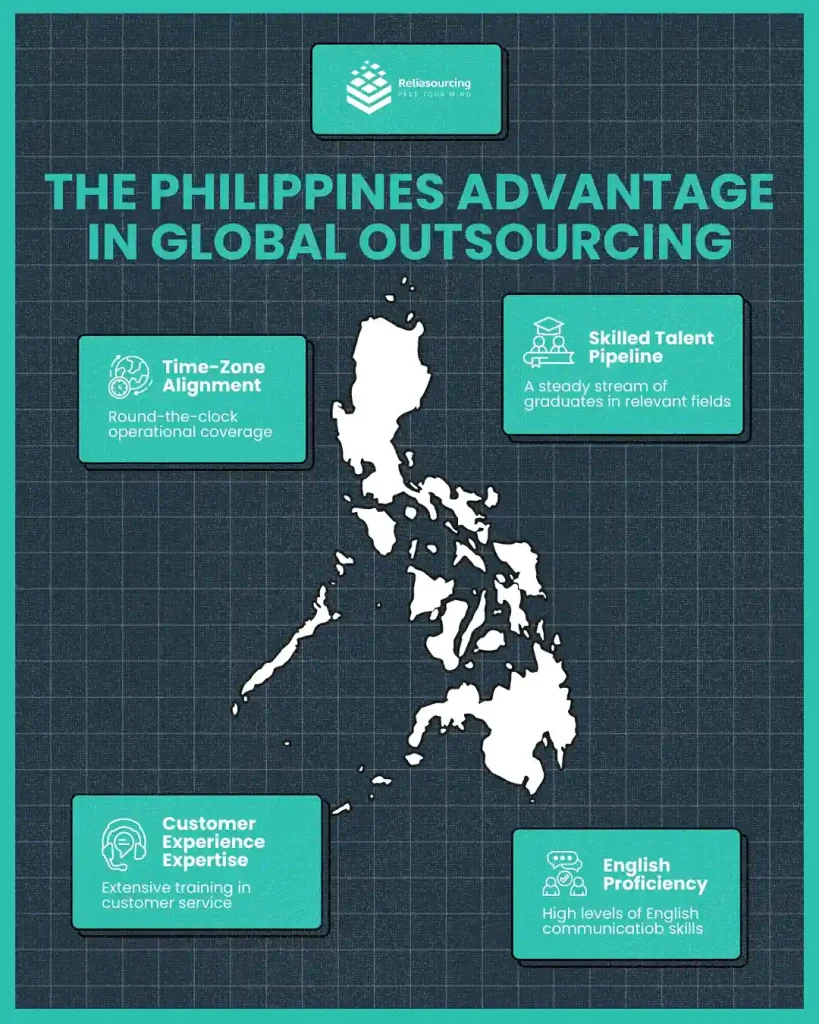
Location remains one of the most important strategic considerations in outsourcing. The Philippines, specifically, continues to rank among the world’s most mature outsourcing ecosystems due to its workforce readiness, language capabilities, and operational experience.
Large Skilled Talent Pipeline
The country produces roughly 350,000 university graduates annually, many trained in business, IT, and communications, a consistent talent pipeline that allows outsourcing providers to scale operations quickly.
High English Proficiency
The 2025 EF English Proficiency Index ranks the Philippines among the strongest English-speaking nations in Asia. Taking the 28th spot, Filipino professionals are known to communicate effectively with international customers.
Global Customer Experience Expertise
Customer service operations remain one of the country’s best capabilities, coming from decades of BPO industry growth that have produced extensive training programs emphasizing communication, empathy, and problem-solving.
Time-Zone Alignment for Western Markets
Philippine teams provide round-the-clock operational coverage for organizations headquartered in regions like North America, EMEA (Europe, the Middle East, and Africa), and APAC (Asia-Pacific), allowing companies to maintain continuous customer support operations. Structural advantages like these explain why the Philippines continues attracting global outsourcing investment.
Strategic Outsourcing Partnerships Replace Vendor Relationships
One of the most important developments in outsourcing during 2025 was the shift from transactional vendor relationships toward strategic partnerships. According to Outsource Accelerator, there’s been a growing shift towards strategic partnerships, with a Gartner study saying over 60% of companies directly involve their outsourcing providers in operational planning and digital transformation initiatives. Hence, instead of simply completing assigned tasks, outsourcing partners contribute to:
- Operational design
- Workflow optimization
- Technology integration
- Global expansion strategies
Case Study: FinTech Partnerships Pipeline
A FinTech pricing intelligence company partnered with Reliasourcing to build a global partnership sourcing framework targeting senior executives across multiple markets. Results included:
- 6–7× increase in qualified partnership meetings
- Expanded coverage across APAC, EMEA, and North America
- Improved pipeline predictability
In Reliasourcing’s 2026 case study, the engagement demonstrates how outsourcing can support both complex strategic initiatives and administrative functions.
Industry Winners in Outsourcing Adoption
Outsourcing adoption accelerated across multiple industries in 2025, though growth patterns increasingly reflect how sectors are adapting to digital transformation, artificial intelligence, and global workforce distribution.
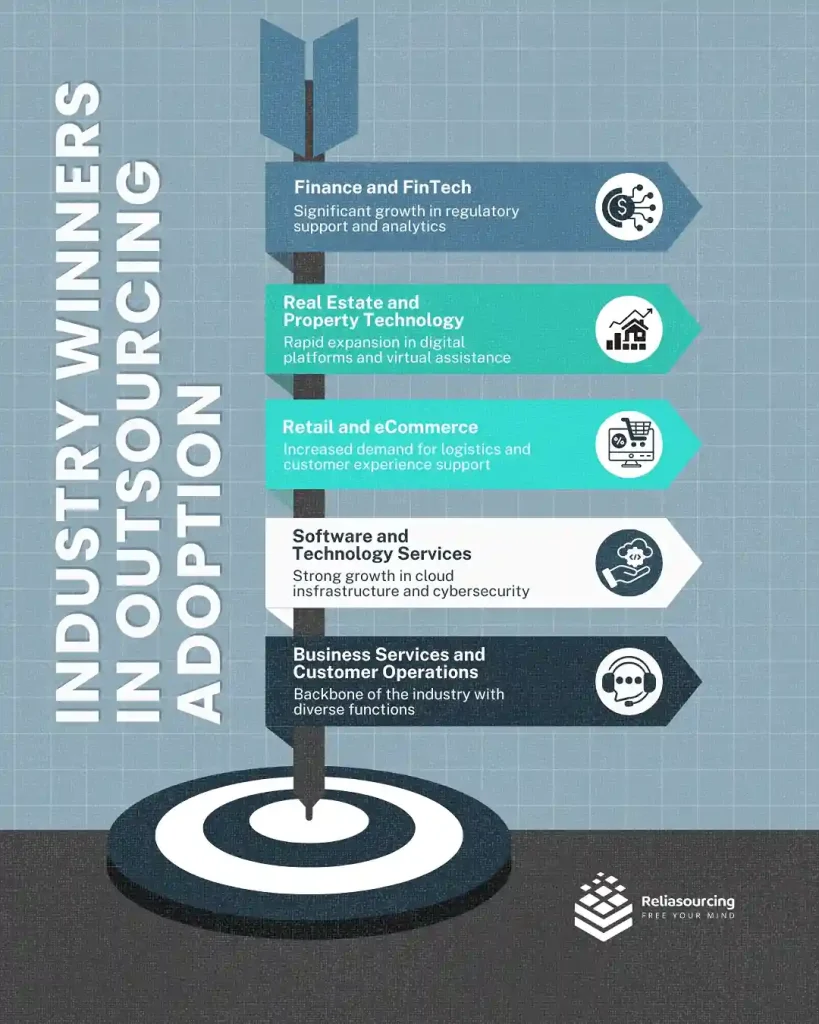
Insights from the OA500 2025 Global Outsourcing Firm (BPO) Index, which analyzed more than 3,018 outsourcing firms worldwide, show that outsourcing demand is shifting toward specialized services, knowledge-intensive work, and technology-enabled operations. Several industries emerged as particularly strong drivers of outsourcing growth.
Finance and FinTech
Financial services experienced some of the most significant outsourcing growth in recent years. According to the OA500 2025 report, finance outsourcing revenues grew 69.91% compared with 2024 and more than 172% since 2023, reflecting increased demand for regulatory support, fraud monitoring, analytics, and compliance operations. Web traffic to finance outsourcing providers also increased by an extraordinary 5,718%, signaling heightened market interest in financial outsourcing solutions.
For many fintech platforms and financial institutions, outsourcing now plays a critical role in scaling risk management, customer support, and operational analytics while maintaining regulatory compliance across multiple markets.
Real Estate and Property Technology
One of the fastest-growing outsourcing segments in 2025 came from real estate and property services, as the OA500 report notes that real estate outsourcing revenues surged more than 1,039%, rising from approximately $77 million in 2024 to over $880 million in 2025.
The rapid expansion was proof of the growing adoption of digital property platforms, property management analytics, virtual assistance services, and transaction coordination teams that support global real estate businesses.
Retail and eCommerce
Retail and eCommerce outsourcing also experienced substantial expansion, with the OA500 analysis finding that web traffic to retail outsourcing firms increased by more than 2,259%, highlighting the accelerating demand for outsourced logistics coordination, order management, digital marketing, and customer experience support.
As global eCommerce continues to grow, retailers increasingly rely on outsourced operational teams to manage customer interactions, supply chain support, and omnichannel customer experiences.
Software and Technology Services
Technology companies remain among the largest users of outsourcing. Software outsourcing expanded nearly 40% over the past two years, reflecting strong demand for cloud infrastructure support, cybersecurity services, and software development capabilities.
However, the sector also illustrates the disruptive influence of automation. While outsourcing demand remains strong, AI-assisted development and automation tools are reshaping the types of services technology companies outsource.
Business Services and Customer Operations
Despite rapid growth in specialized sectors, traditional business services remain the backbone of the outsourcing industry. In the OA500 report, business services account for more than 78% of outsourcing firms, covering functions such as customer service, HR administration, finance support, and back‑office operations, proving that even as the industry evolves, these operational services continue to form the foundational layer of global outsourcing.
Sectors Facing Pressure
Not every sector expanded at the same pace. Some industries experienced slower outsourcing adoption as automation replaced certain tasks or organizations brought operations in‑house. Telecommunications, consumer services, and some insurance functions have seen declining outsourcing activity due to automation and internal digitization initiatives.
The shifts illustrate a broader transformation within outsourcing: industries that embrace automation, analytics, and platform‑based operations are accelerating their use of external partners, while traditional service models face increasing pressure to evolve.
Artificial Intelligence and the Evolution of Outsourcing
Artificial intelligence became one of the defining forces shaping outsourcing in 2025. Rather than replacing outsourcing entirely, AI is changing how outsourced teams operate, what services companies externalize, and how operational workflows are structured.
Insights from the McKinsey report “The State of AI: How Organizations Are Rewiring to Capture Value” show that artificial intelligence adoption has accelerated across global enterprises. The latest survey finds that 78% of organizations now use AI in at least one business function, a significant increase compared with previous years and a sign that AI is becoming embedded in everyday operations.
Generative AI adoption is growing even faster. According to the same report, 71% of organizations report regular use of generative AI in at least one business function, up from 65% earlier in 2024. These technologies are most frequently deployed in functions that closely intersect with outsourcing services, including:
- Marketing and sales
- Product and service development
- Service operations and customer support
- Software engineering
- Corporate IT and knowledge management
For outsourcing providers, the adoption patterns provide a critical insight that AI is not eliminating outsourcing demand, but reshaping the nature of outsourced work.
From Labor Arbitrage to AI‑Augmented Operations
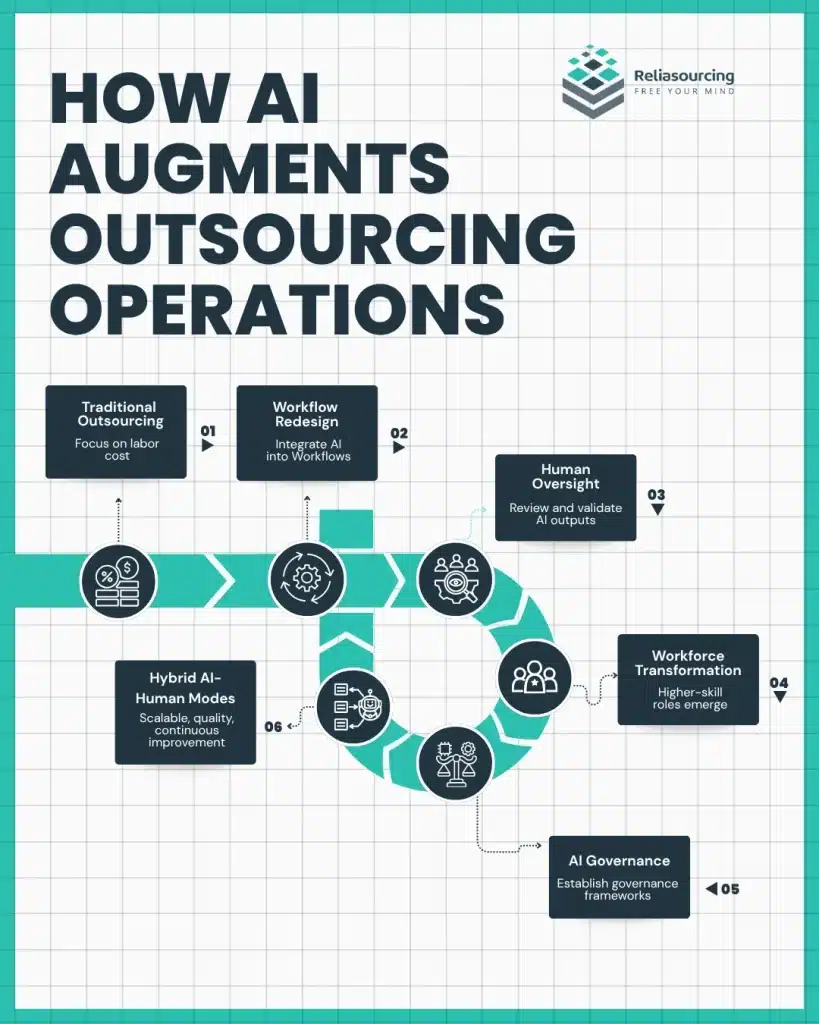
Historically, outsourcing models focused heavily on labor cost optimization. AI-driven automation is now shifting the industry toward AI‑augmented service delivery, where technology and human expertise operate together.
McKinsey’s research shows that many organizations are redesigning workflows as they deploy generative AI. In fact, 21% of organizations using generative AI report that they have fundamentally redesigned at least some business workflows to integrate the technology. For outsourcing providers, the transformation translates to services increasingly revolving around:
- Managing AI‑enabled workflows
- Validating AI-generated outputs
- Training and supervising machine learning systems
- Integrating automation into operational processes
Rather than replacing human teams, AI is expanding the operational complexity organizations must manage.
Human Oversight Remains Critical
Despite rapid technological advances, human oversight remains a crucial component of effective AI deployment.
McKinsey’s survey highlights that organizations vary widely in how they monitor AI-generated outputs. Approximately 27% of organizations review all AI-generated content before it is used, while others review a smaller share of outputs depending on risk tolerance and operational context.
The rising review discipline reinforces the need for human‑in‑the‑loop (HITL) operational models, where outsourced professionals review, validate, and refine AI outputs before they reach customers or decision-makers. Outsourcing partners now provide the operational layer necessary to maintain quality control across AI-driven workflows.
Workforce Transformation, Not Replacement
AI is also reshaping workforce dynamics, contrary to widespread fears of widespread job elimination, with McKinsey’s findings suggesting a more nuanced outcome. Survey responses indicate that many organizations expect little immediate change in overall workforce size, though specific functions may experience shifts in staffing needs as automation expands, in particular:
- Service operations and supply chain roles may see partial automation
- Software engineering and product development roles may expand
- AI governance, data science, and compliance roles are increasing in demand
For outsourcing providers, the shift is creating demand for higher‑skill operational roles, including AI supervision, analytics support, and technology-enabled customer operations.
AI Governance and Organizational Change
Successful AI adoption requires more than deploying new tools. According to McKinsey’s research, organizations that generate meaningful value from AI tend to implement broader operational changes, including governance frameworks, training programs, and cross-functional leadership oversight. Many organizations are also establishing dedicated teams responsible for driving AI adoption and scaling initiatives across business units.
The Future: Hybrid AI‑Human Operating Models
The outsourcing industry is therefore moving toward hybrid operational models where AI systems automate repetitive tasks while human professionals provide oversight, judgment, and strategic input, allowing companies to achieve several objectives simultaneously:
- Operational scalability through automation
- Quality assurance through human oversight
- Continuous improvement through data analysis and feedback
As artificial intelligence continues evolving, outsourcing providers will increasingly function as operators of AI‑enabled business processes, helping organizations transform technology capabilities into practical operational outcomes.
Data Security and Compliance in Outsourcing
Data security has become one of the most decisive factors influencing outsourcing partnerships in 2025. As outsourcing providers increasingly handle sensitive information—from customer records to financial transactions and intellectual property—companies must ensure their partners can maintain strong security frameworks while complying with complex global regulations.
Industry research shows that the financial consequences of security failures are severe. The 2025 IBM Cost of a Data Breach Report estimates that the global average breach cost has reached $4.45 million, underscoring why cybersecurity and compliance are now core criteria in outsourcing vendor selection. Organizations, therefore, expect outsourcing providers to demonstrate compliance with major security frameworks like the ISO/IEC 27001:2022 certification dedicated to data security, which Reliasourcing earned last year.
Modern outsourcing operations also implement encryption protocols, identity-based access controls, and continuous monitoring systems to protect sensitive data.
Sustainability and Ethical Technology Governance
Sustainability and ethical governance have become defining benchmarks for outsourcing providers in 2025. Increasingly, companies evaluating outsourcing partners look beyond operational efficiency and cost advantages. They also assess whether providers contribute positively to environmental sustainability, workforce well‑being, and broader social impact.
According to the Outsourcing Impact Review (OIR) 2025, the industry is undergoing a shift in how success is defined, with outsourcing no longer viewed purely as a vehicle for operational efficiency. At present, it is increasingly recognized as a platform capable of generating measurable social, economic, and environmental impact across communities and global markets.
Sustainability as an Operational Strategy
Environmental sustainability is becoming embedded in everyday outsourcing operations. The OIR 2025 highlights how many outsourcing providers are adopting practices such as energy‑efficient infrastructure, renewable energy integration, and waste‑reduction initiatives as part of their corporate responsibility programs.
In many organizations, sustainability initiatives extend beyond internal operations with providers increasingly collaborating with community partners and environmental organizations to support initiatives ranging from reforestation programs to renewable energy projects. Such initiatives demonstrate how outsourcing firms are integrating environmental stewardship directly into their operational models.
The report also notes that sustainability is becoming closely linked to long‑term operational resilience. Firms that adopt energy‑efficient technologies, digital workflows, and remote work models can simultaneously reduce environmental impact and improve operational flexibility.
Alignment with Global Sustainability Goals
Another important trend highlighted in the OIR 2025 is the growing alignment between outsourcing initiatives and the United Nations Sustainable Development Goals (SDGs). Data from the report shows that outsourcing organizations increasingly design projects that directly contribute to global priorities such as Climate Action (SDG 13), Quality Education (SDG 4), and Decent Work and Economic Growth (SDG 8).
The alignment demonstrates how outsourcing providers are expanding their role beyond service delivery to become contributors to global development goals. Initiatives across the industry presently address topics including digital education programs, workforce upskilling, environmental conservation, and community resilience.
Beyond the most widely adopted SDGs, many outsourcing initiatives also support broader goals such as Gender Equality (SDG 5), Reduced Inequalities (SDG 10), and Responsible Consumption (SDG 12), reflecting the industry’s growing commitment to inclusive growth and responsible digital transformation.
Social Impact and Community Development
The OIR 2025 also highlights how outsourcing firms are expanding their social impact initiatives. Many organizations now invest in programs focused on education, workforce development, healthcare access, and community infrastructure.
Projects documented in the report demonstrate how outsourcing companies are mobilizing resources—including volunteer hours, funding, and technological capabilities—to support underserved communities, focusing on digital literacy programs, remote employment opportunities, and community health initiatives that expand access to essential services, such as Reliasourcing’s outreach for digital inclusion. Outsourcing companies are increasingly positioning themselves as partners in local development over merely serving as commercial service providers, as illustrated by programs like these.
Ethical Governance in a Technology‑Driven Industry
As outsourcing becomes more technology‑driven, ethical governance has emerged as a critical area of focus, as evidenced in an Oxford Brookes study. Likewise, artificial intelligence, automation, and large‑scale data processing introduce new ethical considerations related to transparency, fairness, and accountability.
The OIR 2025 highlights the importance of integrating responsible governance frameworks that ensure technology is deployed in ways that protect workers, communities, and customers. Organizations across the industry are increasingly implementing structured impact measurement systems, third‑party validation processes, and transparent reporting frameworks to strengthen accountability.
Companies are no longer judged solely by operational metrics, but also by their ability to demonstrate responsible governance and measurable societal contributions, a shift toward transparency reflecting a broader development within the outsourcing sector.
The Future of Responsible Outsourcing
The findings of the Outsourcing Impact Review 2025 suggest that sustainability and ethics will continue to shape outsourcing strategies in the coming years. Organizations that integrate environmental stewardship, inclusive employment practices, and transparent governance into their business models will be better positioned to build long‑term partnerships with global clients.
In this emerging model, outsourcing providers are evolving into drivers of sustainable development, leveraging technology, talent, and global collaboration to generate shared value for businesses and the communities they serve.
Case Studies 2025: Outsourcing in Practice
While industry research highlights macro‑level trends, the operational impact of outsourcing is best understood through real on-the-ground engagements. Across SaaS, Gaming, FinTech, and eCommerce sectors, Reliasourcing teams helped companies solve specific growth bottlenecks, from revenue generation to customer experience scaling. The following case studies illustrate how outsourcing translated strategy into measurable results:
eCommerce Customer Experience: Scaling Global Support
Fast‑growing eCommerce brands often struggle to maintain customer experience quality while scaling internationally. The fashion retailer client, a rapidly expanding digital‑first brand, needed a support infrastructure capable of handling rising customer inquiries while maintaining brand voice and service standards.
Reliasourcing deployed a dedicated customer experience team trained specifically on the brand’s tone, product catalog, and order workflows. Key outcomes included:
- Faster response times across email and chat channels
- Consistent brand‑aligned communication with customers
- Improved issue resolution for order, return, and product inquiries
- Scalable support coverage during peak retail demand
By externalizing operational support functions, the client’s internal team remained focused on merchandising, marketing, and brand expansion.
SaaS Customer Success Operations
SaaS companies often need a scalable customer support infrastructure as their user bases grow globally. The business platform client partnered with Reliasourcing to strengthen its customer success operations and maintain service quality across increasing ticket volumes. The engagement delivered measurable results:
- Customer satisfaction scores increased from 3.7 to 4.7
- More than 15,000 monthly support interactions handled
- Approximately $3.8 million in retention and upsell revenue generated
The case demonstrates how outsourced teams can directly influence SaaS growth metrics, particularly customer retention and lifetime value.
SaaS Revenue Operations and Sales Enablement
In addition to customer support, the same business platform client expanded its revenue operations through outsourced sales support. Reliasourcing built a sales development structure responsible for lead qualification, outreach coordination, and pipeline support. Results included:
- $15.63 million in annual revenue generated
- 20–28% conversion rates across campaigns
- Stronger pipeline consistency across multiple sales initiatives
The project demonstrates how outsourced sales teams can operate as an extension of internal revenue operations, rather than simply carrying out lead generation tasks.
FinTech Loan Processing Operations
Financial technology platforms often face operational pressure as loan volumes increase and customer expectations for fast approvals continue rising. The client, a digital lending platform, partnered with Reliasourcing to strengthen its loan processing and back‑office operations.
Reliasourcing deployed a specialized support team responsible for assisting with loan application processing, document verification, and operational coordination within the lending workflow. Key outcomes included:
- Faster processing times for loan applications
- Improved document verification and workflow accuracy
- Increased operational capacity during high‑volume lending periods
For FinTech lenders operating in competitive markets, outsourcing operational loan processing functions can significantly improve scalability while allowing internal teams to focus on product development, risk management, and customer acquisition.
Gaming Industry Sales Support
Live‑service gaming companies must continuously expand partnerships, distribution opportunities, and revenue channels. A gaming company partnered with Reliasourcing to strengthen outbound sales and partnership engagement activities.
Reliasourcing teams supported outreach campaigns, partnership prospecting, and sales coordination activities that enabled the client to expand its commercial pipeline while allowing internal leadership to focus on product development and strategic growth initiatives. The entire partnership is a highlight of how outsourced commercial teams can support the dynamic revenue ecosystems typical of the gaming industry.
AI‑Driven SaaS Solutions Market Expansion
Artificial intelligence companies often operate in rapidly evolving markets where sales cycles involve complex education and solution positioning. The client, an AI solutions provider, leveraged Reliasourcing support to expand market outreach and identify qualified prospects across multiple industries.
Through structured prospecting and outreach operations, the outsourced team helped expand awareness of the company’s AI solutions among enterprise prospects and strengthened early‑stage pipeline development, illustrating how outsourcing can support emerging technology companies, particularly those operating in specialized or rapidly evolving markets.
Cross‑Industry Insights from the Case Studies
Taken together, the engagements illustrate several recurring patterns across the four industries driving outsourcing adoption in 2025: SaaS, FinTech, eCommerce, and Gaming.
- SaaS companies increasingly rely on outsourced teams to support customer success, sales development, and revenue operations as global user bases expand.
- FinTech platforms use outsourcing to strengthen operational infrastructure such as loan processing, compliance workflows, and financial data management.
- eCommerce brands depend on outsourced customer experience teams to maintain service quality while scaling rapidly across international markets.
- Gaming companies, particularly those operating live‑service titles, leverage outsourced commercial and support teams to sustain continuous player engagement and revenue growth.
Across these sectors, outsourcing has evolved beyond simple cost optimization, and organizations are integrating external teams directly into growth‑critical operations, from revenue generation and customer experience to financial workflows and global market expansion. The examples attest to a central theme of the 2025 outsourcing landscape: companies that treat outsourcing partners as extensions of their operational teams gain the flexibility and scale required to compete in fast‑moving digital industries.
30 Outsourcing Statistics for 2026
Understanding the scale of outsourcing adoption requires examining the latest industry benchmarks. The following statistics summarize key indicators shaping the outsourcing landscape in 2025 and early 2026:
Global Market Growth
- The global outsourcing market is expected to reach $7.11 trillion by 2030 (Grandview Research).
- The global business process outsourcing (BPO) market could exceed $525 billion by 2030 (Grandview Research).
- Global outsourcing contracts represent roughly $92.5 billion in total contract value (Exploding Topics).
- IT services account for approximately 72% of all global outsourcing contract values (Exploding Topics).
- The customer experience BPO market is valued at US$92.49B (Grandview Research).
- Around 70% of executives say cost savings drive their decision to outsource (Deloitte).
Workforce and AI Adoption Trends
- 73% of companies are adopting AI specifically to improve process efficiency (Deloitte).
- 78% of organizations use AI in at least one business function, reflecting widespread operational adoption (McKinsey).
- 71% of organizations report regular use of generative AI in at least one business function, particularly in customer service, marketing, and software development workflows(McKinsey).
- About 21% of organizations have already redesigned workflows to integrate AI into operations, indicating structural operational changes driven by automation (McKinsey).
Enterprise Outsourcing Adoption
- 92% of Global 2000 companies use IT outsourcing (Exploding Topics).
- 3 in 5 organizations outsource application development (back4app).
- 83% of IT leaders are considering outsourcing cybersecurity operations (Syntax).
Philippines Outsourcing Industry
- The Philippine IT‑BPM industry is valued at about $38 billion (Philippine News Agency).
- The sector employs approximately 1.82 million professionals (Philippine News Agency).
- The BPO industry contributes to 9% of the Philippines’ GDP (Matchboard).
- Companies outsourcing to the Philippines can reduce labor costs by up to 70% (OutsourceAccelerator).
SME and Operational Outsourcing
- More than one‑third of small businesses outsource at least one business process (Clutch).
- Nearly one‑quarter of small businesses outsource to improve efficiency (Clutch).
- Payroll services are more likely to be outsourced by small organizations than large ones (Statista).
- Organizations that outsource HR functions can reduce HR costs by an average of 27.2% (NAPEO).
- The biggest challenge for SMEs looking to outsource is cost (Exploding Topics).
Industry Structure and Market Concentration
- The Top 500 outsourcing firms collectively generate more than 94% of total industry revenue, highlighting strong market concentration among large providers (OA500 2025).
- Financial services outsourcing recorded approximately 69.9% year‑over‑year revenue growth among leading providers, making it one of the fastest‑growing service segments (OA500 2025).
- Several niche outsourcing segments—including real estate services and specialized digital operations—experienced growth exceeding 1000% in emerging service categories as firms diversified offerings (OA500 2025).
- Large outsourcing providers are increasingly expanding beyond traditional BPO into technology consulting, AI integration, and managed digital services, reflecting the industry’s transition toward higher‑value service delivery (OA500 2025).
Sustainability and Responsible Outsourcing
- 100% of organizations surveyed believe outsourcing can generate positive social or environmental impact when structured intentionally (OIR 2025).
- Outsourcing initiatives increasingly align with UN Sustainable Development Goals including SDG 4 (Quality Education), SDG 8 (Decent Work), and SDG 13 (Climate Action) (OIR 2025).
- Many outsourcing firms now integrate community development, education programs, and workforce upskilling initiatives into their operations (OIR 2025).
- Environmental initiatives—including energy‑efficient operations, digital workflows, and sustainability programs—are becoming standard practices among leading outsourcing providers (OIR 2025).
Key Lessons from the Outsourcing Industry in 2025
Several themes emerged from the outsourcing landscape over the past year, as the industry continues shifting from tactical support toward strategic operational partnerships.
Outsourcing now drives growth, not just cost efficiency. Organizations increasingly rely on external teams to accelerate expansion, access specialized expertise, and support revenue‑generating operations such as sales development, customer success, and global customer experience.
Hybrid AI‑human delivery models consistently outperform fully automated systems. While automation improves speed and efficiency, organizations that combine AI with skilled human teams achieve stronger results in areas requiring judgment, customer interaction, and complex decision‑making.
Strategic partnerships outperform transactional vendor relationships. The most successful outsourcing engagements involve providers participating in operational planning, process optimization, and technology integration rather than simply executing isolated tasks.
Companies that embed outsourcing partners directly into operational strategy gain the flexibility and scalability required to compete in fast‑moving digital markets.
Strategic Priorities for Outsourcing in 2026
Looking ahead, several strategic priorities are likely to shape outsourcing adoption in the coming year, some of which were listed in the blog, Goodbye 2025, Hello 2026 Outsourcing.
Select the Right Delivery Model
Organizations are increasingly using Employer of Record (EOR) hiring structures or Managed Services outsourcing models, allowing companies to scale teams quickly while maintaining structured governance, performance management, and operational accountability.
Prioritize Revenue‑Impact Functions
Functions directly tied to growth, such as sales development, customer support, and customer success operations, often deliver the fastest return on outsourcing investments, enabling companies to expand globally while maintaining consistent customer engagement.
Integrate AI Responsibly
Automation should be deployed to remove operational bottlenecks and improve efficiency while preserving human oversight for complex workflows, compliance requirements, and customer interactions. Organizations that adopt balanced AI‑human models achieve more sustainable operational performance.
Strengthen Operational Foundations
Scalable growth requires strong operational infrastructure. Outsourced support across HR administration, finance operations, compliance management, and back‑office workflows provides the stability needed to support expansion across multiple markets.
Conclusion
The outsourcing industry continues evolving alongside global digital transformation. External teams are no longer peripheral service providers as they increasingly integrate operational partners supporting innovation, scalability, and international expansion.
Organizations that combine strategic outsourcing partnerships, responsible technology adoption, and access to global talent will gain a meaningful competitive advantage in the years ahead.
As companies move deeper into 2026, outsourcing will remain one of the most powerful mechanisms for navigating operational complexity, accelerating growth, and building resilient global organizations.
Value partners that think beyond growth and focus on building sustainable, high-impact teams? If you are looking for a company that stays closely aligned with industry direction, invests in higher-value work, and takes an intentional approach to how outsourcing evolves in the Philippines, contact us today. See how our future-shaping teams grow as part of #LifeAtReliasourcing.
About Reliasourcing
Reliasourcing is a premier outsourcing solutions provider in the Philippines. We deliver tailored services that help businesses across industries achieve operational efficiency and scalability. With a focus on customer experience and innovation, Reliasourcing remains a trusted partner in unlocking potential through outsourcing.
Follow us on Facebook, Instagram, LinkedIn, YouTube, and X for the latest trends and insights on outsourcing, the industry, and the Philippines.
Connect with us, or become part of our growing team today!