The State of Outsourcing in 2025 series set out to answer a simple question: How is the outsourcing industry changing, and what does that mean for businesses navigating global growth? Over the course of an article series, the answer became more nuanced, with outsourcing expanding beyond its traditional boundaries to become a subtle yet integral part of how organizations innovate, scale, and, more importantly, protect themselves as they navigate the growing complexities of their industries.
With 2025 coming to a close, this article brings the full picture into focus. The past year introduced new expectations, driven by smarter technology, deeper responsibility, stronger governance, and more intentional alliances. Taken together, the shifts tell a story of an industry stepping into maturity, into a new stage of development.
The 2024–2025 Arc: A Year Defined by Acceleration
Data often reveals what sentiment alone cannot. The global BPO market’s jump from $280.64 billion to $315.46 billion signaled that outsourcing demand is accelerating at a pace that reflects global reliance on external partners for capability building and digital transformation.
The Philippines, long viewed as the cornerstone of customer experience outsourcing, strengthened its position as the world’s most dependable labor hub. With the IT-BPM sector surpassing $38 billion in revenue and a workforce of 1.82 million, companies across the US, Europe, and the Middle East continue to rely on Filipino talent for roles that now extend beyond call centers, spanning fintech support, SaaS operations, data services, and AI-enabled workflows.
Growth was not universal, however. Finance and accounting, real estate, and e-commerce emerged as this year’s major winners, propelled by digital adoption and market volatility that pushed companies to seek reliable, specialized support. In contrast, industries such as telecommunications, consumer services, and insurance experienced a measurable contraction, driven by automation, structural changes, and evolving customer expectations.
The uneven landscape reflected a core theme running through the series: outsourcing’s future belongs to industries and partners willing to adapt to the changing times. The responsible and responsive integration of technological innovation has become the core principle for driving business growth.
The Forces Reshaping Outsourcing
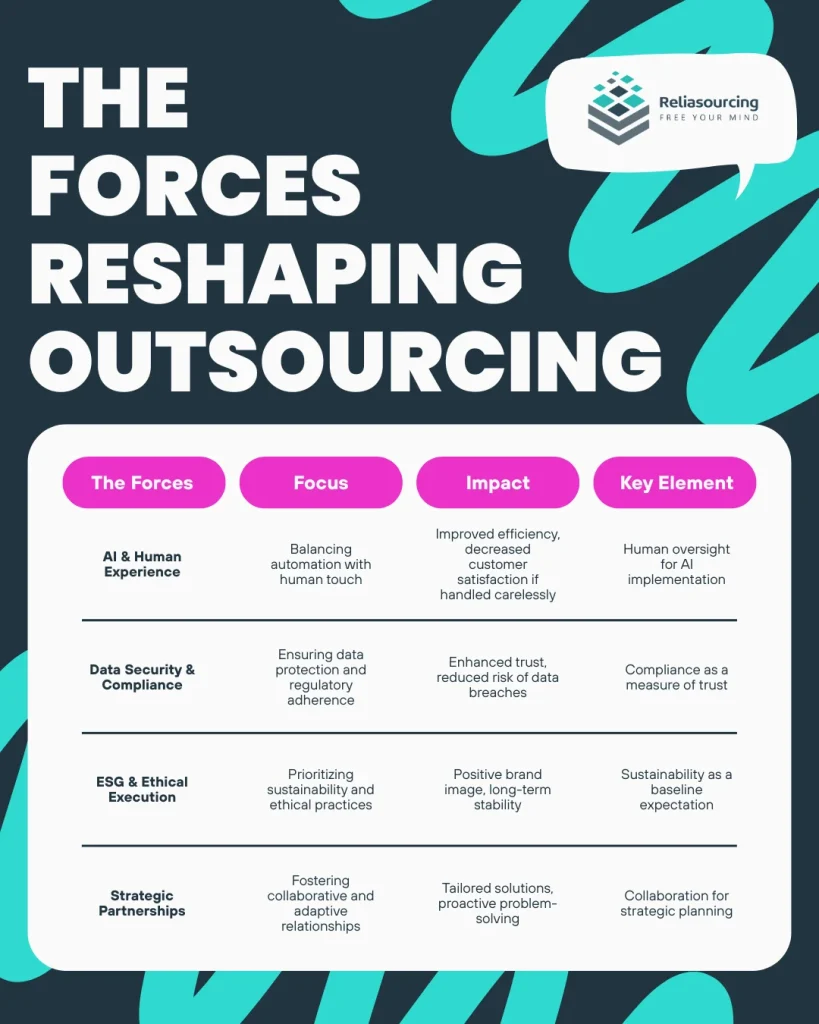
As companies navigate tighter markets and faster innovation cycles, outsourcing has evolved from a focus on efficiency to a far more strategic role. The following forces form the backbone of this transition, each influencing how businesses select partners and design workflows to prepare for long-term growth.
AI Becomes Infrastructure, with Human Experience at the Core
AI moved from a promising add-on to a fundamental component of service delivery. 73% of companies now use AI within their outsourcing frameworks, transforming how providers manage customer conversations by analyzing data and automating administrative tasks.
But the series also revealed a tension: a noticeable 3% decline in customer satisfaction accompanied this rise in automation. Generative AI, despite its popularity, scored the lowest in customer experience rating among emerging technologies.
Behind this dip is a truth businesses cannot simply ignore. While customers want speed, accuracy, and availability, they also want empathy, clarity, and nuance. When AI is left to operate without human oversight, the experience often falters, and this tension surfaced repeatedly across industries, reinforcing a key lesson: AI is powerful, but it is not self-sufficient.
Data Security & Compliance Become Strategic Imperatives
The $4.45 million average cost of a data breach reframed how decision-makers evaluate outsourcing partners. Compliance now marks itself as a measure of trust, competence, and risk management.
Across the series, companies want partners capable of guiding them through global regulatory complexity. Outsourcing firms serve as compliance advisers, helping businesses navigate GDPR, CCPA, HIPAA, and region-specific rules that evolve faster than most internal teams can track. In this sense, security has become integral, extending beyond its technical function.
ESG and Ethical Execution Shift From Aspiration to Expectation
Sustainability and ethics gained new importance in 2024 and 2025. Regulations tightened, consumer expectations rose, and investors began evaluating ESG performance as a proxy for long-term stability. As a result, providers responded by adopting renewable energy, digitizing workflows, launching social impact programs, and integrating ethical AI governance, all of which became a point of meaningful differentiation.
One of the strongest insights from the series was that sustainability is no longer a “nice-to-have.” It is now part of the baseline for global partnerships.
Strategic Partnerships Replace the Traditional Provider Model
A subtle but powerful change defined the industry’s internal dynamics. More than 60% of companies now involve outsourcing partners in strategic planning, signaling a shift from transactional engagements to true alliances.
What companies want now is collaboration:
- Solutions tailored to their industry;
- Insights drawn from cross-market experience;
- Co-created strategies that help them anticipate challenges; and
- Partners who can adjust in real-time as markets shift.
The trend marks the evolution of outsourcing from a support function to a strategic one.
What These Trends Signal for 2025–2026
The shifts explored throughout the series point to a two-year period marked by growing complexity and a higher standard for outsourcing partnerships. Instead of a single sweeping transformation, the trajectory of these trends will be shaped by several converging forces:
AI Will Reshape Roles, Not Replace Them
- Routine tasks will move fully into AI-assisted workflows.
- New categories of work will emerge, such as:
- AI supervisors
- Data governance specialists
- Contextual escalation teams
- CX strategists for AI-human hybrid models
- Companies that prepare their teams for augmented roles—not displaced roles—will adapt fastest.
Compliance Will Become a Deciding Factor
- With regulations tightening across the EU, APAC, and North America, compliance maturity has become a key reason companies choose an outsourcing partner.
- Providers will increasingly act as regulatory interpreters, helping organizations navigate cross-border rules with confidence.
- Outsourcing relationships will expand beyond execution into strategic compliance guidance.
ESG Will Influence Partnership Lifecycles
- Expect outsourcing contracts to include sustainability KPIs, reporting requirements, and ethical governance clauses.
- Companies will gravitate toward providers who demonstrate measurable ESG efforts, including renewable energy use, digital workflows, community programs, and transparent reporting.
Strategic Partnership Will Replace Traditional Vendor Models
- Businesses will lean toward partners who anticipate risk and co-design processes.
- Providers who can support industry-specific challenges—fintech compliance, SaaS churn reduction, e-commerce seasonality—will grow in demand.
- The most successful outsourcing relationships will resemble joint ventures, not vendor agreements.
The Philippines’ Emerging Role in This Next Chapter
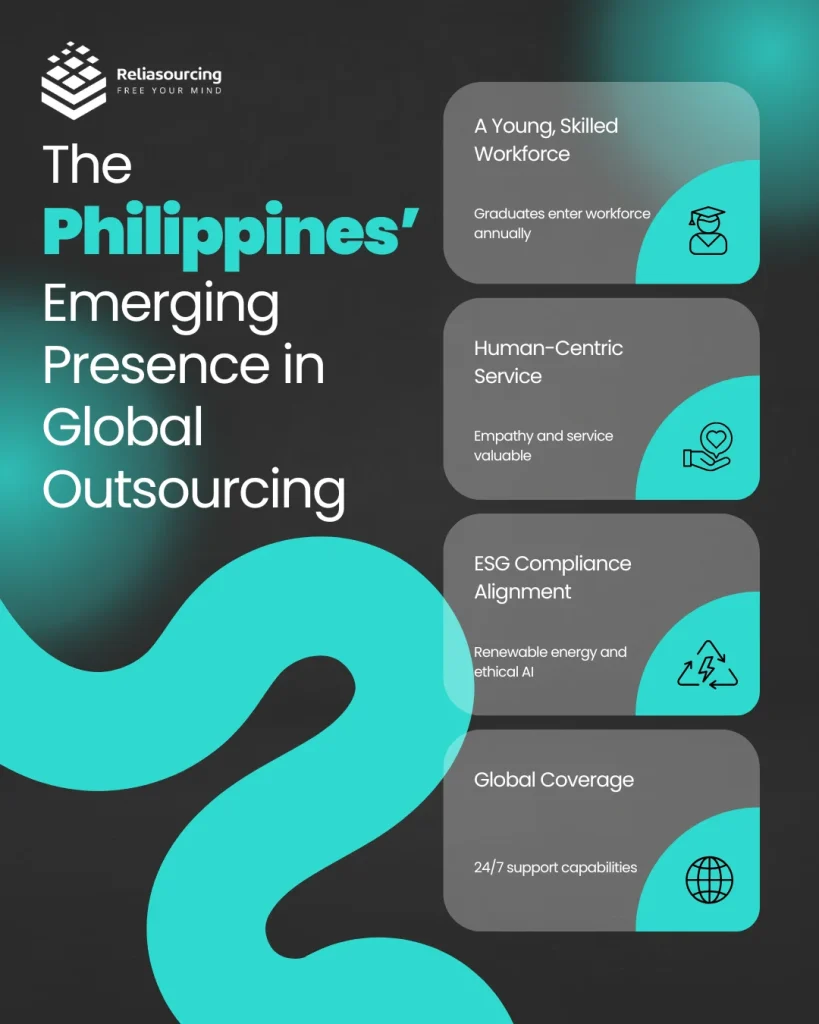
The country’s role in global outsourcing is shifting from volume provider to a strategic capability hub. Several factors shape this rise:
A Young, Skilled, Digital-Ready Workforce
- Over 350,000 graduates enter the workforce every year.
- High English proficiency supports customer-facing and knowledge-heavy roles.
- Filipino professionals are increasingly taking on work tied to SaaS, fintech, data operations, and AI-augmented processes.
Strength in Human-Centric Service
- As more companies adopt hybrid AI models, the Philippines’ deep culture of empathy and service becomes more valuable.
- Businesses now rely on Filipino teams for tone, clarity, and emotional intelligence in customer interactions.
Growing ESG and Compliance Alignment
- Providers are adopting renewable energy and implementing paperless workflows, while also building ethical AI frameworks.
- More organizations are seeking ISO certifications and global compliance benchmarks.
- This positions the Philippines as a trustworthy partner for companies with strict governance requirements.
Global Coverage With Cultural Compatibility
- 24/7 support capabilities and cultural fluency create a natural advantage for time-sensitive operations.
- Philippine teams excel in CX, technical support, and account management, where communication quality directly affects brand reputation.
Executive Takeaways: What Businesses Should Carry Forward
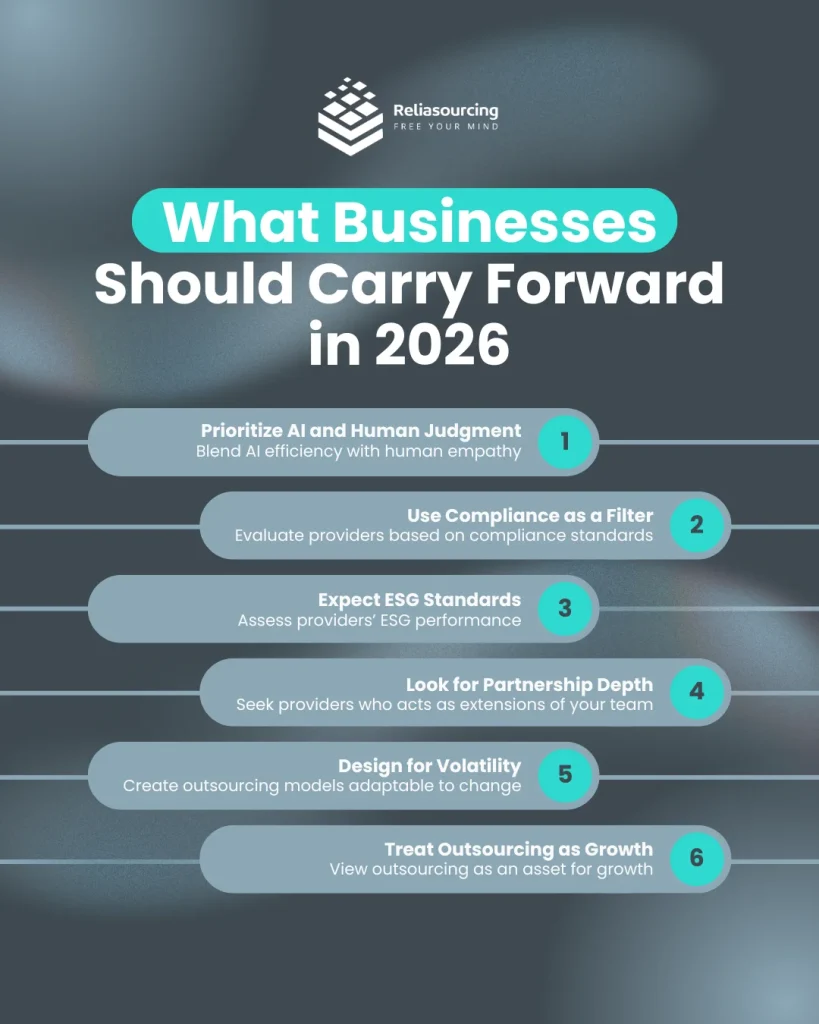
Decision-makers reading the full State of Outsourcing in 2025 series walk away with a richer, more strategic understanding of what outsourcing represents today. The landscape has shifted so significantly that traditional vendor-selection playbooks no longer apply. Instead, leaders should anchor their strategies on the following principles:
1. Prioritize partners who blend AI maturity with human judgment
AI will continue to drive cost efficiency and speed, but customer trust still hinges on empathy, clarity, and creative problem-solving. Providers who design hybrid delivery models, using AI for scale but relying on skilled teams for nuance, will deliver superior outcomes.
2. Use compliance as a first-tier filter
Compliance now offers an advantage. Leaders should evaluate providers based on certifications, audit transparency, zero-trust infrastructure, and evidence of responsible data governance. As compliance requirements expand, the partner you choose becomes a crucial component of your risk management system.
3. Expect ESG standards to shape long-term value
Sustainability and ethics are no longer peripheral considerations since they are integral to corporate identity and market positioning. Leaders should assess providers’ environmental initiatives, labor practices, governance structures, and ESG reporting maturity. Strong ESG performance reduces reputational risk and strengthens stakeholder trust.
4. Look for partnership depth, not just capability breadth
Providers that function as extensions of your internal team, those who co-design processes, contribute market insights, and help anticipate challenges, are significantly more valuable than purely transactional vendors. A strong partner amplifies both speed and strategic foresight.
5. Design outsourcing models built for volatility
Whether facing seasonal shifts, rapid scaling needs, new technologies, or evolving regulations, your outsourcing model must be able to adapt quickly. Prioritize ecosystems that support flexible team structures, multi-skill coverage, cross-functional collaboration, and readiness to adopt new tools.
6. Treat outsourcing as a means for growth, not a cost center
The insights across the series make it clear: outsourcing is no longer something companies do to reduce expenses; now that it’s something they do to compete. When viewed as a vehicle for innovation, risk reduction, and capability expansion, outsourcing becomes a long-term asset.
The takeaways form a blueprint for organizations that want to thrive through the next wave of global operational change.
Reliasourcing’s Place in the Future of Outsourcing
Reliasourcing sits at the intersection of these shifts, not merely responding to the future, but building for it. Our approach reflects a commitment to capability, responsibility, and long-term partnership.
AI-Powered, Human-Centered Operations
- AI is embedded as a support system for agents, not as a replacement.
- Tools are used for efficiency, such as transcription, sentiment cues, and data retrieval, while humans handle context and empathy.
- This allows clients to scale without sacrificing customer trust.
Compliance and Data Protection as Core Identity
- Our infrastructure and processes are designed with compliance at the center.
- Clients gain a partner who treats data governance as a shared responsibility.
- Transparency, audit readiness, and security-first design guide our day-to-day operations.
Ethical and Sustainable Practices
- Community impact programs expand local opportunities and digital access.
- Our operational decisions—hybrid work, digitized processes, skill development—are aligned with modern ESG expectations.
- These principles strengthen the trust our clients place in us.
A Partnership Model Built for High-Growth Companies
- We integrate directly with clients’ strategies and workflows.
- Teams adapt quickly to shifts in market conditions, product launches, or scaling needs.
- The partnership extends beyond staffing into advisory support, capability building, and co-owned success metrics.
Conclusion: The Outsourcing Landscape Ahead
As we approach the end of 2025 and the series comes to a close, one key takeaway remains: outsourcing is entering a maturity stage characterized by responsibility and collaboration. The industry’s future will not be shaped by who can deliver tasks the fastest or the cheapest, but ultimately by who can provide the capability and foresight enough to gain client trust.
The State of Outsourcing in 2025 series captured a world in transition, one where businesses are learning to scale through technology, strengthen their operations through compliance, and lead with their values. As you plan for the year ahead, we invite you to revisit the full set of articles, reflect on the opportunities, and consider how the right partnership can help you build the next chapter of your global strategy.
When you’re ready to design a smarter, more resilient approach to global operations, the Reliasourcing team is here to help. Connect with us today.