A young Software-as-a-Service (SaaS) company can look efficient from the outside while carrying a surprising amount of operational strain behind the scenes: Headcount grows after a funding round, hiring picks up after a product launch, new managers step in before internal systems are fully documented. Somewhere along the way, HR becomes a patchwork of spreadsheets, shared folders, Slack messages, and founder memory. Nothing seems fully broken, but nothing feels especially steady either, and growth is usually what exposes the issue.
A team of 10 can work around informal HR processes for a while, however, a team of 30 or 40 usually cannot. New hires need a smoother start and managers need clearer guidance, in addition to documentation needing to be current and accessible. Payroll coordination, compliance support, employee recordkeeping, and onboarding start pulling time away from product, customer growth, and operations.
At that stage, HR outsourcing becomes relevant because it gives SaaS companies a way to put structure in place before small operational gaps turn into bigger growth problems. Founders who have already explored why companies outsource work often arrive at a similar question in people operations: how do you support hiring, onboarding, compliance, and team growth without building a full internal HR function too early?
This article looks at where that pressure starts, what waiting can cost, how global hiring raises the stakes, and why outside HR support often makes sense sooner than many SaaS leaders expect.
What Is HRO and What Is a SaaS Company?
Human Resources Outsourcing, or simply HRO, refers to the practice of handing certain HR responsibilities to an external partner. Support may include onboarding, payroll coordination, employee documentation, HR administration, hiring process support, and compliance-related tasks.
A SaaS company, meanwhile, sells software through a subscription-based model, and early-stage SaaS businesses tend to stay lean for as long as possible. Teams are expected to move fast, wear multiple hats, and keep overhead in check, which is a setup that works well until people operations begin demanding more consistency than the company has built internally.
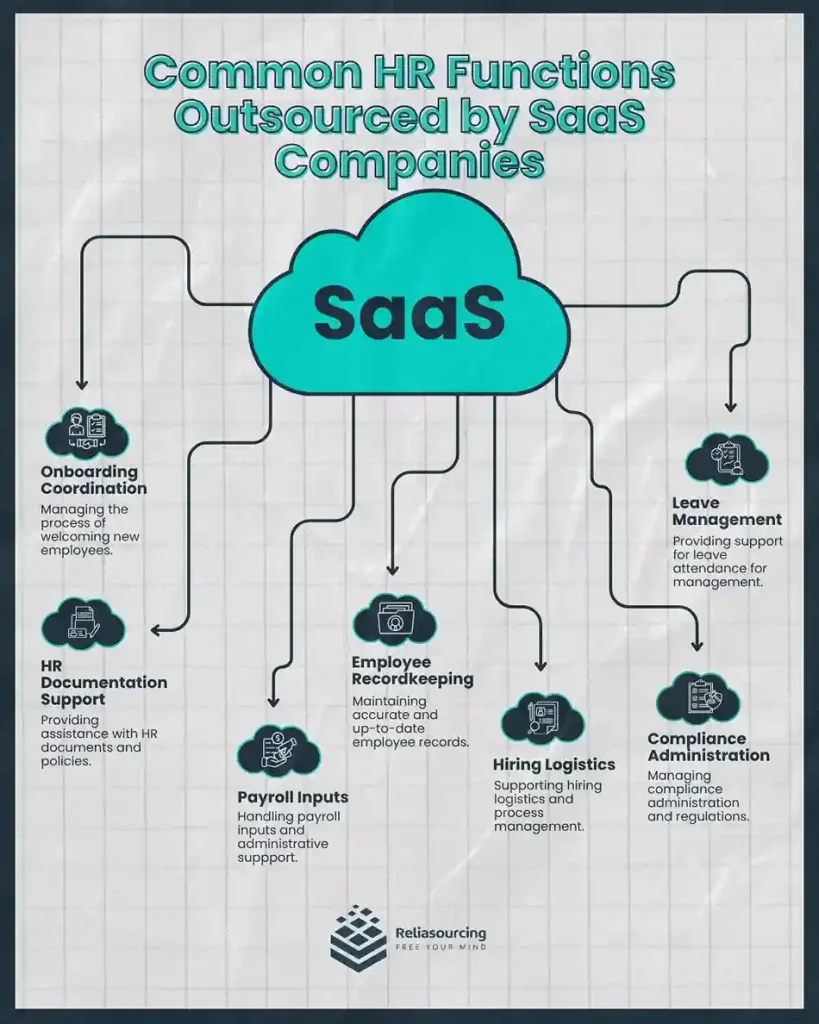
Common HR functions a SaaS company may outsource
- Onboarding coordination
- HR documentation and policy support
- Payroll inputs and administrative support
- Employee recordkeeping
- Hiring logistics and process support
- Compliance administration
- Leave and attendance management support
Why SaaS companies feel HR pressure early
- Hiring can accelerate quickly after revenue or funding milestones.
- Founders and operators often carry HR tasks on top of core business work.
- Teams may spread across locations before formal systems are ready.
- Internal HR hiring can feel premature even when HR support is already needed.
A useful way to think about HRO is as a middle path. A company does not need to choose between doing everything in-house and overbuilding too soon. Plenty of founders already understand that principle from business process outsourcing, and HR is often the next area where the same logic applies.
The HR Strain Behind Rapid SaaS Growth
Most SaaS teams do not experience HR strain as one dramatic failure because pressure tends to show up in smaller signs first. Many early-stage founders describe this as startup messiness but a more useful term is HR debt.
Early Warning Signs of HR Debt
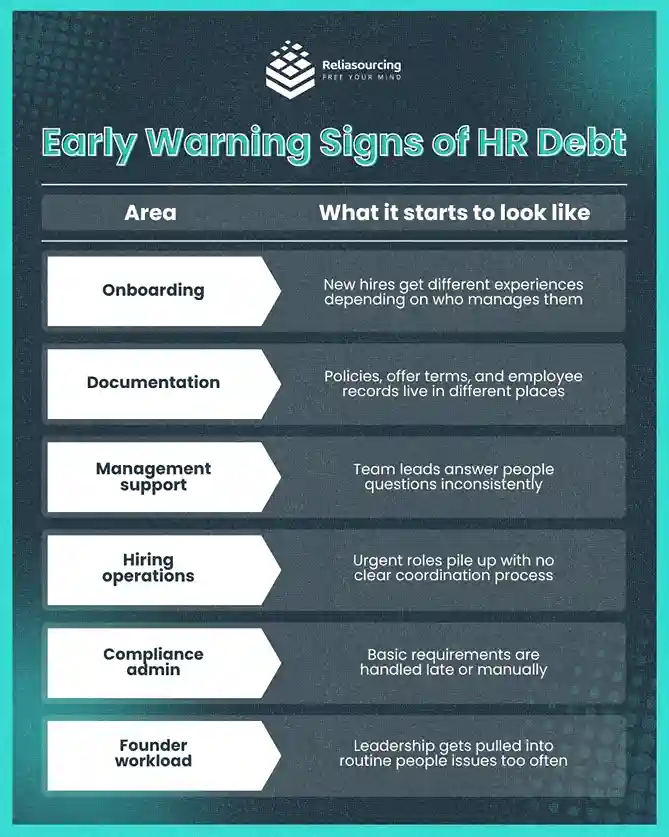
HR debt builds when people operations are deferred because other priorities feel louder, such as when product deadlines are immediate, revenue targets feel urgent, or customer delivery takes center stage. HR gets handled later, then later again, until the business is carrying a backlog of loose processes that are harder to fix than they would have been six months earlier.
Consider a hypothetical SaaS team growing from 15 to 45 employees in under a year. At first, informal systems may seem manageable. Later, every missing process starts affecting something else:
- Onboarding becomes uneven
- Managers improvise policy decisions
- Hiring support becomes reactive
- Employee experience starts depending on who happens to be available
- Leadership time gets consumed by repeat admin issues
Operational drag often enters quietly, and employee confidence usually notices before leadership does.
The Hidden Costs of Waiting Too Long to Fix HR Operations
Waiting can seem cheaper in the short term. In practice, delayed HR support often creates costs that are harder to see at first.
What founders think they are saving
- Budget
- Headcount
- Internal overhead
- Time spent setting up formal systems
What delayed HR support often costs instead
- Slower hiring
- Repeated onboarding mistakes
- Inconsistent employee handling
- More founder and manager interruption
- Higher cleanup effort later
- Greater compliance exposure
A simple comparison makes the point clearer.
| Decision | Short-term effect | Long-term effect |
| Delay HR support | Keeps spending low for now | Creates process gaps that grow with headcount |
| Add structured support early | Adds some operational cost | Improves consistency and reduces future rework |
Moreover, unstructured HR does not stay small for long. One missing process turns into several. One rushed hire creates onboarding friction for a manager who is already overloaded, one undocumented practice turns into team-wide inconsistency.
A practical founder question is not just, “Can we wait?” A better question is, “What becomes harder to fix if we keep waiting?”
Common hidden costs of HR debt in SaaS
- Leadership distraction. Founders and operators end up answering repeat questions, reviewing paperwork, and patching issues that should already have a process.
- Manager inconsistency. New managers often make judgment calls without enough documentation or HR guidance.
- Employee friction. Staff notice when policies feel unclear, onboarding feels rushed, or support depends on who they ask.
- Hiring slowdown. Recruiting momentum weakens when coordination, approvals, and documentation are still improvised.
Founders evaluating hr outsourcing often realize the value is not limited to admin relief for cleaner HR systems also protect momentum.
How Global Hiring Changes the HR Equation for SaaS Companies
International hiring changes the picture much earlier than many SaaS founders expect. A company may begin with a local team, then discover that the best engineer, customer success lead, or operations hire is based overseas. Access to talent improves, but HR demands increase as well with contracts, payroll coordination, onboarding, local employment requirements, and employee support, all requiring more discipline once hiring crosses borders.
Global hiring raises new questions fast
- Who handles compliant employment paperwork?
- How are onboarding standards kept consistent across countries?
- What internal team owns payroll coordination and documentation?
- How does a small SaaS company hire abroad without building an entity first?
A lean team can manage one international hire informally, while several hires across markets create a different level of responsibility.
Why global hiring often pushes SaaS companies toward outside support
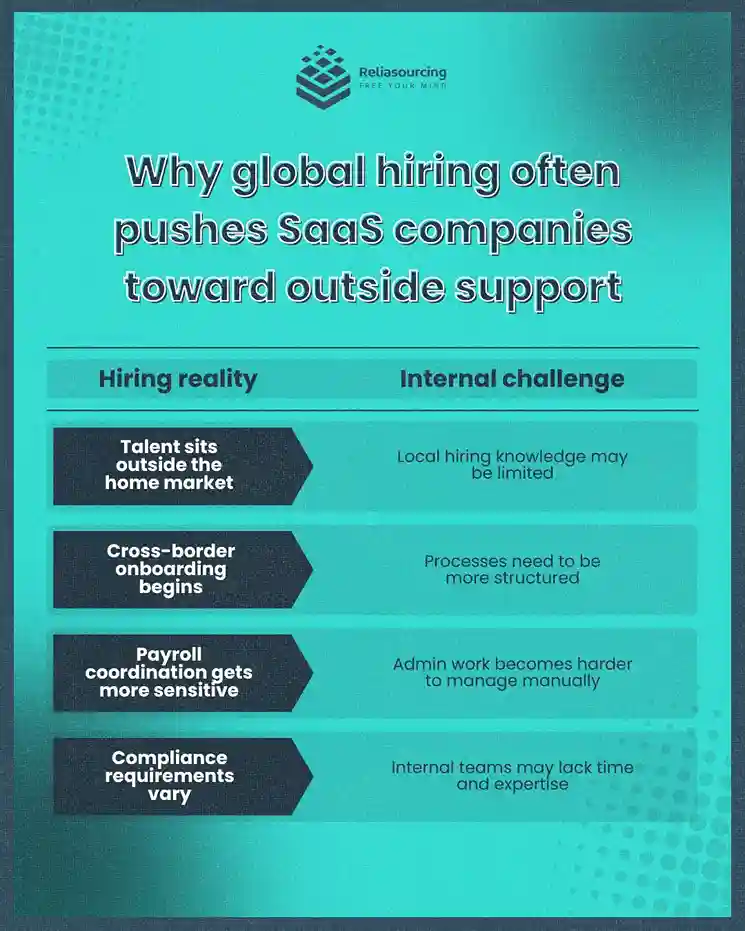
Employer of Record support can make that transition easier. An Employer of Record partner legally employs talent in another country on the company’s behalf, allowing the SaaS business to direct day-to-day work without setting up a local entity first.
The model becomes especially relevant for founders who want access to global talent without building internal HR infrastructure too early. Teams exploring broader international staffing options often end up outsourcing in the Philippines for the same reason: growth needs support, but overhead still has to stay sensible.
Frequently Asked Questions
What is HRO or HR Outsourcing?
HRO, or HR Outsourcing, means assigning selected Human Resource responsibilities to an external provider instead of handling every people-ops task fully in-house. Early-stage SaaS companies usually use it to create more consistency across onboarding, documentation, payroll support, and employee administration without committing too early to a full internal HR department.
When should a SaaS company outsource HR?
A SaaS company should outsource HR support once people operations begin slowing down hiring, disrupting onboarding quality, or pulling founders and managers too far into routine HR work. Fast headcount growth, scattered documentation, cross-border hiring, and repeated admin bottlenecks are usually clear signs.
Is HR outsourcing cost-effective for startups and scale-ups?
HR outsourcing tends to be cost-effective for startups and scale-ups when the alternative is founder overload, repeated process mistakes, or delayed hiring. A startup may not yet need a full internal HR team, but it still needs structure. Outside support can provide that structure in a more flexible way while helping leadership protect time and focus.
How does HR outsourcing support international hiring?
HR outsourcing supports international hiring by giving growing SaaS companies more consistent operational support across onboarding, documentation, payroll coordination, and employee administration. Once cross-border hiring becomes part of the growth plan, structured support reduces friction and helps the company move with more confidence.
What is the difference between HR outsourcing and EOR?
The difference between HR outsourcing and EOR is that the former usually refers to delegating HR functions to an external partner, while the latter refers to a model where another company legally employs workers on the business’s behalf in another country. A SaaS company may use HRO to improve internal people operations and use EOR when legal international employment support is also required.
How Reliasourcing Supports Growing SaaS Companies
Reliasourcing supports growing SaaS companies with practical HR support that fits the early growth stage. A young company often does not need a large internal HR function right away, but it does need cleaner processes, steadier documentation, and more dependable operational support. Support can help SaaS teams improve:
- Onboarding consistency
- Employee admin workflows
- HR documentation structure
- Hiring coordination
- Day-to-day people operations discipline
International hiring support can also be part of the picture. Employer of Record solutions help SaaS businesses hire across borders without building local entities before the business is ready. Founders and operators looking for a measured next step can contact us to explore what support makes sense for their current stage.
Final Thoughts
Early HR gaps rarely stay minor for long since growth tends to turn small workarounds into larger operating problems.
The factors make HR outsourcing a feasible and practical early move for many SaaS companies since the benefits do not stop at time savings. Better onboarding, clearer documentation, steadier compliance support, and smoother hiring operations all make growth easier to manage.
A founder does not have to wait for HR to become a problem before fixing it. Early structure often prevents later cleanup, so for a SaaS business trying to scale without building too much overhead too soon, HR outsourcing is usually the smarter move.