Human Resources (HR) outsourcing has become the next strategic move for modern businesses that want to grow with control and consistency. Founders and operators face pressure from multiple directions at once, including hiring in competitive markets, managing compliance across jurisdictions, supporting distributed teams, and protecting employee data. With HR sitting at the center of all those pressures, the value of the service becomes evident for day-to-day operations as well as long-term stability.
Growth exposes cracks in people operations faster than most teams expect, and early shortcuts around payroll, contracts, or onboarding may hold for a short period. But problems surface once headcount rises or investors enter the picture, hence HR outsourcing responds to that reality by giving businesses access to structure, expertise, and execution discipline, all without slowing momentum.
The article breaks down the strategic benefits of HR outsourcing through a practical lens. Each benefit explains why it matters operationally, how it applies at different growth stages, and what leaders should look for when evaluating providers. Outsourcing is no silver bullet, but it definitely supports business resilience and employee trust when done well.
1.) Strategic Focus: Freeing Leaders to Work on Growth, Not Admin
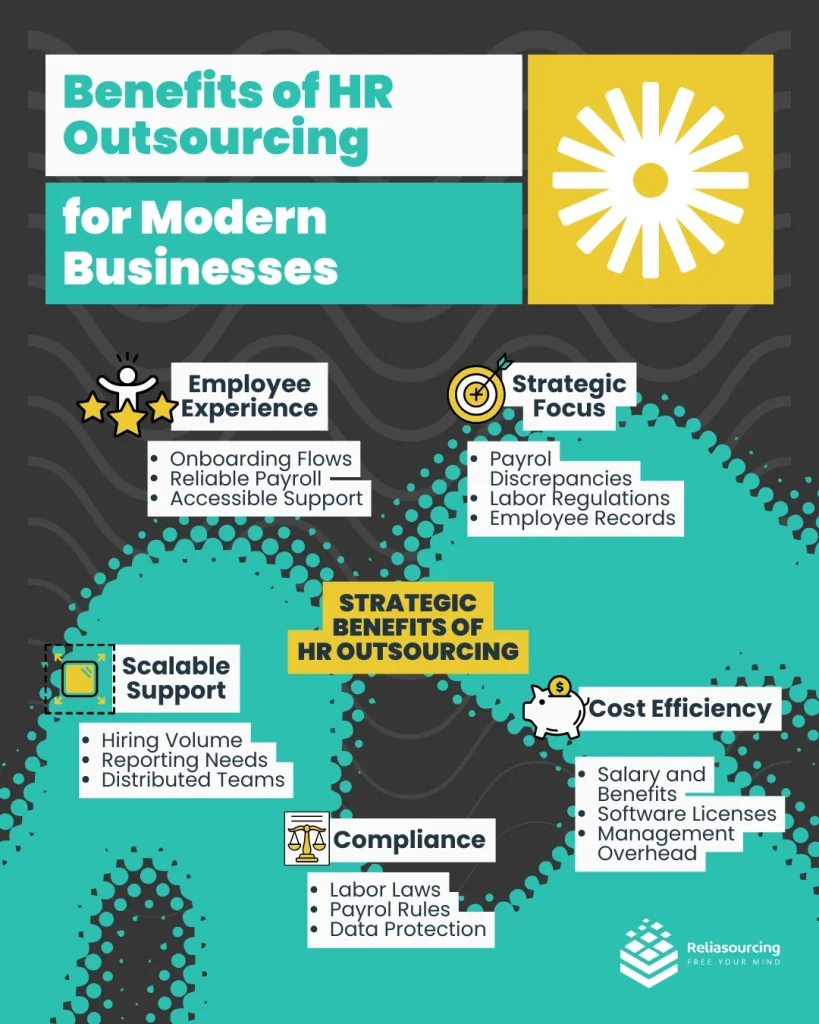
Founders rarely plan to spend time resolving payroll discrepancies, interpreting labor regulations, chasing incomplete employee records—but the reality often looks different. HR administration expands quietly until leadership attention is suddenly pulled into tasks that feel urgent but add little to no value.
Hence, HR outsourcing restores focus by shifting operational ownership away from leadership teams since routine processes such as onboarding documentation, leave management, payroll coordination, and policy updates are more effective when they move into structured workflows handled by specialists. Through this, leadership essentially regains time to work on product, revenue, partnerships, and culture setting, which are business activities that are revenue-generating.
Early-stage companies, in fact, often feel this benefit first. A founder managing ten people may handle HR personally, yet scaling to thirty employees changes the equation. Outsourcing, then, creates breathing room without requiring a full internal HR department. Meanwhile, larger organizations experience a different version of the same benefit, wherein executives stop firefighting operational issues and start using HR insights to guide workforce planning and performance decisions.
For companies already outsourcing operational functions through business process outsourcing, alignment with broader strategies reinforces consistency across teams and vendors, reducing fragmentation, instead of just adding another layer of complexity.
2.) Cost Efficiency Without Compromising Expertise
Cost reduction motivates many first conversations about HR outsourcing, yet savings alone rarely justify the decision in the long term. On the contrary, the real value lies in predictable access to experienced professionals without the overhead of full-time hires, tools, or constant retraining.
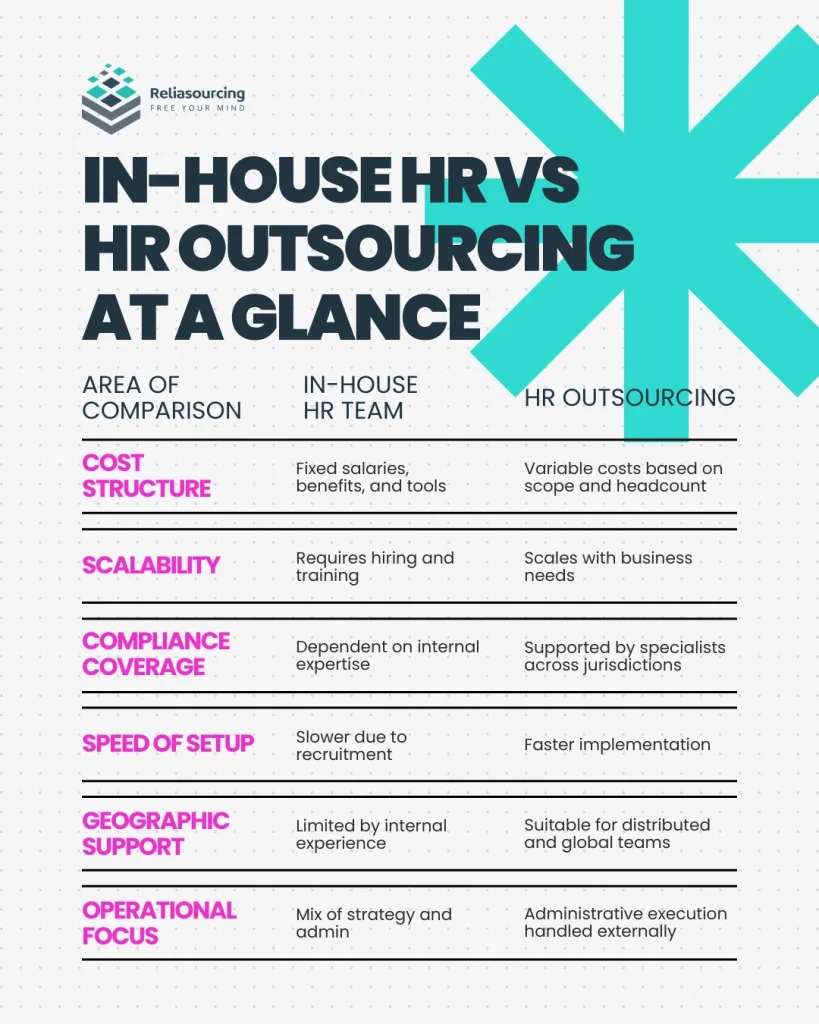
An internal HR hire brings salary, benefits, software licenses, and management overhead, but outsourcing spreads those costs across a team that already maintains compliance knowledge, process discipline, and performance benchmarks. With this, businesses gain coverage across payroll, employee relations, and reporting at a stable monthly cost.
Startups benefit by avoiding premature senior hires while still accessing professional-grade execution. And consequently, scale-ups gain cost control as headcount rises, preventing HR spend from growing faster than revenue. In addition, enterprises use outsourcing to standardize processes across regions while keeping internal HR focused on leadership development and strategy.
Value also comes from reduced error costs from payroll mistakes, misclassified contracts, to missed filings, all of which create expenses far beyond direct HR spend. In effect, decision-makers go for a reliable outsourcing partner to limit those risks while delivering consistency.
Leaders comparing internal and outsourced models often revisit why companies even outsource work in the first place, once total cost and risk exposure become clear.
3.) Compliance, Risk Management, and Peace of Mind
Compliance remains one of the strongest arguments for HR outsourcing, especially as regulations evolve and enforcement tightens. Labor laws, payroll rules, benefits requirements, and data protection obligations vary by location and change frequently, and missteps in this area are among the many ways companies can expose themselves to fines, disputes, and reputational damage.
Accordingly, HR outsourcing providers maintain dedicated compliance teams focused on accuracy and monitoring. Payroll calculations follow documented checks. Employment contracts align with current labor standards. Data handling follows defined security protocols. Audits, essentially, become manageable than disruptive.
Trust matters most when sensitive information is involved. Providers that operate under certifications demonstrate discipline beyond verbal assurances. As a matter of fact, Reliasourcing is certified across the following:
- ISO 9001:2015 for quality management;
- ISO/IEC 27001:2022 for information security; and
- ISO 22301:2019 for business continuity.
Certifications like these signal mature processes that protect employee data and maintain service continuity during disruptions.
Moreover, growing companies often underestimate how quickly compliance exposure scales with headcount, with investors and enterprise clients increasingly scrutinizing these areas during due diligence. For this reason, HR outsourcing reduces uncertainty and builds confidence without having to overburden internal teams.
For organizations hiring across borders or entering new markets, pairing HR outsourcing with an Employer of Record model simplifies employment compliance while preserving operational speed.
4.) Scalable HR Support as Companies Grow
HR requirements shift as businesses expand: hiring volume increases, reporting needs change, and workforce distribution becomes more complex. As a result, internal HR teams often struggle to scale at the same pace as operations.
For that matter, HR outsourcing introduces flexibility that internal models rarely match. Support levels adjust based on headcount, hiring cycles, and geographic reach, where new processes roll out without lengthy recruitment cycles. And to top it all off, reporting adapts as leadership needs to.
However, it remains a fact that distributed teams create additional challenges. Remote employees expect consistent onboarding, timely support, and clear policies regardless of location. In response, outsourced HR teams already operate across time zones and jurisdictions, making coordination smoother.
The Philippines continues to stand out as a strong destination for HR outsourcing due to deep HR talent pools, strong English proficiency, cultural alignment with Western business practices, and cost efficiency at scale. Businesses exploring outsourcing in the Philippines often find that the combination of capability and stability is difficult to replicate elsewhere.
Scalability also supports business continuity, as workforce changes, mergers, or restructuring events can place heavy strain on HR. And so, outsourcing ensures coverage remains intact during periods of transition.
5.) Improved Employee Experience and Retention
Lastly, employee experience rarely improves by accident. HR outsourcing contributes to this by standardizing processes that shape how employees interact with the company from day one.
It is imperative for employees to feel supported rather than managed through ad hoc decisions, so it’s important to:
- Clear onboarding flows to set expectations early;
- Ensure reliable payroll to build trust;
- Have accessible HR support to resolve issues quickly; and
- Maintain consistency across policies to reduce confusion and frustration.
Now, retention ties directly to these fundamentals since teams that trust HR systems focus more energy on performance and collaboration. Managers spend less time troubleshooting administrative issues and more time actually developing people.
Growth-stage companies often feel the impact most strongly, with early employees noticing when processes break under scale. With the help of outsourcing, this stabilizes operations before dissatisfaction turns into attrition. For enterprises, outsourcing improves the experience by enforcing uniform standards across departments and locations, ensuring employees receive the same level of support regardless of team or region.
FAQ About HR Outsourcing
What is HR outsourcing and how does it work?
HR outsourcing involves delegating specific HR functions such as payroll, onboarding, compliance, and employee support to an external provider. The provider operates under agreed processes while aligning with company policies and culture.
Is HR outsourcing suitable for startups and SMEs?
HR outsourcing is suitable for startups and SMEs that need professional HR support without building a full internal team. The model scales as headcount grows, making it suitable across stages.
What HR functions can be outsourced?
HR functions that can be outsourced include payroll processing, benefits administration, onboarding, compliance reporting, employee relations support, and HR data management.
How secure is outsourced HR data?
Outsourced HR data security depends on provider standards. Certified providers following ISO/IEC 27001:2022, and other similar standards, maintain structured controls for data access, storage, and incident response.
How Reliasourcing Supports Businesses with HR Outsourcing
Reliasourcing approaches HR outsourcing as an execution partnership. Support focuses on reliability, clarity, and respect for both leadership priorities and employee experience.
Teams operate with documented processes, quality controls aligned with ISO 9001:2015, and security frameworks grounded in ISO/IEC 27001:2022. Business continuity planning under ISO 22301:2019 ensures service stability during operational disruptions.
Philippines-based HR teams deliver consistent execution while integrating closely with client workflows, enabling services to scale alongside growth without introducing unnecessary friction. Extended capabilities, including Employer of Record support and managed service models, enable faster hiring and market entry without overcomplicating employment structures.
To sum it all up
HR outsourcing delivers strategic value when aligned with growth goals rather than treated as a cost shortcut: 1) focus improves when leaders step away from administrative burden, 2) risk decreases through disciplined compliance and data protection, 3) scalability supports expansion without constant restructuring. All this ensures employee experience strengthens through consistency and reliability.
Founders and operators benefit most when outsourcing partners act as execution extensions. Evaluating readiness, priorities, and internal gaps likewise helps clarify where outsourcing fits within broader operational strategy.
Businesses considering next steps often begin by reviewing existing people operations and identifying friction points. From there, conversations around HR outsourcing become practical than theoretical. For teams ready to move forward, opening a discussion through our contact form creates space to explore options grounded in real operational needs.