
Growth-stage startups often discover that operational strain appears quietly, with systems growing more layered, security obligations tightening, and compliance expectations becoming less forgiving. Internal teams that once handled everything now spend more time maintaining infrastructure than moving the business forward. As a result, managed service providers (MSPs) have emerged as a practical solution to that pressure.
This article explains what a managed service provider is in modern terms, how MSPs operate in 2026, and why scaling companies increasingly rely on them. Learn how MSPs differ from traditional outsourcing models, what services are most important today, how to evaluate providers, and how Reliasourcing supports global clients through structured managed services in the Philippines.
Why MSPs Matter in 2026
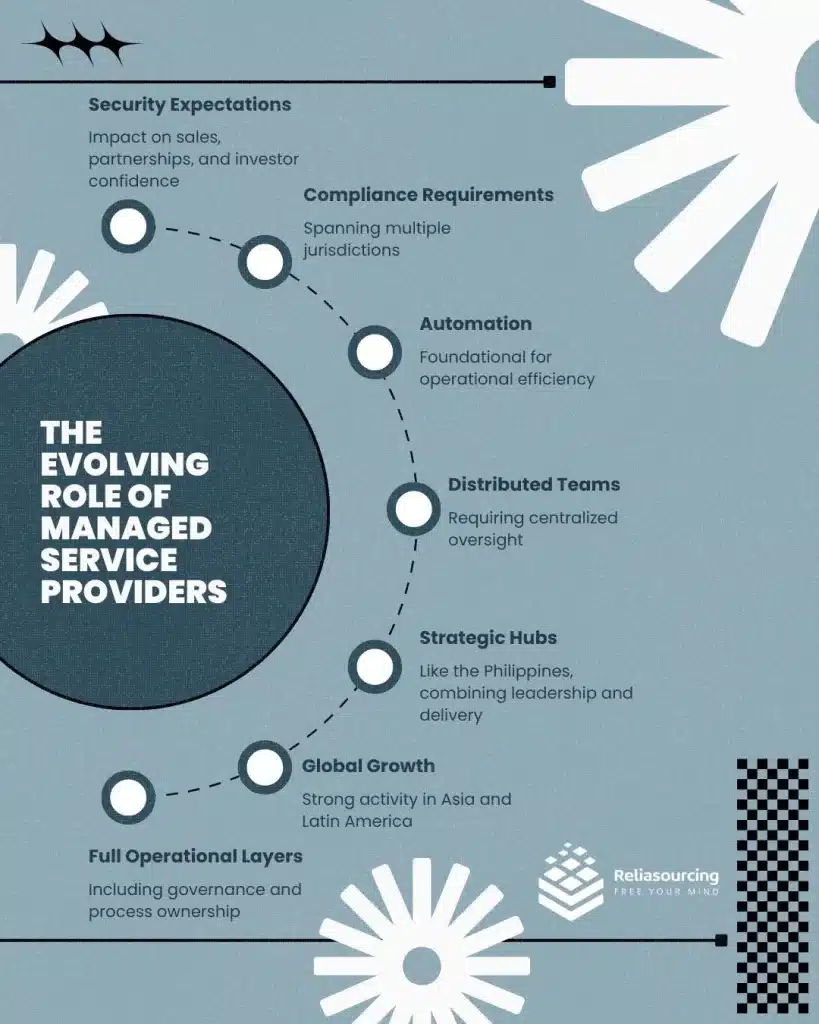
Operational demands now scale faster than employee headcount. Growth-stage companies operate across a broader range of tools, regions, and regulatory environments than ever before, and several shifts explain why MSPs matter more today than in previous years:
- Security expectations now affect sales cycles, partnerships, and investor confidence;
- Compliance requirements span multiple jurisdictions, even for mid-sized teams;
- Automation has become foundational rather than optional; and
- Distributed teams require centralized oversight without slowing execution.
Early managed services focused on IT upkeep, but modern providers in the Philippines now manage full operational layers, including governance and process ownership. MSP adoption has grown globally, with strong activity in Asia and parts of Latin America, where providers support operations. Countries like the Philippines now function as strategic MSP hubs, combining leadership, service management, and delivery under one operational structure. Businesses already exploring outsourcing in the Philippines often view MSPs as the next step once scale demands tighter control and long-term accountability.
What Is a Managed Service Provider?
A managed service provider (MSP) assumes ongoing responsibility for defined business functions under formal service agreements. The relationship centers on accountability rather than task completion.
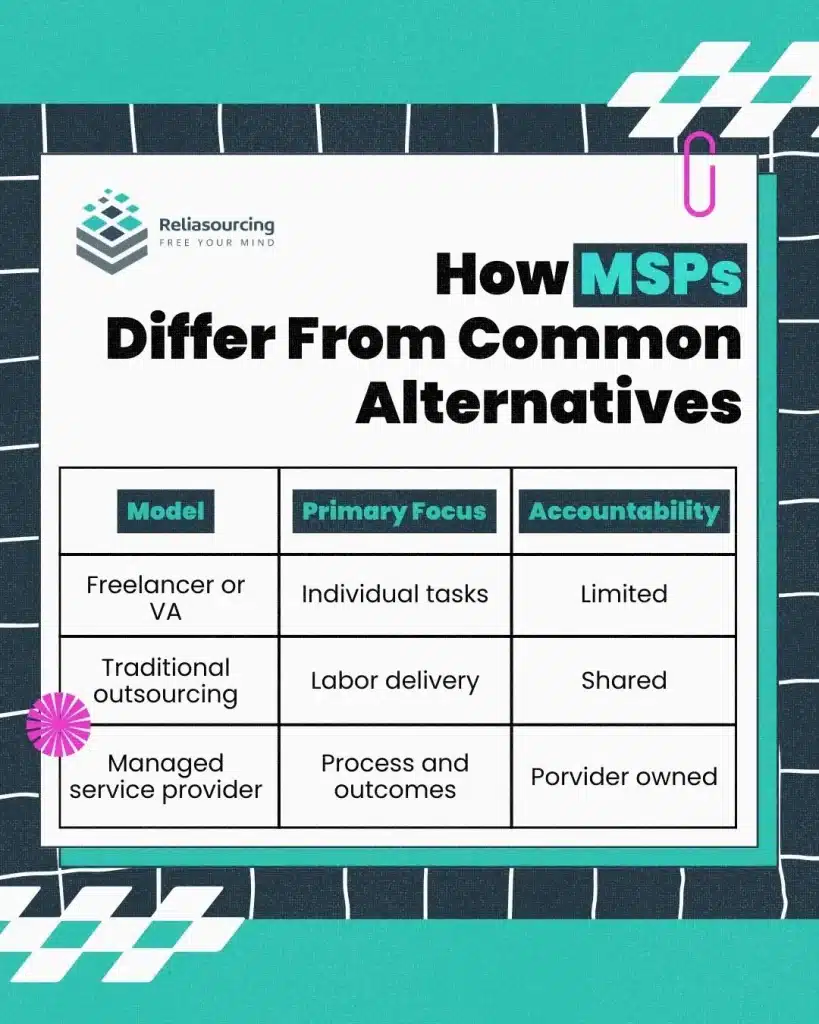
MSPs operate under service-level agreements that define response times, escalation paths, reporting requirements, and performance metrics. The providers manage continuity, documentation, and improvement cycles. Businesses that compare managed services and outsourcing often notice that MSPs reduce operational ambiguity by clearly assigning ownership and accountability.
Key Services MSPs Offer Today
Managed services in 2026, especially in the Philippines, extended well beyond IT helpdesks, with providers supporting operational backbones that allow internal teams to stay focused on growth.
Common managed service categories
- IT operations and cloud management
System monitoring, updates, access control, and incident handling - Cybersecurity oversight
Threat monitoring, vulnerability management, and security governance - Compliance and audit support
Policy enforcement, reporting, and readiness tracking across regions - Automation maintenance
Workflow monitoring, tool integration, and exception handling - Workforce and HR support (provider-dependent)
Payroll coordination, employment compliance, and benefits administration
Many providers integrate this workforce service, especially for companies expanding globally. The operational value behind this lies in the long-term benefits of managed services, particularly in terms of predictable costs and reduced internal strain.
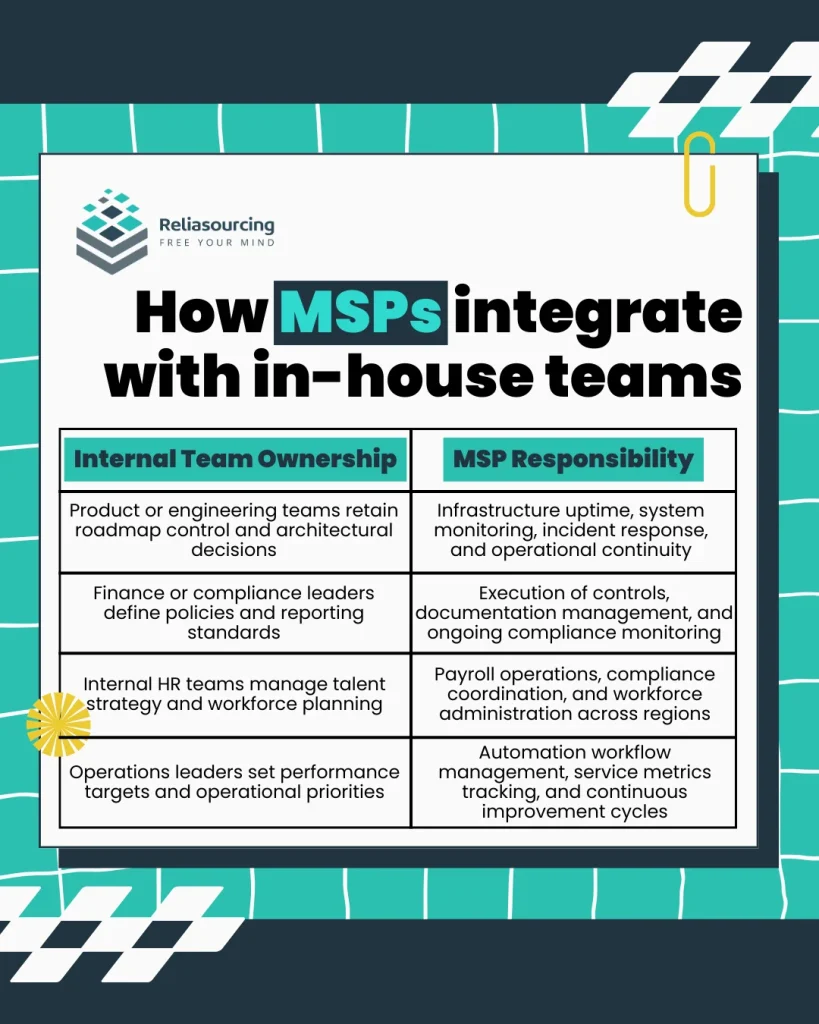
The integration model keeps strategic decision-making inside the company while assigning execution, monitoring, and operational discipline to the MSP. Growth-stage startups often prefer this structure since it reduces internal load without sacrificing control, especially as teams and systems expand across multiple regions.
How to Choose the Right Managed Service Provider
Selecting an MSP requires a structured evaluation rather than a feature comparison.
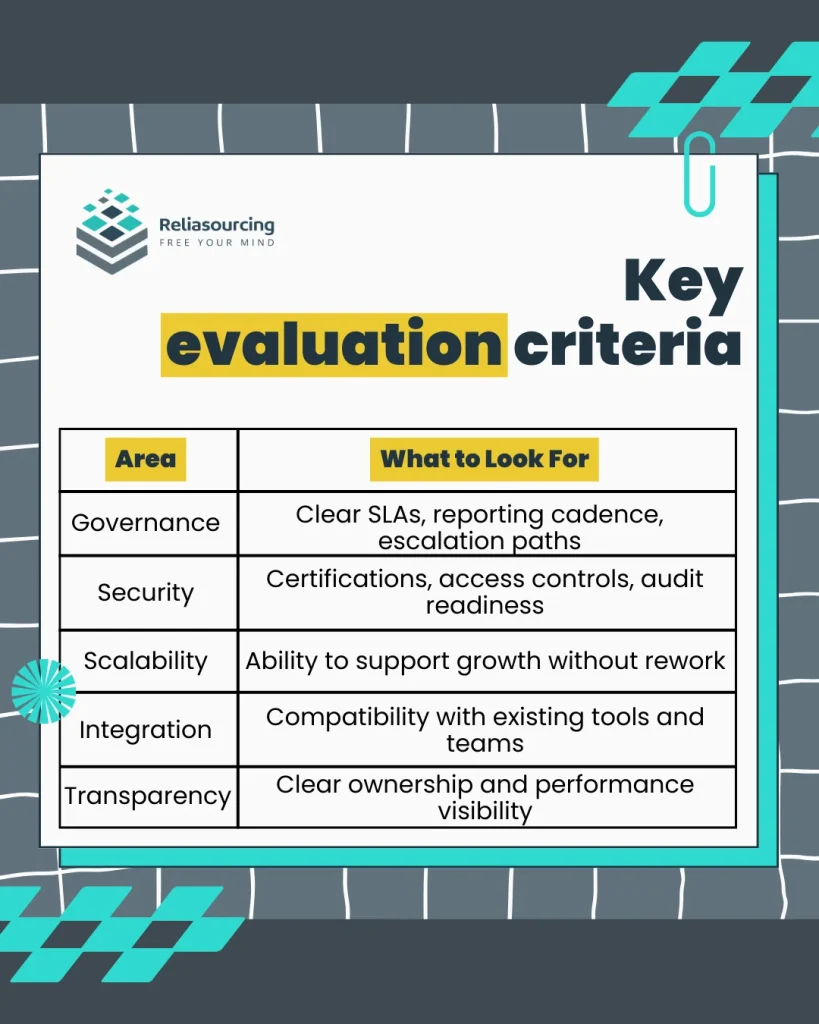
Questions buyers often miss
- Who owns failures when systems cross vendors or tools?
- How service performance is reviewed and adjusted over time?
- What happens when transaction volume doubles?
- How internal teams interact with MSP leadership?
Explicit comparison helps avoid confusion between MSPs and traditional outsourcing providers. MSPs manage functions and outcomes rather than supplying labor alone, a distinction from the usual outsourcing format that becomes critical as complexity grows.
Frequently Asked Questions
What does a managed service provider do?
A managed service provider oversees defined operational functions on an ongoing basis. Services often include IT operations, security monitoring, compliance oversight, and automation maintenance. Providers also operate under service-level agreements (SLAs) that define accountability and performance standards, a structure that supports consistency as businesses scale.
How much do MSP services typically cost?
MSP services typically cost around promising margins, as the pricing usually follows monthly retainers based on scope and service depth. Some providers charge per user or system, while others bundle services under fixed agreements. Predictability often improves compared to internal staffing since responsibilities are clearly defined, and costs align with outcomes rather than hours worked.
Are MSPs the same as outsourcing or BPO companies?
MSPs differ from outsourcing and BPO models in terms of ownership. On one hand, outsourcing supplies labor, and on the other, MSPs manage processes, governance, and results. The distinction becomes more visible as regulatory and operational demands increase.
Why do companies prefer MSPs over in-house teams?
Companies choose MSPs to gain continuity and expertise without expanding internal headcount indefinitely. Providers bring established processes and monitoring frameworks in place, so internal teams retain focus on strategy, product, and customer experience.
How Reliasourcing Provides Managed Services to Clients Globally
Reliasourcing delivers managed services through structured operational ownership rather than task-based delivery. Our service models cover governance, compliance support, and continuity across global teams, with support tailored directly for your needs. With our team certified across three ISO certifications—quality management, information security, and business continuity—Reliasourcing serves as your modern MSP partner in business growth.
Situated in the Philippines, Reliasourcing, as a managed service provider, works in Asia’s strategic hub for leadership, service management, and delivery work in tandem. The structure and culture combined support clients in SaaS, fintech, gaming, and eCommerce sectors that require reliability and oversight.
Service quality at Reliasourcing is maintained through structured onboarding, consistent training programs, and clearly defined delivery standards. And with teams operating within documented processes that support accountability, service consistency, and measurable performance, continuous skills development enables service teams to stay aligned with changing tools, compliance expectations, and operational demands. Meanwhile, scalable delivery models support growth without service disruption, a structure that gives companies confidence that managed services remain dependable as operational scope and volume increase.
Final Thoughts
Managed service providers have become foundational partners for growth-stage startups in 2026, and this growing relevance is expected to continue into 2026. Operational stability, compliance discipline, and system reliability now influence growth just as much as product development.
The Philippines continues to strengthen its role as a strategic MSP hub, offering governance and leadership that propels execution. Companies seeking structure without internal overload benefit from managed service models built for scale.
To explore how managed services will support your next phase of growth, contact us today. We’d be happy to help you.