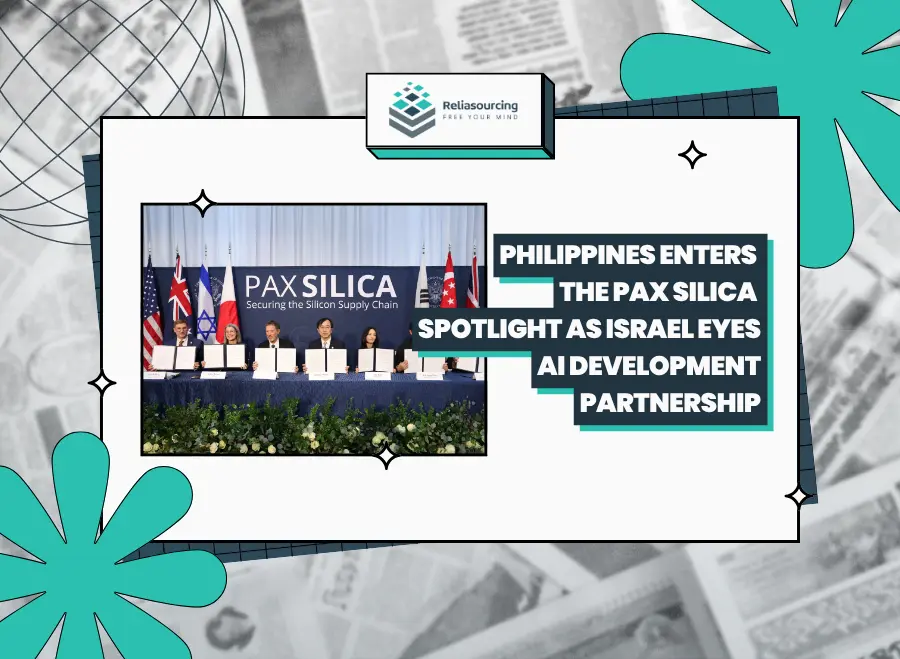
The Philippines is drawing fresh international attention as the United States-led Pax Silica initiative is beginning to take shape in Southeast Asia. At the center of the conversation is New Clark City in Tarlac, where a 4,000-acre industrial hub is being positioned as a future site for artificial intelligence development, digital infrastructure, advanced technology support, and supply chain activity.
While semiconductors remain part of the broader Pax Silica picture, the Philippines’ opportunity may extend further into the systems, people, and operational support needed to make AI development possible. AI does not grow from technology alone, as it depends on reliable infrastructure, secure data environments, skilled technical teams, energy capacity, digital governance, and partner ecosystems that can support companies from development to deployment.
For the Philippines, Pax Silica presents a high-stakes opportunity: the chance to shift from a supporting player in global electronics and mineral exports to a more active role in advanced technology ecosystems. For partners including Israel, the country offers a mix of strategic location, critical resources, service-oriented talent, and a young workforce that could support the next stage of AI-driven growth.
What Is Pax Silica?
Pax Silica is a U.S.-led coalition designed to secure the foundations of the next technology economy. The initiative connects artificial intelligence, critical minerals, energy, advanced manufacturing, data infrastructure, cybersecurity, and semiconductor supply chains under one framework, launched in December 2025, and has since expanded to include several partner countries.
The underlying goal is straightforward: reduce dependence on vulnerable or rival-controlled supply chains while building a network of aligned countries capable of supporting the full technology stack.
In practical terms, Pax Silica focuses on creating environments where developers can build, power, protect, scale, and integrate AI systems into various industries rather than just producing hardware. The initiative recognizes that AI requires a wide base of support, which often sits in different jurisdictions with each country controlling a specific part of the chain, from the minerals used in technology components to the data centers and cybersecurity systems that keep digital operations running. Pax Silica seeks to connect countries that can contribute specific strengths.
The Philippines formally joined the initiative in April 2026, with its role expected to center on critical minerals, electronics activity, logistics, talent, infrastructure, and potentially higher-value AI-related work through the Luzon Economic Corridor.
Why the Philippines Is Being Considered a Key Site
The proposed Pax Silica hub in New Clark City sits within the broader Luzon Economic Corridor, which links Subic Bay, Clark, Metro Manila, and Batangas. The Philippines, the United States, and Japan are positioning the corridor as a route for manufacturing, logistics, energy, digital infrastructure, and investment. New Clark City offers several advantages:
| Factors | The Advantage |
| Land availability | A 4,000-acre site gives investors room for AI infrastructure, technology facilities, logistics operations, and support businesses. |
| Location | Clark connects to Subic, Metro Manila, and Batangas, making it relevant for business movement, talent access, and export activity. |
| Digital infrastructure potential | The site can support future data centers, secure operations, cloud-adjacent services, and AI-related facilities. |
| Critical minerals | Nickel, copper, cobalt, chromite, and other resources could support higher-value technology supply chains. |
| Workforce | The country has a young, English-proficient labor pool with experience in services, technical support, electronics, and operations. |
According to the Philippine Daily Inquirer, more than 50 companies have reportedly shown interest in the proposed hub, including major global technology firms. The Bases Conversion and Development Authority has also been working with U.S. counterparts on a framework agreement that would address legal, commercial, labor, and operational matters.
One of the biggest infrastructure questions is power. Officials estimate that the planned industrial zone will require significant electricity capacity, potentially around 5,000 megawatts. This demand highlights the scale of their ambition, especially if the hub is to support AI infrastructure, large technology facilities, data operations, and advanced manufacturing, all of which need stable and reliable energy.
For the Philippines, the energy question is not only a utility concern, as it will help determine whether the country can realistically host AI-ready facilities and support companies that depend on uninterrupted digital operations.
Israel Sees a Strategic Match
Israel’s interest adds another layer to the Philippines’ involvement in Pax Silica. Israeli Ambassador to the Philippines Dana Kursh has described the potential partnership as “tremendous,” noting that the Philippines has mineral resources that Israel does not possess at scale, whereas Israel brings strengths in AI, chip design, cybersecurity, and other technological solutions.
The two countries are reportedly working on a memorandum of understanding focused on critical minerals cooperation. A separate cybersecurity MOU is also being finalized with the Department of Information and Communications Technology, according to the Philippine News Agency.
The relationship rests on a practical exchange: the Philippines can offer resources, location, and infrastructure potential, and operational talent, while Israel can provide technology expertise in AI deployment, secure systems, digital platforms, cybersecurity, and innovation-driven applications.
The Board of Investments has also described the partnership as a way to explore mineral processing, research and development, AI, and the Philippines’ technology manufacturing sector, opening the broader opportunity to both export materials or host facilities and participate in knowledge transfer, workforce development, digital capability-building, and AI support ecosystems.
Israel’s existing cooperation with the Philippines also suggests that the partnership may not be limited to one industry. Israeli officials have also highlighted existing cooperation in agriculture, water solutions, education, health, and cybersecurity, one of which is the Israeli-linked agricultural project in Bacolod using hydroponic greenhouse systems, AI, and water conservation technologies.
The Opportunity: Building AI Development and Support Capacity
The Philippines should not view its role in Pax Silica solely through the lens of semiconductors or critical minerals. While those remain important, the broader opportunity lies in building the support systems that enable AI companies and technology investors to operate effectively.
AI development requires data management, cybersecurity, cloud support, compliance, user testing, platform operations, customer success, documentation, and ongoing human oversight, all of which are areas where the Philippines may have a meaningful opening. Hence, the country could develop stronger capabilities in:
- AI infrastructure operations. AI-ready facilities need reliable support for data center operations, network monitoring, cybersecurity, power coordination, technical documentation, and business continuity.
- Cybersecurity and secure digital systems. As AI tools become more integrated into business and public systems, cybersecurity will become a critical layer of support. Philippine teams could help provide monitoring, incident documentation, ticket triage, compliance support, and platform assistance.
- AI training and data support. Companies building AI products often need help with data preparation, model evaluation, content review, quality assurance, and workflow testing. The functions combine technical literacy with process discipline.
- Technology-enabled business operations. AI companies and digital infrastructure firms still need customer support, partner coordination, finance operations, HR support, vendor management, and procurement assistance.
- Workforce upskilling. The initiative could create demand for engineers, analysts, cybersecurity specialists, technical support professionals, operations leads, and AI-literate business teams.
The last point may prove especially important as infrastructure can attract investment, but skilled people determine whether that investment becomes sustainable. If the Philippines can train workers for AI-adjacent roles, the country may be able to capture more value from Pax Silica than it would through land, minerals, or facilities alone.
Why AI Support Matters for the Philippines
AI development is often discussed as though it happens entirely inside research labs or large technology companies. In practice, the work of building and deploying AI is distributed across many roles.
On one hand, a company building an AI platform may need data operations, while a cybersecurity firm may need analysts to review alerts within a security operations center (SOC). On the other hand, a software company may need technical support representatives who understand AI-enabled products, a data center operator may need workforce support for facilities, documentation, compliance, and client coordination, and a startup entering the Philippine market may need recruitment, payroll, onboarding, and administrative support.
These are not secondary details, as they are operational layers that help technology companies scale. This is where the Philippines’ existing strengths become relevant. The country has long been known for service delivery, English-language communication, customer support, business process management (BPM), and adaptable teams. If those strengths are paired with stronger technical training, the Philippines could become a valuable support base for AI-focused companies.
The opportunity is not to replace engineers or research teams abroad but to support the wider AI ecosystem through roles that help companies build, test, monitor, operate, and serve users more effectively.
The Concerns: Transparency, Land Use, and Sovereignty
The promise of Pax Silica comes with public concerns. Rappler’s explainer highlights questions around sovereignty, economic roles, transparency, and long-term risk. Critics have questioned whether the Philippines could be locked into a subordinate role, supplying raw materials and labor while higher-value control, technology, and profit remain abroad. Several concerns have emerged:
- Transparency. The terms of the economic security zone and any “joint governance” arrangements need public explanation.
- Land conversion. A large industrial hub could raise questions about agricultural land, rural livelihoods, and local displacement.
- Environmental risk. Expanded mineral activity could affect communities in areas already exposed to ecological degradation.
- Military implications. Officials have emphasized that the Clark development is commercial, not military, but critics remain concerned about its place in a broader geopolitical contest.
- Energy demand. A high-tech industrial zone will require large-scale power generation, which raises cost, sustainability, and reliability questions.
The concerns don’t erase the opportunity, but they do shape the standard by which the initiative will be judged. For the Philippines to benefit meaningfully, the project must deliver more than land leases, resource extraction, and headline investment figures.
Soon, the test will be whether Pax Silica supports local capability-building. If it creates skilled jobs, strengthens technical education, improves infrastructure, and gives Philippine workers access to higher-value technology roles, the initiative could produce broader economic value. If it leaves the country in a mostly extractive or low-value support position, public criticism will likely continue.
What This Could Mean for the Outsourcing Industry
The Philippine outsourcing sector already serves global companies through customer experience, back-office operations, sales support, technical assistance, finance, HR, and content moderation. Pax Silica could create a pathway for some outsourcing providers to move into more specialized technology support roles tied to AI development and digital infrastructure. Potential demand could emerge in areas such as:
- AI data support and quality assurance
- Technical customer support for AI-enabled products
- Cybersecurity ticket triage and documentation
- Compliance and reporting support
- HR and recruitment support for technology firms
- Vendor and partner coordination
- Knowledge base and technical documentation
- Customer success support for SaaS and AI companies
However, this does not mean the outsourcing industry will automatically benefit. Providers will need to invest in training, information security, process maturity, and technical specialization. Clients in AI, cybersecurity, and digital infrastructure will expect stronger controls, clearer documentation, and higher trust.
Still, the direction is promising. If the Philippines becomes more visible as a site for AI-related investment, outsourcing firms could help provide the operational backbone that allows technology companies to scale locally and further serve global markets.
What Happens Next
The next stage will depend on the details of the agreements being negotiated. Investors will be watching for clarity on incentives, land use, power availability, governance, security, labor rules, and infrastructure timelines.
For the public, the most important question is whether Pax Silica can create broad-based economic value. The Philippines has a chance to connect its mineral resources, digital infrastructure potential, service strength, technical workforce, and young talent pool to one of the most important technology movements of the decade. And while the opportunity is real, the outcome, however, will depend on execution.
If the country can secure technology transfer, local capability-building, responsible environmental safeguards, AI-focused training, and meaningful job creation, Pax Silica could become more than an industrial zone and could signal a turning point in how the Philippines participates in the global AI economy.
Follow Reliasourcing’s Trends & Insights for more updates on how global technology, AI, and supply chain shifts are shaping the future of business operations in the Philippines.
About Reliasourcing
Reliasourcing is a premier outsourcing solutions provider in the Philippines. We deliver tailored services that help businesses across industries achieve operational efficiency and scalability. With a focus on customer experience and innovation, Reliasourcing remains a trusted partner in unlocking potential through outsourcing.
Follow us on Facebook, Instagram, LinkedIn, YouTube, and X for the latest trends and insights on outsourcing, the industry, and the Philippines.
Connect with us, or become part of our growing team today!