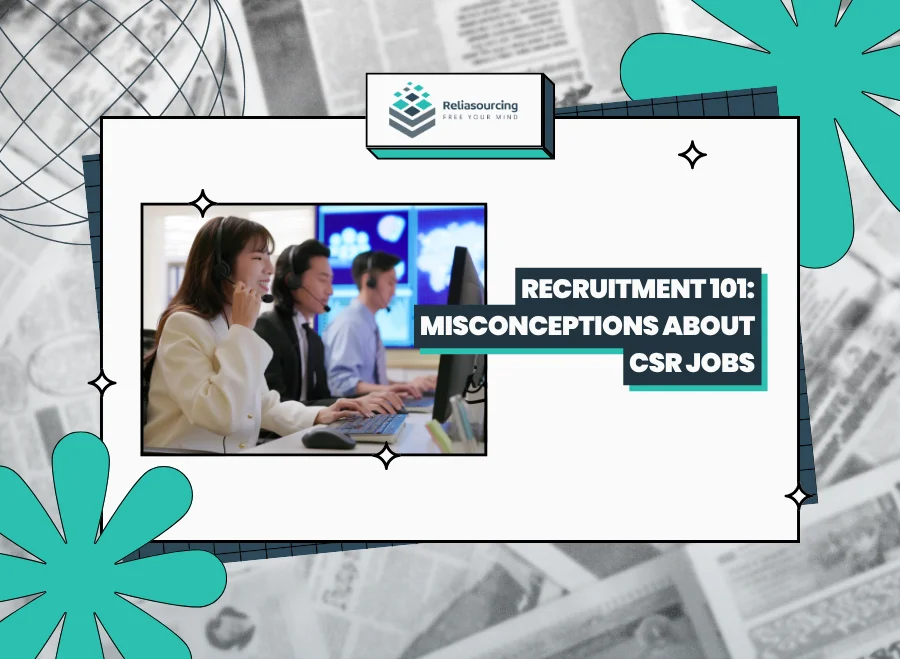
Customer Service Representative, or CSR, is one of the most familiar roles in the Philippine BPO industry. Because of that familiarity, many applicants already have an idea of what the job supposedly looks like before they even read the job description. Some picture nonstop calls, while others think CSR work is only for fresh graduates, requires perfect English, or offers little room for career growth, but the reality is much broader.
Customer service now covers multiple channels, industries, systems, and skill levels. For Filipino applicants, separating the myths from the actual work can make it easier to decide whether a CSR role fits their strengths and career goals.
CSR at a Glance: Myth vs Reality
| Common Misconception | What the Role Is Really Like |
| CSR means taking calls all day | Many roles now use chat, email, social media, and ticket-based support |
| You only follow scripts | Good CSR work requires judgment, problem-solving, and product knowledge |
| You need perfect English | Clear, professional communication matters more than sounding “perfect” |
| CSR is only for fresh graduates | Many companies also hire experienced and specialized support professionals |
| There is no career growth | CSR experience can lead to QA, training, leadership, customer success, and other roles |
| Anyone can do it | Strong customer service requires patience, accuracy, communication, and emotional control |
Misconception #1: “CSR Means You’ll Be on Calls All Day”
Phone support is still a major part of customer service, but it is no longer the only format. The U.S. Bureau of Labor Statistics notes that customer service representatives may assist customers through phone calls, email, live chat, text, social media, or in-person interactions depending on the employer and industry. Modern CSR roles may include:
- Voice support
- Email support
- Live chat
- Social media support
- Ticket-based support
- Blended voice and non-voice work
Reliasourcing’s Inside the Role: Customer Service Representative guide explains the differences between voice and non-voice roles in more detail.
Voice vs Non-Voice CSR Work
| Voice Support | Non-Voice Support |
| Handles customer calls | Handles email, chat, or tickets |
| Requires strong verbal communication | Requires strong written communication |
| Often involves live problem-solving | May involve multiple conversations at once |
| Can require faster verbal responses | Can require more detailed documentation |
Neither format is automatically easier as each requires a different communication style and set of strengths.
Misconception #2: “You Just Follow a Script”
Scripts, macros, and templates can help maintain consistency, but CSR work is rarely just about repeating prepared lines. Customers may explain their concerns unclearly, ask questions that do not match standard templates, or have multiple issues at the same time. A CSR may need to:
- Identify the actual problem
- Check customer records or account information
- Follow internal policies
- Troubleshoot basic issues
- Explain next steps
- Escalate cases when necessary
- Document the interaction accurately
O*NET lists customer service duties that include recording customer interactions, resolving complaints, checking whether issues were addressed, and referring unresolved cases to other teams, meaning problem-solving and judgment matter just as much as knowing what to say.
Misconception #3: “You Need Perfect English”
Strong English communication can be important, especially when supporting international customers, but recruiters are not usually looking for a flawless accent or textbook-perfect speech. They are more interested in whether you can:
- Listen clearly. Can you understand what the customer is actually asking?
- Explain information properly. Can you give instructions without creating more confusion?
- Stay professional. Can you communicate respectfully when a customer is frustrated?
- Adjust your tone. Can you speak or write differently depending on the situation?
Communication skills also improve through training and experience. If you’re nervous about explaining yourself during the application process, our guide on how to prepare for your first job interview can help you practice presenting your skills more confidently.
Misconception #4: “CSR Is Only for Fresh Graduates”
CSR positions are often marketed as entry-level opportunities, but customer service is not limited to first-time workers. Some roles welcome:
- Fresh graduates
- Career shifters
- Experienced BPO professionals
- Industry specialists
- Technical support backgrounds
- Employees with knowledge in gaming, SaaS, FinTech, eCommerce, or other sectors
The Philippine IT-BPM industry has also grown well beyond traditional call center operations. The IT and Business Process Association of the Philippines describes the sector as covering a broad range of business processes, IT, healthcare, shared services, and digital functions. The job title may still say CSR, but the actual work can become significantly more specialized depending on the account.
Misconception #5: “There’s No Career Growth”
CSR can be a starting point rather than a final destination. A possible career path might look like:
CSR → Senior CSR → Subject Matter Expert → Quality Analyst → Trainer → Team Leader → Operations
Other employees move into:
- Customer success
- Technical support
- Workforce management
- Account management
- Fraud and risk operations
- Training
- Quality assurance
The Bureau of Labor Statistics also notes that experienced customer service representatives may advance into supervisory positions.
Skills You Can Build in CSR
| Skill | Why It Matters Later |
| Communication | Useful in leadership, sales, account management, and customer success |
| Problem-solving | Valuable across operations and technical roles |
| Documentation | Important in QA, compliance, and process work |
| Product knowledge | Can support specialist and trainer roles |
| Customer handling | Useful in management and escalation-based positions |
Customer service can therefore build transferable skills even if you eventually move into another field.
Misconception #6: “Anyone Can Do Customer Service”
CSR work can be accessible, but that does not mean it is easy. The role often requires a combination of:
- Patience
- Emotional control
- Attention to detail
- Communication
- System navigation
- Time management
- Policy awareness
- Problem-solving
Some customer interactions are straightforward, while others involve delayed orders, disputed payments, account issues, service interruptions, or frustrated users. Customer service roles can also involve evenings, weekends, holidays, or shifting schedules because many companies support customers outside standard Philippine business hours. A realistic view of the role helps applicants avoid entering the job with the wrong expectations.
Misconception #7: “CSR Work Is Just Dealing With Angry Customers”
Complaints are part of customer service, but they are only one part. A CSR might spend a shift helping customers:
- Reset account access
- Track an order
- Understand a bill
- Update personal information
- Learn how to use a feature
- Resolve a technical problem
- Clarify company policies
- Process a request
In many cases, the interaction is routine rather than confrontational. Customer service is ultimately about helping people navigate their relationship with a company.
Quick Self-Check: Could CSR Be a Good Fit for You?
Consider a CSR role if you can answer yes to several of these:
- I am comfortable speaking or writing to different kinds of people.
- I can remain calm when someone is frustrated.
- I am ready to learn new systems and processes.
- I can follow instructions without losing sight of the customer’s actual problem.
- I am comfortable working toward quality or productivity targets.
- I can adjust to schedules that may include evenings or weekends.
- I enjoy solving practical problems.
You do not need to match every point perfectly. The goal is simply to understand whether the role fits how you prefer to work.
So, What Should Applicants Really Know About CSR?
The biggest mistake is judging customer service based only on the old “call center agent” stereotype. Modern CSR work can include voice support, digital channels, troubleshooting, account management, specialized industries, and collaboration with multiple teams. For applicants, the better question is not: “Is CSR just a call center job?” It is: “What does this specific CSR role actually require, and does it match my skills?”
Reading the job description carefully will always give you a better answer than relying on assumptions. If you are preparing your first application, our guide on how to make an effective resume for fresh graduates can help you present transferable skills from school, internships, volunteer work, and previous experience.
Final Thoughts
CSR work is broader, more demanding, and more flexible than many applicants expect, and can be an entry point into the BPO industry, a long-term specialization, or a stepping stone toward leadership and other customer-focused careers.
The key is to look beyond the job title. Understand the channel, industry, schedule, tools, expectations, and career opportunities attached to the role before deciding whether it is right for you.
Ready to explore customer service and other opportunities? If you’re seeking a company that values your target role, visit our Careers Page. Browse our open positions to see if you’re a good match for #LifeAtReliasourcing.
About Reliasourcing
Reliasourcing is a premier outsourcing solutions provider in the Philippines. We deliver tailored services that help businesses across industries achieve operational efficiency and scalability. With a focus on customer experience and innovation, Reliasourcing continues to be a trusted partner in unlocking potential through outsourcing.
Follow us on Facebook, Instagram, LinkedIn, YouTube, and X for more information on the latest trends and insights in outsourcing, the industry, and the Philippines.
Connect with us or become part of our growing team today!