The first surprise of job hunting is that applying for work is not only about finding the right opening, since it is also about understanding what employers mean when they ask for qualifications, requirements, and supporting documents.
For fresh graduates, those words can blur together quickly. One job post may focus on communication skills and course background, while another may mention a valid ID, transcript of records, or NBI Clearance. Then, once an offer comes in, the list often grows. Government numbers, onboarding forms, and verification documents start entering the conversation.
If you understand which requirements affect the application stage, which ones come later, and which documents are worth preparing early, the process feels much more manageable.
In this article, we’ll break down common job requirements examples, explain the difference between job qualifications and employment requirements, and show what fresh graduates in the Philippines should realistically prepare first.
Quick Answer: What Do Fresh Graduates Usually Need Before Applying?
Not everything has to be complete before your first application. For most fresh graduates, the smartest starting kit looks like this:
- A resume or CV
- At least one valid ID
- Diploma, certificate of graduation, or transcript of records, if available
- Digital copies of basic documents
- A plan for follow-up requirements, such as NBI Clearance, TIN, PhilHealth, SSS, and employer-specific onboarding paperwork
The reason this matters is simple: some requirements belong to the application stage, while others appear during pre-employment. The NBI and its online clearance platform both recognize first-time job seekers as a distinct group under the First Time Jobseekers Assistance Act, reflecting how common these employment-related documents are for new entrants to the workforce.
What Are Job Requirements?
Job requirements are the things an employer asks from an applicant or employee as part of the hiring process. Some relate to your fit for the role, others relate to documentation, compliance, or onboarding. In practice, job requirements can include:
- Educational background
- Relevant skills
- Schedule availability
- Proof of identity
- School documents
- Pre-employment clearances
- Government registration details needed once you are hired
Sometimes it refers to your profile as a candidate. Other times, it refers to the paperwork needed to formalize your employment.
Job Requirements vs Job Qualifications: What’s the Difference?
This is where many first-time applicants get stuck.
Job qualifications refer to what makes you fit for the role
These are the qualities, skills, or credentials that help an employer decide whether you can do the work, as outlined in the job description. Common examples include:
- Degree or course background
- Communication skills
- Customer service ability
- Software knowledge
- Internship experience
- Willingness to work shifts or in a hybrid setup
Job requirements often refer to the documents or steps needed for hiring
These are the items employers may ask for during the application or after selection. Common examples include:
- Resume or CV
- Valid ID
- Transcript of records or diploma
- NBI Clearance
- Tax and benefits-related records
- Company onboarding forms
A clearer way to think about it is this:
Qualifications help you win the job. Requirements help you complete the hiring process.
Common Job Requirements Examples for Fresh Graduates in the Philippines
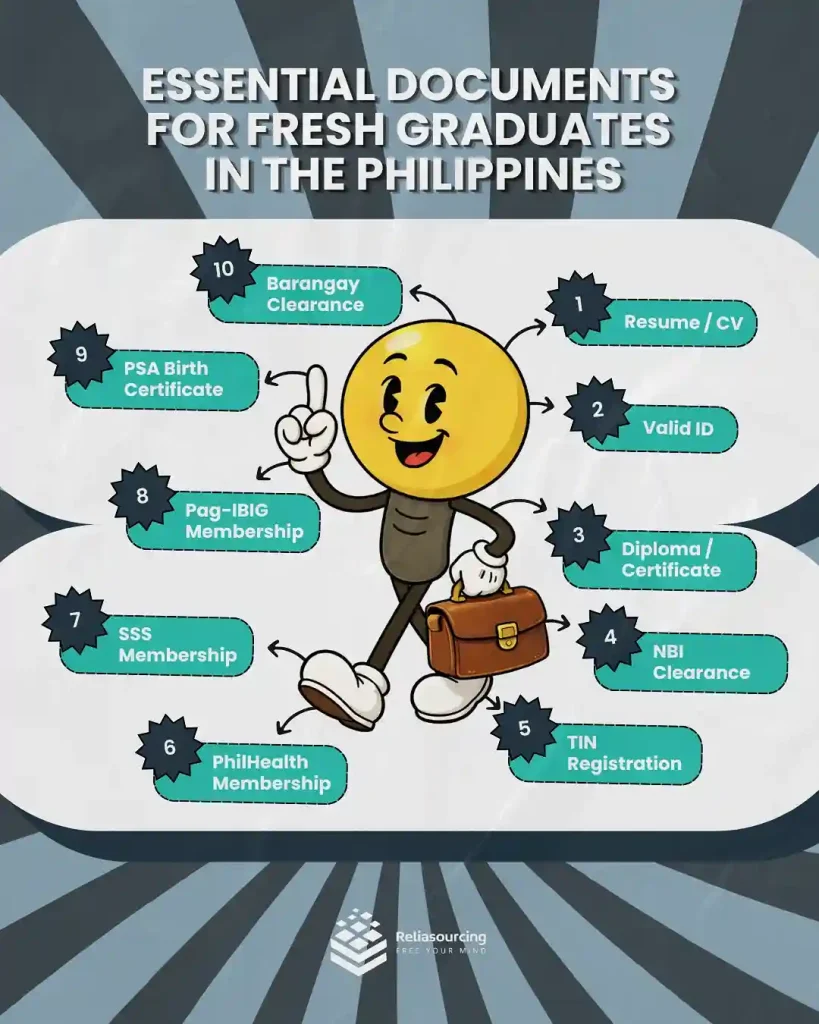
If you are searching for a realistic example of job requirements, the list below covers the documents and materials many employers commonly ask for from fresh graduates.
1) Resume or CV
What it is
Your resume or CV is your first introduction to an employer.
Why employers ask for it
It gives hiring teams a quick picture of your education, internships, projects, skills, and work potential.
What fresh grads should prepare
Even if you do not yet have full-time experience, your resume can still be strong. Academic projects, student leadership, internships, volunteer work, certifications, and freelance experience all matter when they are relevant.
Best for
Every application stage. This is almost always the first requirement.
Fresh grad tip: A clean, focused resume usually performs better than one that tries to include everything. Download our free resume template here.
2) Valid ID
What it is
A valid ID is a government-issued or institutionally accepted document used for identity verification.
Why employers ask for it
Employers may request a valid ID for applicant verification, onboarding, payroll setup, or other records-related processes.
What fresh grads should prepare
At least one dependable ID is a good starting point. The PhilSys National ID is intended for identity verification across public and private transactions, while agencies such as the DFA and LTO maintain their own identity-document systems.
Best for
Application-stage readiness and follow-up verification.
Fresh grad tip: One valid ID is often enough to begin. You can build the rest of your document set over time.
You can also read our companion guide on valid IDs in the Philippines for fresh graduates.
3) Diploma, Certificate of Graduation, or Transcript of Records
What it is
These documents verify your academic background.
Why employers ask for it
They help confirm that you completed, or are close to completing, the educational requirements for the role.
What fresh grads should prepare
Not every employer asks for the same school documents at the same time. Some may accept a certificate of graduation first, while others may ask for a transcript later. The practical move is to have digital copies ready and know how quickly you can request originals if needed.
Best for
Application stage and verification after shortlisting.
Fresh grad tip: If your final school documents are still being processed, communicate that clearly instead of staying silent.
4) NBI Clearance
What it is
The NBI Clearance is a criminal record clearance often requested during hiring.
Why employers ask for it
This is one of the most common pre-employment documents, especially for roles that involve trust, data access, client interaction, or regulated environments.
How to get it
The NBI Clearance Online Registration and Application Services support registration, appointments, and verification. The NBI also maintains a dedicated First Time Job Seekers page.
What to prepare
The NBI’s own guidance says general applicants need valid government-issued IDs, and first-time job seekers may use a barangay certification and other supporting documents under the First Time Jobseekers Assistance Act route.
Best for
Pre-employment readiness.
Fresh grad tip: If you are already interviewing, this is one of the smartest documents to work on early.
5) TIN Registration
What it is
The TIN, or Taxpayer Identification Number, is used for tax-related records and payroll-related transactions.
Why employers ask for it
Once you are formally hired, tax-related registration becomes part of the normal employment setup.
How to get it
The BIR Primary Registration page is the official starting point for registration-related guidance, and BIR also provides online tools such as eTINQuery.
What to prepare
The exact requirements depend on your taxpayer category, which is why it is more accurate to think in terms of TIN registration than simply “getting a TIN card.”
Best for
Offer stage and onboarding.
Fresh grad tip: This usually becomes important after you are further along in hiring, not necessarily before your first application.
6) PhilHealth Membership Details
What it is
PhilHealth documents connect you to healthcare-related benefits and employment records.
Why employers ask for it
PhilHealth often comes up once an employer begins preparing benefits-related paperwork. PhilHealth’s employer-facing page also emphasizes documentary support and records as part of smooth benefit availment.
How to get it
PhilHealth publishes a registration procedure for informal economy members, along with downloadable forms in its downloads section.
What to prepare
The PhilHealth Member Registration Form and supporting member information are part of the standard process, although the exact steps may vary by membership category.
Best for
Pre-employment and benefits setup.
Fresh grad tip: This is less about getting “another ID” and more about becoming onboarding-ready.
7) SSS Membership Details
What it is
The Social Security System covers private-sector workers and related member categories.
Why employers ask for it
SSS membership details are commonly part of a formal employment setup for private-sector work. SSS’s official site explains that membership applies to workers in the private sector and provides member registration pathways through its online systems.
How to get it
The Become an SSS Member and My.SSS registration pages are the best official entry points.
What to prepare
Supporting documents vary depending on the transaction, and SSS maintains a required supporting documents page.
Best for
Onboarding and statutory benefits setup.
Fresh grad tip: This usually matters after an offer is on the table, not before you send your first resume.
8) Pag-IBIG Membership Details
What it is
Pag-IBIG membership is another statutory item that often appears in employment paperwork.
Why employers ask for it
It is commonly part of the standard government-related records employers prepare for new hires.
What fresh grads should prepare
The Virtual Pag-IBIG services site outlines the general process for registering to be a member. Treat this as an onboarding requirement that you confirm directly with your employer or through Pag-IBIG’s official channels at the time you need it.
Best for
Offer stage and employee-record completion.
Fresh grad tip: Do not let this delay your applications since it is usually a later-stage requirement.
9) PSA Birth Certificate
What it is
This is a civil registry document that verifies core personal details.
Why employers ask for it
Some employers request it for identity verification, government-record matching, or onboarding paperwork.
What fresh grads should prepare
Have at least a digital copy ready if available, and know how to request a fresh copy when needed.
Best for
Verification and pre-employment documentation.
Fresh grad tip: This is not always asked for upfront, but it is commonly requested later.
10) Barangay Clearance
What it is
Barangay Clearance is a locally issued supporting document.
Why employers ask for it
It is not a universal hiring requirement, but it may be useful in certain local or first-time job seeker processes. The NBI’s first-time job seeker route specifically references a barangay certification as part of its documentary path.
What fresh grads should prepare
Requirements vary by barangay, so this is something to check locally rather than assume nationally.
Best for
Specific supporting-document needs, especially if another application asks for it.
Fresh grad tip: Think of this as a support document, not a core primary requirement for every application.
Common Job Qualifications Employers Look For
Documents matter, but they are only half of the story. Employers also evaluate whether you fit the role. Here are the qualifications many entry-level employers care about most:
- Educational background. A course aligned with the role can help, but it is not always the only deciding factor.
- Communication skills. This matters across customer service, operations, support, admin, and many client-facing roles.
- Role-specific skills. Spreadsheet literacy, writing ability, attention to detail, software familiarity, or portfolio work can all strengthen your application.
- Reliability and professionalism. Employers notice responsiveness, timeliness, and how you handle instructions.
- Willingness to learn. For fresh graduates, growth potential often carries real weight.
- Schedule or setup readiness. Some roles may require shift flexibility, onsite readiness, or stable remote-work conditions.
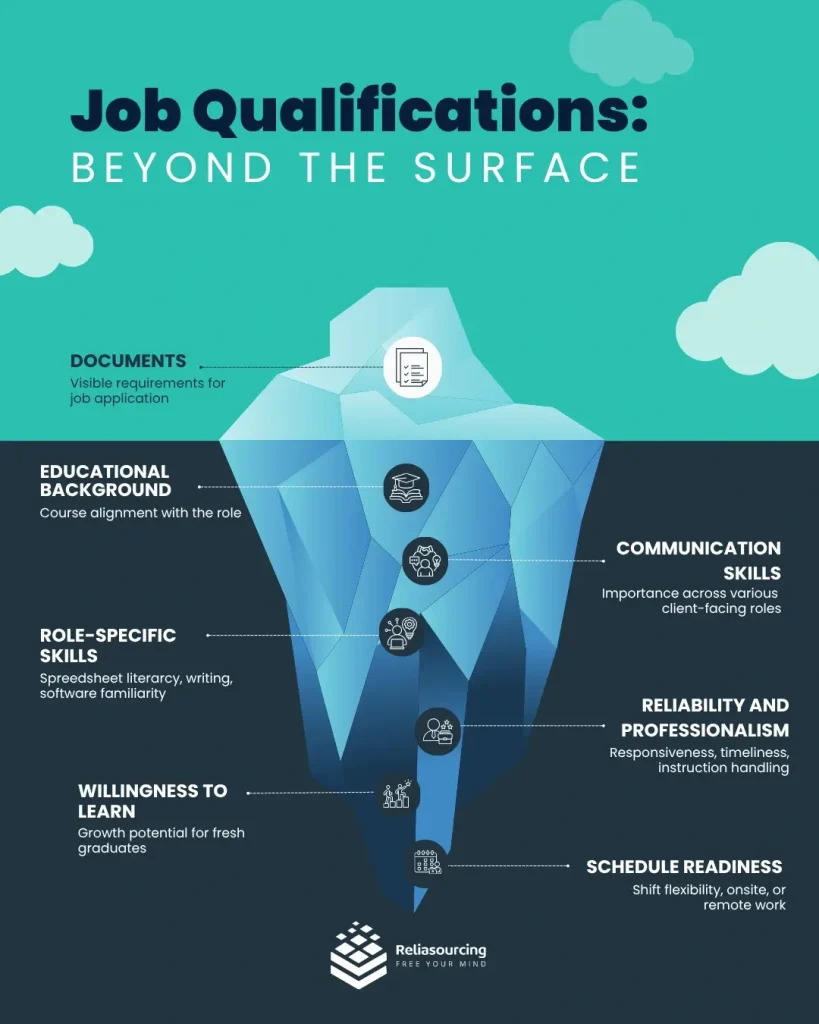
Missing one document does not automatically mean you are not qualified. Often, employers first ask whether you can do the job well, then guide you through the paperwork that follows.
Job Requirements for Career Shifters
Career shifters are not starting from zero, but they do face a slightly different version of the same process.
What stays the same
Most of the documentation side remains familiar:
- Valid ID
- Resume
- Government registration details
- Pre-employment paperwork when hired
What may be different
Career shifters often need to present:
- Updated resume positioning
- Transferable skills
- Short explanation of the transition
- Training, certifications, or project work that supports the new direction
What employers may focus on more closely
Employers may pay extra attention to your reason for shifting, your ability to adapt, and whether your skills transfer well to the new role. For career shifters, the paperwork is rarely the hardest part. The more important challenge is framing your experience clearly.
Which Documents Should You Prepare Before Applying, and Which Can Wait?
This is where most people feel relief. You do not need to complete everything before sending applications.
Prepare these before you start applying
- Resume or CV
- At least one valid ID
- School documents or proof of graduation, if available
- Digital copies of key records
- A shortlist of roles you are targeting
These often come later
- NBI Clearance
- TIN registration details
- PhilHealth membership details
- SSS membership details
- Pag-IBIG membership details
- Medical exam results, if required
- Company-specific onboarding forms
The distinction is one of the most useful things to remember. The application stage is about getting into the process, and the pre-employment stage is about completing it.
Fresh Graduate Job Requirements Checklist
Here is a more practical, skim-friendly checklist.
Basic application-ready documents
- Updated resume or CV
- One valid ID
- Diploma, TOR, or proof of graduation
- Digital copies of your main records
Common pre-employment documents
- NBI Clearance
- PSA Birth Certificate
- TIN registration details
- PhilHealth membership details
- SSS membership details
- Pag-IBIG membership details
- Medical results, if requested
Nice to have
- Passport-sized photos
- Internship certificates
- Training certificates
- Portfolio or work samples for relevant roles
| Job Qualifications vs Employment Requirements | ||
|---|---|---|
| Category | What It Means | Examples |
| Job Qualifications | What makes you a fit for the role | Degree, communication skills, software knowledge, customer service ability |
| Application Requirements | What you may need to submit when applying | Resume, valid ID, diploma, TOR |
| Pre-employment Requirements | What employers may ask for before onboarding | NBI Clearance, tax/benefit details, medical exam, employer forms |
What Employers Usually Care About Most
Fresh graduates often assume they need a perfect document set before they are “allowed” to apply, but that is rarely how hiring works. Most employers care first about whether:
- You are a plausible fit for the role;
- You communicate well;
- You follow instructions; and
- You can complete missing documents within a reasonable timeline.
Friendly note: Being incomplete is not the same as being unqualified.
FAQs About Job Requirements in the Philippines
What are job requirements?
Job requirements are the qualifications, documents, or steps an employer asks for during hiring. Job requirements can refer both to your fit for the role and to the paperwork needed to complete employment.
What is an example of job requirements for fresh graduates?
An example of job requirements for fresh graduates usually includes a resume, one valid ID, school documents, and later-stage paperwork such as NBI Clearance and government registration details.
What is the difference between job qualifications and job requirements?
The difference between job qualifications and job requirements is that “qualifications describe what makes you fit for the role, while requirements” often include the documents or onboarding steps needed to formalize employment.
Do I need all my documents before applying for a job?
No. You don’t need all your documents before applying for a job. Many documents are only needed after you move further into the hiring process. In many cases, your resume, one valid ID, and basic school records are enough to begin.
What documents do employers usually ask from fresh graduates?
The documents employers usually ask for from fresh graduates are a resume, a valid ID, school records, and later-stage documents such as NBI Clearance, TIN, PhilHealth, SSS, and other onboarding forms.
What job requirements should career shifters prepare first?
Job requirements career shifters should prepare first are the same baseline documents as fresh graduates, then strengthen their resume and narrative to highlight transferable skills and readiness for the new role.
Final Thoughts
Starting a career is not only about finding the right opening, but it is also about understanding what employers really mean when they ask for qualifications, requirements, and documents.
Once you separate the process into stages, it becomes much easier to manage. Prepare the basics before you apply. Build the rest as you move forward. And that approach gives you momentum without creating unnecessary pressure.
For most fresh graduates, that means having a strong resume, one valid ID, and a working understanding of the documents that usually follow: NBI Clearance, tax registration, healthcare membership, and statutory employment records. This is how the process starts feeling less overwhelming and more like progress.
Ready to put your documents to use? Explore open roles at Reliasourcing and take the next step in your career. If you’re looking for a company that guides you from the start of your job application to landing your first job, visit our Careers Page. Check our open roles and see if you’re a great fit for #LifeAtReliasourcing.
About Reliasourcing
Reliasourcing is a premier outsourcing solutions provider in the Philippines. We deliver tailored services that help businesses across industries achieve operational efficiency and scalability. With a focus on customer experience and innovation, Reliasourcing remains a trusted partner in unlocking potential through outsourcing.
Follow us on Facebook, Instagram, LinkedIn, YouTube, and X for the latest trends and insights on outsourcing, the industry, and the Philippines.
Connect with us, or become part of our growing team today!